
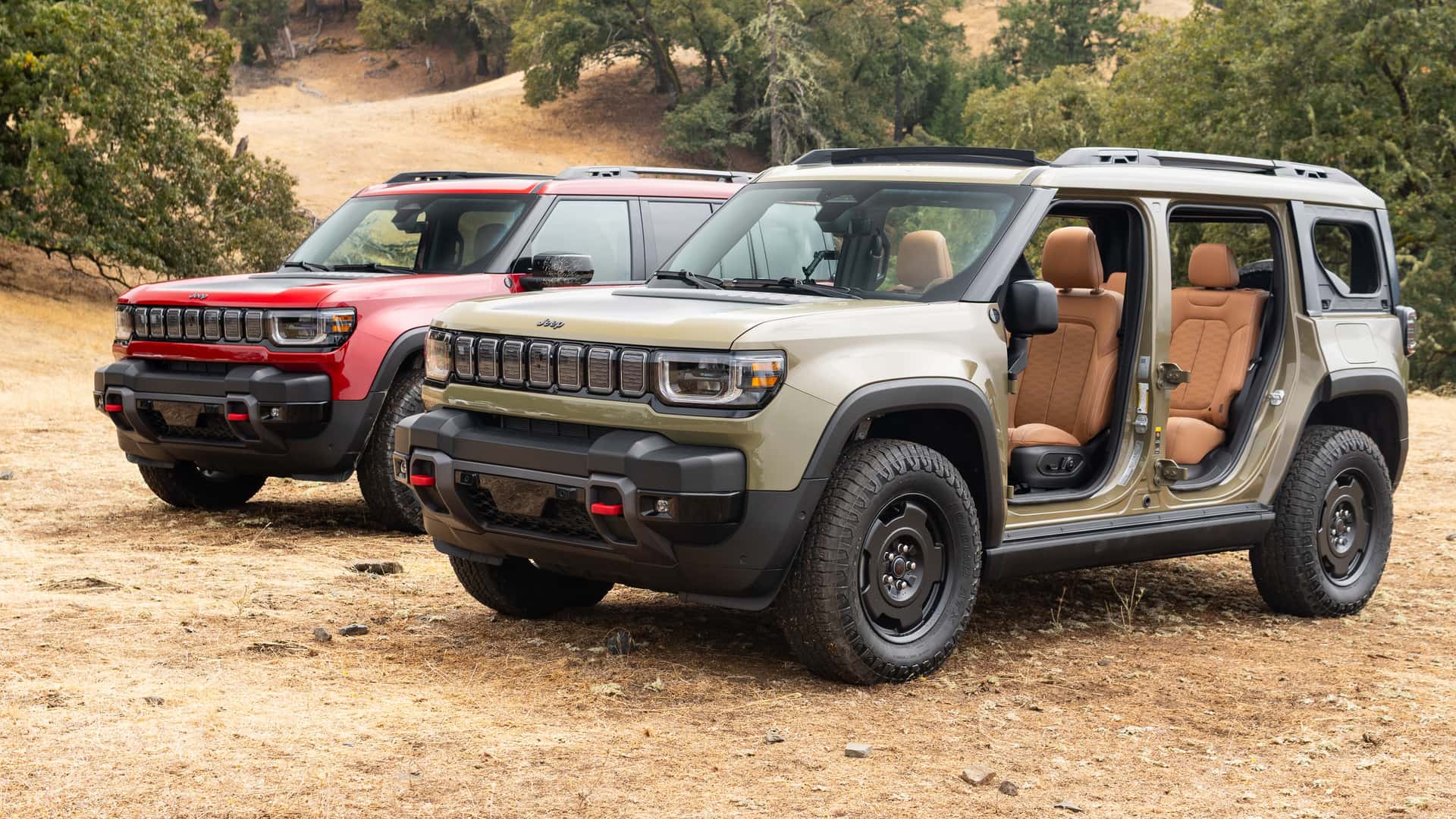
The announcement of the all-electric Jeep Recon Moab’s estimated 222-mile range has sparked considerable debate among automotive enthusiasts and journalists alike. Many have voiced disappointment, contending that a lower price point and extended range should be standard for an electric off-roader. However, this perspective overlooks the inherent trade-offs integral to vehicle engineering, particularly in the specialized segment of off-road electric vehicles.
Key Takeaways (TL;DR)
- The Jeep Recon Moab’s 222-mile range and $66,995 starting price are direct consequences of its design for superior off-road capability.
- Achieving high ground clearance, robust skid plates, large all-terrain tires, and aggressive gearing fundamentally reduces on-road efficiency for any vehicle, including EVs.
- These design choices, critical for off-road performance, lead to increased aerodynamic drag, rolling resistance, and higher energy consumption, directly impacting EV range.
- Compared to efficiency-focused EVs or even other premium electric off-roaders like the Rivian R1S or Mercedes G580 w/EQ Technology, the Jeep Recon makes deliberate compromises to prioritize torque and resilience over maximum range.
- Consumers must adjust expectations: combining extensive off-road capability with long range and affordability in EVs presents significant engineering and cost challenges that are still evolving.
The Inherent Conflict: Off-Road Capability vs. Energy Efficiency
The automotive industry operates on a fundamental principle of compromise. Engineering a vehicle involves balancing conflicting objectives such as performance, comfort, safety, and efficiency. This balance becomes particularly delicate in the niche of off-road vehicles, where demands for ruggedness and terrain-conquering abilities often directly counteract efforts to maximize fuel or energy efficiency.

Traditional gas-powered, body-on-frame 4×4 trucks with lifted suspensions and aggressive gearing typically deliver less than 20 miles per gallon (mpg), often closer to 10 or 15 mpg. This reduced efficiency is not a flaw but a direct consequence of their design for extreme conditions.
The Efficiency Challenge of Traditional Off-Roaders
Several design elements crucial for off-roading inherently diminish efficiency. Tall suspension systems, while providing essential ground clearance for navigating obstacles, significantly increase aerodynamic drag, demanding more energy to maintain speed.
Knobby, large, all-terrain tires, essential for traction on challenging surfaces like mud or rocks, are notably inefficient and loud on paved roads compared to street-oriented tires. Furthermore, a robust 4×4 system, invaluable in slippery conditions, consumes more fuel when engaged than a two-wheel-drive system.

Aggressive gearing, which amplifies torque at the wheels for improved climbing and acceleration, also results in the engine spinning faster at highway speeds, thereby increasing fuel consumption. These characteristics are precisely why a fuel-efficient Toyota Prius, optimized for 50 mpg, bears no resemblance to a Jeep Wrangler, built for rugged terrain.
Engineering Compromises in Electric Off-Road Vehicles
These fundamental principles of compromise do not change when transitioning from internal combustion engines to electric powertrains. For an electric vehicle (EV) designed for off-roading, features like high ground clearance, dual-motor setups, large tires, and a boxy, upright silhouette—all vital for approach and departure angles—contribute to reduced energy efficiency.
These are not merely desirable attributes but necessary ones for a vehicle to credibly claim off-road prowess. An off-road vehicle with minimal ground clearance and thin street tires would fail to meet the functional requirements of its intended purpose.
Design Choices Impacting Jeep Recon’s Range
Stellantis, the parent company of Jeep, offers a clear illustration of this compromise. The Wagoneer S EV, built on the same 100.5 kWh battery platform as the Jeep Recon, achieves an impressive 294 miles of range. This is largely due to its design with 6 inches of ground clearance and street tires, prioritizing on-road efficiency and aerodynamics.
In contrast, the Jeep Recon is engineered for legitimate off-road capability. It features 9.1 inches of ground clearance, robust skid plates for underbody protection, 33-inch all-terrain tires for superior grip, and a more upright body design optimized for approach and departure angles. Each of these enhancements, while critical for off-road performance, inevitably diminishes the vehicle’s overall range by increasing drag and rolling resistance.
The Role of Gearing in EV Performance
While EVs lack traditional multi-speed transmissions, they utilize gear ratios to manage how motor torque is delivered to the wheels. Taller gear ratios (e.g., a lower numerical value like 9:1 for an EV) are generally more efficient for cruising and higher speeds.
Conversely, shorter gearing, which means a higher numerical ratio (e.g., 15:1), significantly increases torque at the wheels from a standstill. This is a game-changer for off-roading, enabling a vehicle to climb steep inclines and push through challenging obstacles more effectively. The Jeep Recon‘s rear motor features a 15:1 gearing ratio, a deliberate choice to maximize low-end torque. This engineering decision also contributes to its rapid acceleration, allowing the Recon to reach 60 mph in just 3.6 seconds.
However, this focus on low-end torque comes with an inherent compromise: reduced efficiency at higher speeds. Observations indicate the Jeep Recon achieves approximately 2.5 miles per kWh, directly reflecting these performance-oriented gearing choices.
Comparative Analysis: Jeep Recon Against Rivals
Examining other electric off-roaders reinforces the notion that superior off-road capability often comes at the expense of range and price. The challenges faced by the Jeep Recon are mirrored across the burgeoning EV off-road segment.
Rivian R1S: Balancing Range and Capability
The Rivian R1S, a heavier electric SUV, generally demonstrates higher efficiency. However, even Rivian acknowledges the range implications of off-road components. The company does not offer all-terrain tires on models equipped with the base 108 kWh battery pack.
To include all-terrain tires, customers must upgrade to the larger 140 kWh battery version. This upgrade results in a range reduction from 410 miles to 370 miles, with the vehicle’s price approaching $96,000. Despite its impressive range, the R1S, with its taller gearing and absence of a locking rear differential, prioritizes a different set of compromises compared to the Jeep Recon, potentially limiting its extreme off-road prowess in certain scenarios.
Mercedes G580 w/EQ Technology: Premium Off-Roading at a Price
At the pinnacle of electric off-road luxury is the Mercedes G580 w/EQ Technology. This vehicle offers an even higher degree of off-road capability than the Jeep Recon or Rivian R1S, incorporating separate low-range gears for each of its four motors. This advanced system allows it to excel in climbing while also providing the flexibility to switch to higher gears for more efficient on-road cruising.
Despite its sophisticated hardware, a hefty $163,000 price tag, and a 116 kWh usable battery capacity, the Mercedes G580 w/EQ Technology achieves an EPA-estimated range of only 239 miles. For all these premium electric off-road vehicles, it’s crucial to remember that highway range typically falls significantly below combined range estimates, as the collective impact of off-road features intensifies at higher speeds.
Implications for the EV Industry and Consumer Expectations
The discussion surrounding the Jeep Recon‘s range highlights a critical understanding needed in the evolving electric vehicle market: the electrification journey for the most inefficient vehicle types will be the most challenging. Consequently, lower range figures for purpose-built vehicles like the Volkswagen ID. Buzz or the Jeep Recon should not be a surprise.
Integrating substantial battery packs—like the Recon’s 91- or 100 kWh unit—is a costly endeavor. The primary issue is not the battery size itself, but rather that the stored energy is rapidly consumed when propelling a large, heavy, and aerodynamically inefficient vehicle. This energy drain is further compounded by the inclusion of all-terrain tires, elevated ground clearance, and aggressive gearing.
As battery technology advances, charging times decrease, and the charging infrastructure expands, many of these existing challenges will undoubtedly mitigate. However, for the foreseeable future, consumers seeking formidable EV off-roading capabilities must be prepared to accept trade-offs in both driving range and acquisition cost. The current market dictates that extreme capability in an electric off-roader necessitates strategic compromises.
FAQ Section
What is the primary reason for the Jeep Recon’s 222-mile range?
The primary reason for the Jeep Recon‘s 222-mile range is its design optimized for extreme off-road capability. Features like high ground clearance (9.1 inches), heavy skid plates, aggressive 33-inch all-terrain tires, a boxy aerodynamic profile, and low-end biased 15:1 gearing all contribute to increased energy consumption, thereby reducing its overall driving range compared to road-focused EVs.
How does the Jeep Recon’s range compare to other electric SUVs?
Compared to mainstream electric SUVs like the Wagoneer S (294 miles with similar battery size), the Jeep Recon has a shorter range due to its off-road specific modifications. When compared to other electric off-roaders like the Rivian R1S (370-410 miles, though at a higher price and with different gearing) or the Mercedes G580 w/EQ Technology (239 miles at a much higher cost), the Recon’s range falls within the expected spectrum for vehicles prioritizing ruggedness.
Are the design compromises unique to the Jeep Recon?
No, the design compromises are not unique to the Jeep Recon. Any vehicle, whether gasoline or electric, that prioritizes off-road capability will inherently sacrifice on-road efficiency. Features like lifted suspension, aggressive tires, and powerful 4×4 systems increase drag and rolling resistance, which translates directly to reduced range or fuel economy. This is a universal principle of vehicle engineering.
Why does aggressive gearing reduce EV range?
Aggressive gearing in an EV prioritizes torque delivery at the wheels, which is crucial for climbing and accelerating in off-road conditions. However, this also means the motors operate at higher RPMs at cruising speeds, leading to increased energy consumption and reduced efficiency. While it provides superior low-end grunt, it compromises overall range, particularly during sustained highway driving.
What is the starting price of the Jeep Recon Moab?
The Jeep Recon Moab has a starting price of $66,995. This price point reflects the advanced electric powertrain technology, specialized off-road hardware, and the general market positioning of premium electric SUVs designed for niche capabilities. The cost also covers the extensive engineering required to integrate off-road prowess with an electric architecture.
Will future battery technology improve the range of off-road EVs?
Yes, advancements in battery technology are expected to significantly improve the range of off-road EVs. As battery energy density increases and costs decrease, manufacturers will be able to either fit larger capacity batteries without excessive weight or cost penalties, or achieve better range with existing battery sizes. Improvements in charging infrastructure and speed will also alleviate range anxiety for off-road enthusiasts.