
Key Takeaways:
- New York City has launched its first lamppost EV charger, the Voltpost Air, in South Brooklyn, aiming to address the critical challenge of urban electric vehicle (EV) charging.
- The innovative curbside EV charging solution transforms existing street infrastructure, such as lampposts, into EV charging stations, significantly reducing deployment costs and time.
- Designed for convenience, the Level 2 charger provides a practical option for city dwellers who park on the street, offering cost-effective and battery-friendly charging over several hours.
- The Voltpost Air features a high-mounted dispenser and an automatically retracting cable, mitigating concerns about vandalism, flooding, and pedestrian obstruction.
- This initiative, alongside other smart city solutions from startups like It’s Electric, signals a proactive approach to scaling electric vehicle charging infrastructure in dense urban environments without extensive new construction.
Navigating the bustling streets of New York City presents a unique set of challenges for motorists. From the relentless pursuit of parking spots to stringent street-cleaning regulations and formidable traffic, urban driving often feels like a competitive sport. Yet, despite these complexities, the metropolis maintains a strong automotive culture, increasingly embracing the transition to electric vehicles (EVs) and plug-in hybrids.

Recent data underscores this shift, with combined registrations for EVs and plug-in hybrids surpassing 81,000 in September. This surge in electric vehicle adoption, however, highlights a significant logistical hurdle: accessible and efficient charging infrastructure, particularly for the vast majority of residents who reside in apartments and rely on street parking.
While suburban homeowners often enjoy the convenience of dedicated home chargers, urban dwellers face a fundamentally different predicament. The scarcity of available space, prohibitive real-estate costs, and protracted permitting processes limit the rapid expansion of traditional fast-charging stations across the five boroughs. Consequently, there is a growing demand for charging solutions that integrate seamlessly into the urban fabric.
Not every charging session necessitates a high-powered station. For many city residents, the ideal solution involves a Level 2 lamppost EV charger or a similar curbside option that allows their vehicle to charge discreetly while they engage in other activities for a few hours. This approach prioritizes convenience and cost-efficiency over speed, addressing a critical gap in the existing EV charging infrastructure.

The Emergence of Curbside Charging Innovations in Urban Centers
The imperative for more widespread Level 2 curbside EV charging and solutions within parking lots is becoming increasingly clear. These charging points offer a distinct advantage, being substantially more economical to use than their fast-charging counterparts. Depending on the battery size, a Level 2 charger can replenish an EV’s range in approximately six to eight hours.
For most private vehicle owners, whose cars remain stationary for the majority of the day, these slower charging speeds are not only more cost-effective but also contribute to reduced battery stress. This paradigm shift in thinking about where and how EVs are charged is pivotal for sustainable urban mobility, particularly in dense areas where overnight or long-duration parking is common.
In response to this pressing need, several New York-based startups are pioneering innovative solutions. Among them is Voltpost, a company with a remarkably straightforward yet impactful concept: repurposing existing street infrastructure, such as lampposts or utility poles, into functional EV charging stations. This approach sidesteps the need for entirely new construction, offering a streamlined path to expanding charging access.
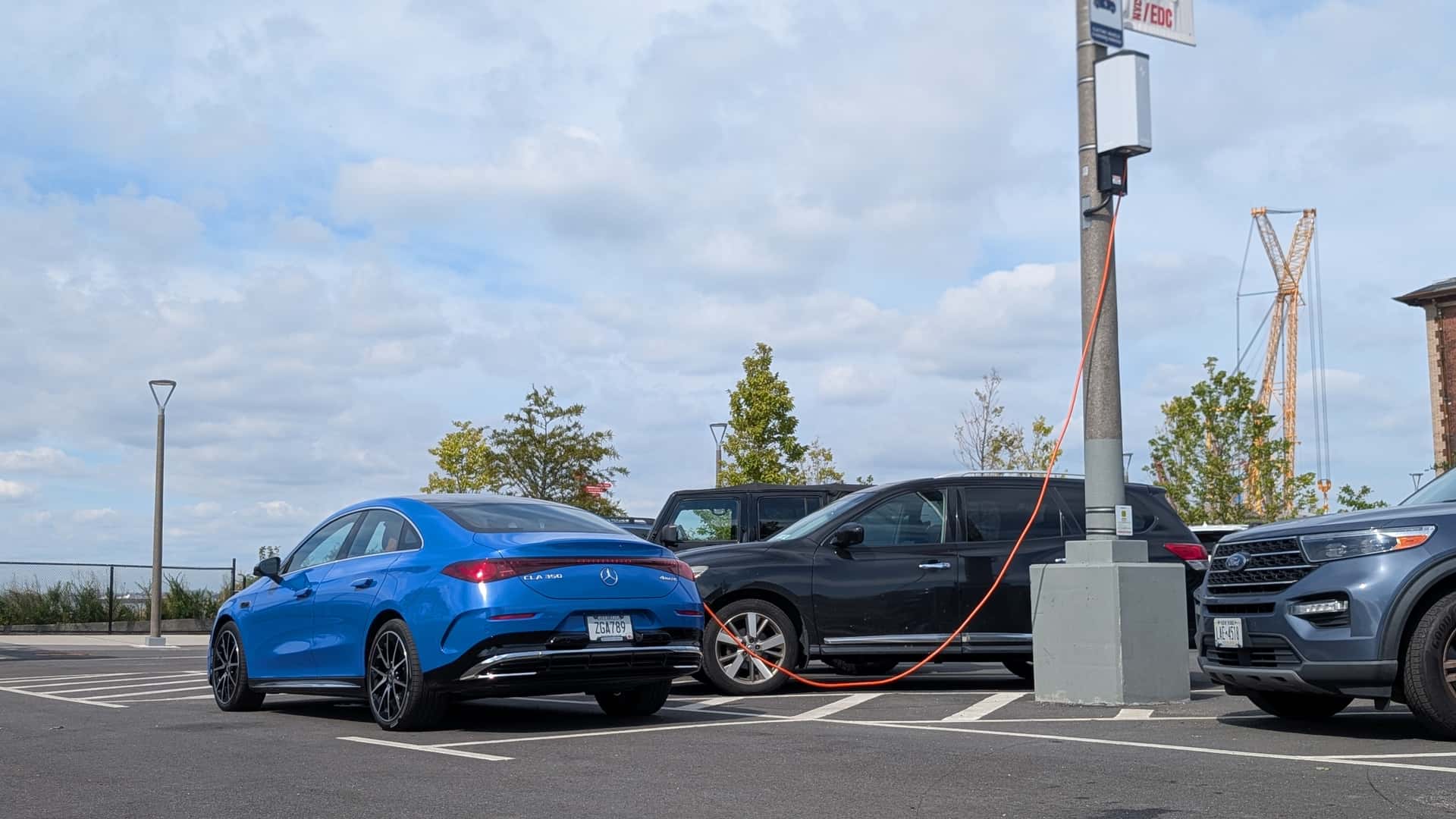
Voltpost recently unveiled NYC’s inaugural lamppost EV charger, known as Voltpost Air, at Bush Terminal Park in South Brooklyn. A recent hands-on assessment of this innovative charger revealed its transformative potential. If implemented at scale across the city, such solutions could significantly accelerate New York’s ambitious electric vehicle adoption goals.
A User’s Experience with NYC’s Pioneering Lamppost Charger
Upon arrival at Bush Terminal Park, the Voltpost Air lamppost EV charger presented itself, strategically positioned approximately 10 feet up a streetlight pole—a height chosen, according to Voltpost, to safeguard it against vandalism and potential flooding. Despite the common urban challenge of conventional petrol cars occupying nearby spots, the dispenser’s 25-foot cable proved sufficiently long, effortlessly reaching the charge port of the Mercedes-Benz CLA 350 Electric being tested, without obstructing other parked vehicles.
Initiating the charging session was designed for simplicity. A quick scan of the QR code prominently displayed on the charger, followed by just two clicks within the accompanying application, prompted the cable to automatically descend from the pole. Once the connector was within reach, a press of a button on its handle extended the cable, ready for connection to the vehicle.
While a card reader remains the gold standard for truly frictionless charging, offering instant authorization without digital steps, Voltpost’s application proved remarkably efficient. Its slick interface and instantaneous connection were particularly noteworthy, often surpassing the performance of apps from even some of the more established fast-charging networks.
Concluding the session was equally straightforward: disconnecting the cable triggered its automatic retraction back into the dispenser. A minor observation during the test indicated that a gentle release of the handle was necessary; an abrupt detachment could cause the cable to swing and hit the pole during retraction. Otherwise, the entire charging experience proceeded smoothly and uneventfully.
During the hour-long test, the Mercedes-Benz CLA 350 Electric gained approximately 30 miles of indicated range. This incremental addition proved sufficient to cover a round trip from the reporter’s apartment and provided an additional 20 miles, effectively meeting the day’s driving requirements. This scenario perfectly illustrates the utility of such curbside EV charging solutions.
The primary advantage lies in the charger’s ability to replenish a vehicle’s battery while the owner is engaged elsewhere. Locations such as parks, shopping centers, apartment complexes, and office buildings are prime candidates for this technology, allowing EVs to charge quietly while drivers attend to daily errands, shop for groceries, or socialize with friends.
Financially, the cost of charging stood at $0.39 per kilowatt-hour (kWh). This rate is significantly more economical than fast chargers in the vicinity, which often exceed $0.60 per kWh, and aligns closely with the pricing of other public Level 2 chargers currently available across New York City.
Strategic Advantages of Pole-Mounted EV Charging
Voltpost asserts that its lamppost EV charger installations effectively mitigate several common inconveniences associated with traditional curbside EV charging. These include issues like charging cables obstructing sidewalks and bulky stations encroaching on public spaces.
A key benefit of the Voltpost design is its elevated position, safely above street level. This not only offers robust protection against flooding but also, crucially, prevents cables from being left on the ground. The automatic retraction mechanism minimizes wear and tear on the cables and eliminates potential tripping hazards for pedestrians, enhancing public safety.
However, the most compelling advantage, as articulated by Luke Mairo, COO and co-founder of Voltpost, lies in the accelerated speed and reduced cost of deployment. Unlike conventional installations that necessitate extensive excavation, new conduit laying, and dedicated electrical connections, Voltpost leverages existing poles and electrical infrastructure. This significantly streamlines the deployment process for each lamppost EV charger.
“The main benefit of using pole mounted infrastructure is that we don’t do construction and trenching work,” Mairo stated in an interview. He further explained that this approach translates to “less permitting, significant reductions in the cost to install, and less disruption to the communities.”
The specific installation in Brooklyn, for instance, does not draw power directly from the lamppost it is mounted on but rather from a nearby building. Mairo clarified, “We don’t split the power to the light. With the conversion of street lights to LED, there’s spare capacity on the grid. We can use the existing capacity at the distribution to bring new service through the grid to our lamppost locations.”
This innovative strategy can slash project costs by up to 70% and enables the installation of a lamppost EV charger within hours, largely circumventing the need for disruptive construction or trenching. The chargers are versatile, supporting both J1772 and Tesla-style J3400 connectors, and are capable of delivering up to 9.6 kilowatts at 240 volts and 40 amps.
Voltpost’s deployment began with its first lamppost EV charger in Chicago last year, followed by installations in Detroit and multiple sites in New York. The expansion continues, with an additional 26 lamppost EV chargers slated for New York State as part of a program funded by the New York State Energy Research and Development Authority (NYSERDA). In total, approximately 500 new chargers have been allocated across nine U.S. states, indicating a significant national rollout.
Ensuring Durability and Scalability in a Demanding Urban Environment
The introduction of a cable retraction system on a streetlight naturally raises questions about its long-term reliability in diverse and challenging environmental conditions. Cities like New York experience freezing winters, scorching summers, and thousands of charging sessions annually, prompting concerns about the mechanism’s resilience.
Addressing these durability concerns, Luke Mairo highlighted the Voltpost lamppost EV charger‘s UL certification. He confirmed that the mechanism has undergone extensive testing, simulating thousands of cycles across a wide range of climates and temperatures. The system is rated to operate effectively within an extreme temperature range, from -22 degrees Fahrenheit (-30 degrees Celsius) to 122 degrees Fahrenheit (50 degrees Celsius).
Despite rigorous testing, the true measure of robustness will come from widespread, real-world usage by drivers. Anecdotal evidence suggests that urban charging equipment often endures rough handling, with broken plugs and cracked screens being common observations. Voltpost acknowledges these challenges and has implemented a comprehensive monitoring system.
The company monitors its chargers in real-time, allowing for remote diagnosis and resolution of certain software-related issues. For problems requiring physical intervention, Voltpost maintains a network of local maintenance providers ready to be dispatched, ensuring operational continuity and minimizing downtime for their curbside EV charging network.
The Broader Landscape of Curbside Charging in New York City
Voltpost is not alone in its pursuit of innovative EV charging solutions that leverage existing electrical infrastructure, thereby circumventing the costly and time-intensive utility upgrades typically associated with new installations. This collaborative spirit among startups is accelerating the expansion of New York City’s electric vehicle charging infrastructure.
Another prominent New York startup, It’s Electric, is actively planning its expansion with sleek curbside chargers. These units are designed to draw spare electrical capacity from adjacent residential and commercial buildings. A distinctive feature of It’s Electric’s model is that drivers utilize their own charging cables, which the company also supplies. This approach eliminates dangling cables and allows users to simply take their cable with them after charging, much like a personal device charger.
On a larger scale, the Gravity Charging Center in Times Square exemplifies a similar principle. This ambitious project utilizes surplus electricity from its immediate block, claiming sufficient capacity to power its substantial 500 kW charging station. These diverse approaches share a common strategic thread: rather than awaiting a wholesale reconstruction of the city’s streets, these startups are ingeniously integrating electric vehicle charging capabilities within the existing urban framework.
The goal is to foster more efficient and rapid EV adoption. While these innovations are promising, there remains a significant journey ahead before chargers from companies like Voltpost and It’s Electric become ubiquitous across the United States. New York City, in particular, lags behind several other major global cities in terms of readily available curbside EV charging options.
For instance, London boasts an impressive network of over 27,000 curbside chargers, many of which are similarly integrated into existing lamppost infrastructure, demonstrating that the lamppost EV charger concept is a proven model internationally. In contrast, NYC’s current network is considerably smaller, featuring only 88 curbside chargers installed by Flo. These Flo units, with their taller towers and longer cables, can sometimes present a visually intrusive element on already congested city streets.
Despite the current disparity, the demand for electric vehicle charging far outstrips the existing supply, as evidenced by the frequent queues at public fast-chargers across the city. With EVs now accounting for 8.3% of new vehicle registrations in NYC, plans are underway to install approximately 600 additional curbside EV chargers in the coming years. The critical question now revolves around the speed and efficiency with which the city can deploy these crucial new charging points to genuinely ease the lives of electric vehicle owners.
Frequently Asked Questions About Lamppost EV Chargers
What is a lamppost EV charger?
A lamppost EV charger is an innovative electric vehicle charging station integrated into existing street infrastructure, such as lampposts or utility poles. It allows urban residents, particularly those without private garages, to charge their EVs conveniently on the street, leveraging the city’s existing electrical grid and infrastructure without extensive new construction.
How does Voltpost Air work?
The Voltpost Air lamppost EV charger, like NYC’s first installation, is mounted high on a streetlight pole. Users scan a QR code via an app to initiate charging, causing the cable to automatically lower. After charging, the cable retracts. It utilizes existing grid capacity from nearby buildings, not the lamppost’s light circuit, offering Level 2 charging.
What are the benefits of using existing lampposts for EV charging?
Repurposing lampposts for curbside EV charging offers several advantages. It significantly reduces deployment costs and time by avoiding extensive construction and trenching. It protects the charger from vandalism and flooding, and the retractable cable system keeps sidewalks clear, improving urban aesthetics and pedestrian safety.
Is lamppost EV charging expensive?
No, lamppost EV chargers typically provide Level 2 charging, which is considerably more cost-effective than public fast chargers. For instance, the Voltpost Air in NYC charges around $0.39 per kilowatt-hour, which is lower than the $0.60+ per kWh often seen at fast-charging stations, making it an economical option for daily charging needs.
How much range can a lamppost EV charger add in an hour?
A Level 2 lamppost EV charger can add approximately 25-30 miles of indicated range per hour, depending on the vehicle’s efficiency and charging rate. This makes it ideal for topping up an EV while parked for a few hours, such as during work, shopping, or leisure activities, catering to daily commute requirements efficiently.
How durable are these pole-mounted chargers in urban environments?
Voltpost emphasizes the durability of its lamppost EV chargers, citing UL certification and extensive testing under various climate conditions, from -22°F to 122°F. The company also employs real-time monitoring and local maintenance teams to address any issues promptly, ensuring reliable operation despite the demanding urban environment and user interaction.
How does NYC compare to other global cities in curbside EV charging?
New York City currently lags behind global leaders like London, which boasts over 27,000 curbside EV chargers, many of which are also lamppost retrofits. NYC has fewer than 100 such chargers currently but has plans to install an additional 600 in the coming years to meet rapidly growing demand for electric vehicle charging infrastructure.