
Key Takeaways
- Geely Auto Group has introduced a revolutionary electric vehicle battery capable of handling charging speeds exceeding 1,000 kilowatts, alongside a 2.2-megawatt charger.
- The automaker directly addresses concerns about accelerated battery degradation from ultra-fast charging through a suite of innovative solutions.
- Key advancements include the Ultra Short Blade Battery’s compact design, structural modifications to cathode and anode, a ‘lithium pulse restoration’ technology, and an AI-powered ‘Xingrui PowerMind’ thermal management system.
- Geely has extended its battery warranty from 8 years/150,000 km to 8 years/200,000 km, signaling strong confidence in the new battery’s long-term durability.
- These innovations aim to set new benchmarks in EV charging speed and battery health, particularly as megawatt charging gains traction in the Chinese market.
In a significant leap for electric vehicle technology, Chinese automotive giant Geely Auto Group has unveiled a new electric vehicle battery designed to withstand charging speeds upwards of 1,000 kilowatts. This development positions Geely at the forefront of the global race for ultra-fast EV charging, where Chinese manufacturers are consistently pushing the boundaries beyond their Western counterparts.
The introduction of such high-power charging, while accelerating the convenience of EV ownership, typically raises concerns about battery degradation and long-term health. However, Geely asserts that its new battery incorporates advanced engineering solutions specifically developed to mitigate these risks, ensuring both rapid charging capabilities and sustained battery longevity.

The Megawatt Charging Frontier: Geely’s Dominance
The global electric vehicle landscape is witnessing an intense competition in charging infrastructure, with Chinese automakers setting unprecedented benchmarks. While Western companies currently offer peak charging speeds around 600 kilowatts, with plans for 750 kW chargers, manufacturers like Geely Auto Group and BYD have already surpassed the 1,000 kW threshold for passenger vehicles.
At a recent launch event in Ningbo, China, Geely Auto Group showcased its remarkably powerful 2.2-megawatt charger. This infrastructure is designed to deliver immense power, allowing some high-end Geely EVs to peak at approximately 1,100 kilowatts. Notably, Geely announced this was the first system globally where two electric vehicles can simultaneously draw megawatt speeds from a single charging station, marking a new era in rapid replenishment.
During a live demonstration, a Lynk & Co 10 electric vehicle, powered by Geely’s new battery, was charged from 10% to an impressive 97% in a mere 8 minutes and 40 seconds. This performance significantly outpaces leading fast-charging EVs in markets like the U.S., such as the Lucid Gravity and the Porsche Cayenne Electric, which typically peak at 400 kilowatts. Even the upcoming Mercedes-AMG GT is projected to peak at 600 kilowatts, underscoring the formidable speed achieved by Geely.

Prioritizing Longevity Amidst Speed
The introduction of such extreme charging speeds naturally prompts questions about their impact on the long-term health of an electric vehicle’s battery. Frequent exposure to megawatt charging can accelerate battery aging if not meticulously managed. This necessitates a delicate balance between achieving rapid charging times and ensuring robust battery longevity.
Jerry Gan, CEO of Geely Auto Group, candidly addressed these concerns at the launch event, stating, “We do not advocate fast-charging technologies at the expense of lifespan.” He further elaborated on the critical need for proper battery management, adding, “If a battery frequently fast-charged is not maintained or repaired, its lifespan suffers irreversible decline.”
In a tangible demonstration of confidence in the durability of Geely’s new battery, the company has extended its warranty. The standard warranty has been upgraded from eight years or 150,000 kilometers (approximately 93,205 miles) to a more generous eight years or 200,000 kilometers (approximately 124,000 miles). This enhancement underscores Geely’s belief in the efficacy of its degradation-prevention technologies.
Deciphering Battery Degradation: The Core Challenges
To fully appreciate Geely’s innovative solutions, it is crucial to understand the fundamental mechanisms that lead to battery degradation, particularly under the stress of high-power charging. Geely’s research identifies two primary root causes: lithium plating and extreme temperatures.
The Role of Heat in Accelerated Aging
Megawatt charging generates substantial heat within a battery, significantly contributing to its aging process. Geely’s analysis indicates that megawatt speeds account for approximately 60% of the heat generated within the battery. This thermal stress primarily arises from the immense current being pushed through the internal pathways of the cells.
An additional 35% of the heat is attributed to electrochemical reactions occurring within the battery during charging. The remaining portion of the thermal energy comes from what the company refers to as “entropic” heat, which originates from the inherent electrode reactions themselves. Effectively managing this heat is paramount for preserving battery integrity.
Understanding Lithium Plating and Dendrite Formation
Lithium plating represents another critical cause of degradation in EV batteries. This phenomenon occurs when lithium ions, during the charging process, flood the anode—the component of the cell where electrons travel. In instances of rapid or excessive charging, these ions may not be absorbed efficiently into the anode’s graphite structure.
Instead, some ions accumulate on the anode’s surface, forming metallic lithium deposits. This accumulation, if severe, can lead to the growth of lithium dendrites—tiny, needle-like spikes that penetrate within the battery cell. These dendrites pose a serious risk, as they can cause internal short circuits, leading to permanent damage and significantly compromising the battery’s lifespan and safety.
Geely’s Innovative Engineering: Safeguarding Battery Health
Addressing these complex challenges, Ren Xiangfei, the chief engineering scientist at Geely Auto Group, outlined a multi-faceted approach. This strategy involves significant modifications to the cell design, the raw materials used, the manufacturing processes, and the integration of an intelligent, AI-powered charger management system.
Xiangfei emphasized the goal of optimized ion movement, stating, “In an ideal world, the ions settle into the graphite evenly and smoothly.” Geely’s new battery technology aims to bring this ideal closer to reality.
Redesigned Cell Architecture: The Ultra Short Blade Battery
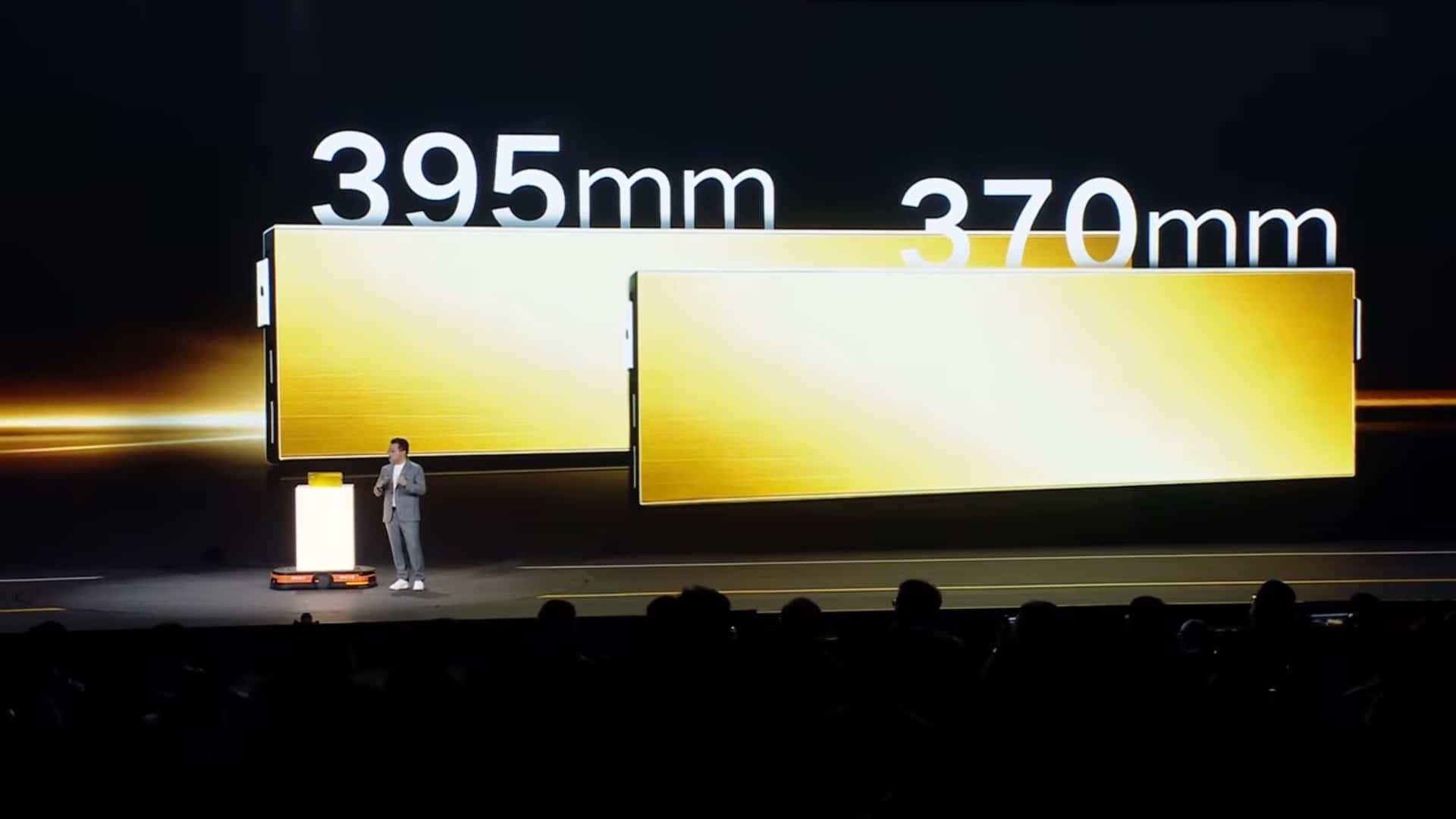
At the heart of Geely’s solution is the innovative Ultra Short Blade Battery cell. These cells are produced in two primary sizes: 395 mm and 370 mm in length. These dimensions are notably more compact compared to Geely’s previous 580 mm cell and significantly smaller than what the automaker identifies as an industry common size, typically around 960 mm.
This reduction in cell size plays a pivotal role in mitigating degradation. A shorter cell length directly translates to a reduced migration path for lithium ions during both charging and discharging cycles. This shorter journey for the ions has a direct benefit: it lowers the internal resistance within the battery cells, which in turn significantly reduces the generation of undesirable heat, particularly during high-speed charging.
Advanced Material Science and Structural Enhancements
Geely has also implemented sophisticated structural changes to both the cathode and the anode components of Geely’s new battery to actively prevent lithium plating. On the cathode side, the introduction of “high entropy elements” serves to widen the pathways through which ions travel from the cathode to the anode. Xiangfei likened this improvement to “turning a single lane into a multi-lane highway,” facilitating smoother and more efficient ion movement.
Concurrently, the graphite anode has undergone structural modifications, which Xiangfei described as equivalent to “building a flyover.” These architectural changes are designed to improve ion absorption and prevent the localized accumulation that leads to lithium plating and dendrite formation. These material and structural innovations are critical for enhancing the battery’s ability to handle high current densities without compromising its internal integrity.
Lithium Pulse Restoration Technology
To directly combat the accumulation of ions on the anode surface, Geely has introduced a novel “lithium pulse restoration” technology. This innovative process involves injecting a “micro amplitude pulse current” into the anode at a precise frequency. The gentle, rhythmic application of this pulse current helps to redistribute and properly absorb accumulated lithium ions, effectively preventing plating.
Xiangfei used an accessible analogy to explain this technology, comparing the process to using a massage gun on muscles after a workout to relieve tension. This technology ensures that even under rapid charging conditions, the anode remains clear and efficient in absorbing lithium ions, thereby extending the battery’s active lifespan.
Intelligent Thermal Management: The Xingrui PowerMind System
Managing heat is paramount for battery health, especially with megawatt charging. Geely has developed an “end-to-end five-point liquid cooling system” that operates synergistically across multiple components. This comprehensive system encompasses the on-site energy storage battery, the power module, the charger itself, the charging port, and Geely’s new battery within the electric vehicle.
Complementing this robust hardware, an AI-powered system named Xingrui PowerMind plays a crucial role. This intelligent system is capable of predicting battery temperatures up to 30 seconds in advance, allowing for real-time adjustments to charging speeds. This predictive capability ensures that the battery operates within optimal thermal parameters, preventing overheating.
The thermal management system is engineered to maintain the battery’s average temperature at a stable 55 degrees Celsius, with a strict ceiling of 65 degrees Celsius. This 65°C threshold aligns with a new national standard implemented in China in July, specifically designed to prevent EV batteries from overheating under intense operating conditions. This adherence to stringent regulatory standards further underscores Geely’s commitment to safety and reliability.
Broader Implications and The Path Ahead
While Geely’s advancements present a compelling vision for the future of EV charging, the long-term impact of megawatt charging on battery health will require sustained observation. The commercialization of such high-power charging solutions only began at scale in China last year, meaning real-world data over extended periods is still accumulating.
Past incidents, such as debates triggered by a blogger’s independent charging tests on a BYD Fangchengbao Tai 3 electric SUV—where a higher maximum temperature was recorded than displayed by the vehicle—highlight the scrutiny and transparency needed in this rapidly evolving sector. Geely’s extended warranty is a strong indicator of its confidence, but consumer experiences over time will be the ultimate testament.
It is important to acknowledge that battery degradation is a complex phenomenon influenced by numerous factors, including individual driving behaviour, charging habits, ambient climate, and the inherent underlying battery technology. While some historical studies have suggested that frequent fast-charging can accelerate battery aging, more recent research indicates that modern EV battery technology has significantly evolved, demonstrating improved resilience to frequent fast-charging with minimal long-term degradation.
For everyday EV owners, concerns about the impact of public fast-chargers, such as Tesla Superchargers, are becoming less pressing due to technological advancements. Best practices continue to recommend following manufacturer-specified charging guidelines. Utilizing a home charger for daily commuting needs and leveraging public fast-chargers for longer journeys remains a practical approach to maintaining optimal battery health. As battery technology progresses, the need for excessive caution regarding charging habits is steadily diminishing, paving the way for more seamless and worry-free EV ownership.
FAQ Section
Q1: What are the key innovations in Geely’s new battery for handling megawatt charging?
Geely’s new battery incorporates several innovations: a compact Ultra Short Blade Battery cell design, structural enhancements to the cathode and anode, a “lithium pulse restoration” technology, and an AI-powered “Xingrui PowerMind” thermal management system, all designed to prevent degradation during ultra-fast charging.
Q2: How fast can Geely’s new battery charge, and how does it compare to other EVs?
Geely’s new battery can peak at nearly 1,100 kilowatts. In a demo, a Lynk & Co 10 charged from 10-97% in 8 minutes and 40 seconds. This is significantly faster than U.S. EVs like the Lucid Gravity (400 kW) and upcoming Mercedes-AMG GT (600 kW).
Q3: What causes battery degradation during fast charging?
Geely identifies two main causes: lithium plating, where ions accumulate on the anode, potentially forming damaging dendrites; and extreme temperatures, with megawatt speeds accounting for 60% of heat generated, 35% from electrochemical reactions, and the rest from entropic heat.
Q4: How does Geely prevent lithium plating in its new battery?
Geely prevents lithium plating through structural changes, including “high entropy elements” in the cathode to widen ion pathways and structural modifications to the graphite anode. Additionally, “lithium pulse restoration” technology injects micro amplitude pulse currents to reduce ion accumulation on the anode surface.
Q5: What is Geely’s thermal management strategy for its megawatt-capable battery?
Geely employs an “end-to-end five-point liquid cooling system” and an AI-powered “Xingrui PowerMind” system that predicts battery temperatures 30 seconds in advance. This ensures the battery maintains an average temperature of 55 degrees Celsius, with a 65 degrees Celsius ceiling, adhering to new Chinese national standards.
Q6: Has Geely extended its battery warranty for this new technology?
Yes, Geely has increased its new battery’s warranty from eight years or 150,000 kilometers (93,205 miles) to eight years or 200,000 kilometers (124,000 miles). This extension reflects the company’s confidence in the battery’s long-term health and durability despite ultra-fast charging capabilities.
Q7: What is the significance of the Ultra Short Blade Battery cell size?
The Ultra Short Blade Battery cells, at 395mm and 370mm, are smaller than conventional cells. This compact size reduces the migration path for ions during charging and discharging, which in turn lowers internal resistance and significantly reduces heat generation, contributing to battery longevity.