
Key Takeaways:
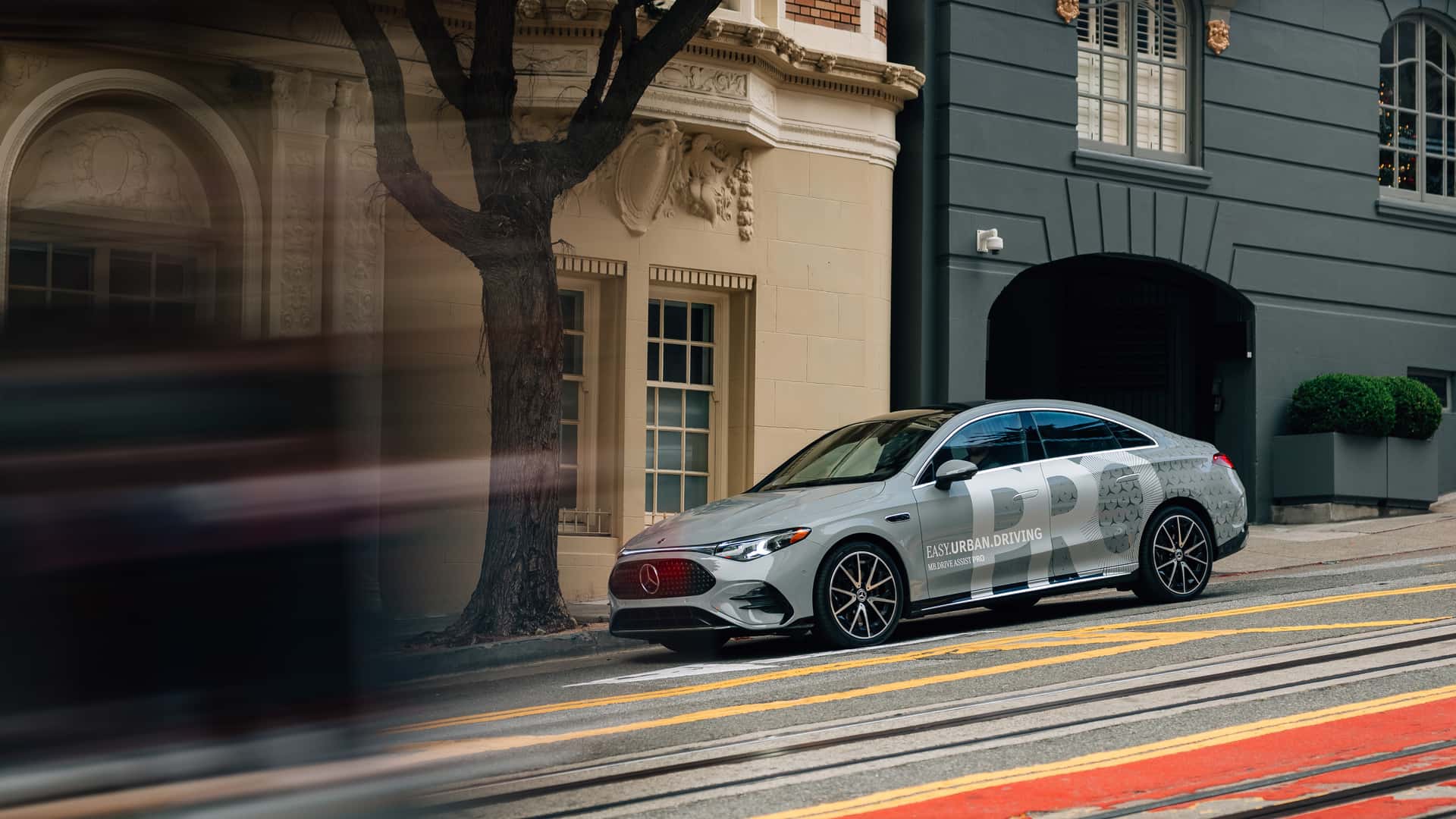
- Mercedes-Benz is set to launch its MB.Drive Assist Pro point-to-point automated driving system early next year, offering an alternative to Tesla’s Full Self-Driving (FSD).
- The Mercedes system operates hands-free on controlled-access highways but requires drivers to keep a hand on the wheel on surface streets, a key distinction from Tesla FSD (Supervised).
- Mercedes’ approach is rooted in a strict adherence to Society of Automotive Engineers (SAE) Level 2 definitions, where the driver remains fully responsible.
- Technically, MB.Drive Assist Pro integrates cameras, five radar sensors, and 12 ultrasonic sensors, contrasting with Tesla’s camera-centric method.
- User perspectives vary, with some appreciating the added safety of hands-on control, while others accustomed to FSD’s hands-off capability on city streets find Mercedes’ approach a step back.
For many commuters, the daily grind can transform even the most picturesque routes into a monotonous chore. Lucian Capellaro, for instance, faces a perpetual challenge navigating Laurel Canyon from the San Fernando Valley to Los Angeles’ west end. His interest was piqued when colleagues lauded the capabilities of Tesla’s Full Self-Driving (FSD) feature, promising effortless point-to-point navigation.
Yet, Capellaro harbored reservations, preferring alternatives to Tesla due to factors spanning design aesthetics, interior quality, and body style, alongside broader political considerations. His search for an advanced driving assistant that aligned with his preferences might soon find an answer in Mercedes-Benz.
The German automotive giant is poised to introduce its MB.Drive Assist Pro point-to-point automated driving system early next year. This sophisticated system will be available across a wide range of Mercedes-Benz electric and internal combustion vehicles. Existing eligible models will gain access to this feature through convenient over-the-air updates, signaling a significant step in the evolution of driver assistance technology.
Mercedes-Benz’s foray into advanced autonomous driving systems marks a pivotal moment in the industry. The upcoming MB.Drive Assist Pro is designed to compete directly with established solutions like Tesla’s Full Self-Driving (Supervised), offering a robust suite of features aimed at enhancing the driving experience.
This development underscores a broader industry trend towards increasingly capable and integrated driver support functionalities. The brand’s strategic decision to make the system available via over-the-air updates also highlights a commitment to continuous improvement and customer convenience in the rapidly evolving automotive landscape.
Defining Autonomy: Mercedes’ Philosophy on Driver Responsibility
The core distinction between MB.Drive Assist Pro and Tesla’s Full Self-Driving (Supervised) lies in a fundamental philosophical approach to autonomous driving. Both systems enable drivers to input a destination, allowing the vehicle to navigate and park independently. However, a crucial difference emerges when operating on surface streets.
While the Mercedes system, much like FSD, permits hands-free operation on controlled-access highways, it mandates that drivers keep a hand on the steering wheel when traversing city roads. This requirement is not an indicator of technical inferiority, but rather a deliberate adherence to the strict interpretations of autonomous driving “levels” as defined by the Society of Automotive Engineers (SAE).
MB.Drive Assist Pro, akin to FSD (Supervised), is classified as a Level 2 system, or what Mercedes terms “Level 2 Plus Plus.” This classification fundamentally means the system must always be supervised by the driver. Mercedes-Benz executives emphasize that true Level 3 systems are characterized by the ability for occupants to engage in non-driving activities, such as watching a movie or reading a book, under certain operational conditions.
Jörg Burzer, Mercedes’ Chief Technology Officer, articulated this distinction, stating, “There is a very important borderline between the levels. That borderline is that with Level 2 Plus Plus, you are responsible. At Level 3, the machine, the car, the software stack, is responsible.” This highlights a clear demarcation of legal and ethical accountability within Mercedes’ development framework.
Burzer further explained that the controlled environment of highways presents fewer variables for a Level 2 system to manage effectively. In stark contrast, surface streets introduce a significantly more chaotic and complex array of scenarios, including unpredictable pedestrians, cyclists, and varied traffic conditions. Consequently, Mercedes-Benz mandates driver hand placement on the wheel in these more challenging urban settings.
This pragmatic decision resonates with safety-conscious drivers like Lucian Capellaro, despite his experience as a motorcycle rider, which suggests a certain degree of risk tolerance. Capellaro observed, “Think about the reaction time it must be for someone to take their hands from off the wheel to on the wheel. I’d view my hand on the wheel as lessening the seconds of reaction time to something crazy happening.”
Customer research conducted by Mercedes-Benz, particularly among European drivers, appears to corroborate Capellaro’s sentiment. Burzer noted, “In the city, they like to have something, some regulation or some requirement that you have to have a hand on the wheel,” although he acknowledged, “I don’t know about U.S. customers yet.”
When pressed on why a customer might prefer the Mercedes system when Tesla offers hands-off driving on surface streets, Burzer consistently referred back to regulatory compliance and the established SAE levels of autonomy. He asserted, “The big question is when is level 3 coming? Because then you can have the hands off (anywhere).”
User Perspectives: Hands-On vs. Hands-Off Autonomy
Despite Mercedes-Benz’s adherence to SAE definitions, many Tesla FSD users frequently operate their vehicles as if they already possess Level 3 capabilities, or even beyond. These users, and perhaps even Tesla itself, do not appear to share Mercedes’ stringent philosophical commitment to definitions formulated by the Society of Automotive Engineers. Instead, their perceptions are shaped by the actual operational performance of their vehicles.
Antonio Hidalgo, a Los Angeles resident, extensively uses FSD for various driving scenarios, not solely for commuting. He candidly admits to occasionally taking naps while driving, particularly when wearing a hat and sunglasses, indicating a high degree of trust in the system. Hidalgo identifies parking as the primary area where he still observes system flaws.
When asked if he would consider switching to the Mercedes system despite its hands-on requirement in city driving, Hidalgo deliberated before concluding, “You know, I probably wouldn’t (make the switch). I mean, I think I would be interested in having a nicer car with a better interior. But no.” This suggests that while vehicle aesthetics and comfort are appealing, the hands-off experience holds significant weight for him.
Mharlon Barrientos, who relies on FSD for his commute in Indianapolis, shared a similar evolution in his trust of the system. Initially, he would “hover” a hand over the wheel on surface streets. However, subsequent system updates and accumulated driving experience have led him to a completely hands-off approach. He articulated the impact of Mercedes’ proposed requirement, stating, “Having a hand on the wheel as a requirement would be a bit of a step back to the feel of full autonomous driving that I’ve gotten used.”
Barrientos’ experience is particularly relevant as he noted that his Model Y originally demanded hands-on operation, illustrating his journey from supervised to largely unsupervised driving. This highlights a user base that has grown accustomed to, and expects, a higher degree of automated convenience in city environments.
Technical Architecture: Mercedes’ Multi-Sensor Approach
Mercedes-Benz is quick to highlight what it perceives as distinct advantages of MB.Drive Assist Pro over Tesla’s FSD (Supervised), particularly concerning its sensor array. Unlike Tesla, which predominantly relies on cameras for obstacle detection, Mercedes-Benz employs a comprehensive multi-sensor strategy. The MB.Drive Assist Pro system integrates not only cameras but also five radar sensors and 12 ultrasonic sensors, all feeding raw data to the vehicle’s Nvidia-powered computer.
Christoph von Hugo, Mercedes’ Head of Active Safety, underscored the importance of this diverse sensor input, stating, “Different sensor inputs increases performance and safety.” He made veiled references to what he implied was Tesla’s comparatively insufficient methodology, adding, “Relying on one just is not enough.” This statement suggests a critical view of camera-only autonomous driving systems.
Von Hugo further emphasized that Mercedes-Benz has no intention of achieving Level 3 capability without the inclusion of LiDAR technology, in addition to its current suite of cameras, radar, and ultrasonic sensors. This commitment reflects a highly cautious and redundancy-focused approach to advancing autonomous capabilities. (It is notable that Mercedes did briefly offer a Level 3 system in the U.S., which has since been phased out).
However, the value of this sophisticated sensor architecture may not be immediately apparent to all consumers. Mharlon Barrientos expressed skepticism about the market impact of such technical specifications, remarking, “I honestly haven’t even thought about the tech behind it, so I’m not so sure knowing that there’s radar and ultra-sonic sensors (on the window sticker) would be a huge selling point.”
Barrientos suggested that practical performance demonstrations, through videos or detailed reviews, would be far more influential than a list of technical components. He stressed the importance of real-world experience: “Just like the Tesla system, I think it would take me some mileage on both highway and streets to gain a trust for the system to know it’ll handle either situation well.”
Despite his engagement with Tesla FSD, Barrientos clarified that his loyalty is not absolute. He noted that not every Tesla owner is a fervent brand loyalist, indicating a willingness to consider other options if they meet his broader automotive preferences.
“The hands-on requirement in the city would not be enough to sway me off of the car provided I like the rest of the car,” Barrientos stated. He emphasized that autonomous driving functionality, while appreciated, remains lower on his priority list compared to fundamental attributes such as overall functionality, comfort, and value. “While I like the functionality of FSD, it’s still a bit further down the list of what I look for in a car. Functionality, comfort, value … I still like to feel the mechanics and have the feel of actually driving a car.”
Lucian Capellaro shares this sentiment. He ponders whether the Mercedes system would offer a significantly different experience compared to his wife’s BMW i4, which already features adaptive cruise control and hands-free highway driving assist for traffic jam scenarios.
Ultimately, the true test for MB.Drive Assist Pro will be its real-world performance. Capellaro summarized his perspective: “I guess I’d just have to experience (MB.Drive Assist Pro) for myself, but if it can navigate all the craziness that is Laurel Canyon through Hollywood, and it is literally just my hand resting on the wheel, and that’s it, then sure. The fact that it’s truly point-to-point, then yes, that sounds super appealing.”
While InsideEVs reported promising initial impressions from a passenger-seat ride in San Francisco in January, a comprehensive review of MB.Drive Assist Pro’s capabilities is eagerly anticipated. The central questions remain: Does the system perform as effectively as Tesla FSD despite its hands-on requirement for surface streets, and is this requirement ultimately beneficial or a deterrent for widespread adoption? The answers will undoubtedly shape the future perception of Mercedes-Benz’s autonomous driving solutions.
Frequently Asked Questions (FAQ)
What is Mercedes MB.Drive Assist Pro?
Mercedes MB.Drive Assist Pro is an upcoming point-to-point automated driving system designed to navigate vehicles from a starting point to a destination, including parking. It will be available on numerous Mercedes-Benz electric and internal combustion models, with existing eligible vehicles able to receive it via over-the-air updates.
How does MB.Drive Assist Pro differ from Tesla Full Self-Driving (FSD)?
The primary difference lies in driver interaction on surface streets. While both systems offer hands-free operation on controlled-access highways, MB.Drive Assist Pro requires drivers to keep a hand on the steering wheel when driving on city roads, whereas Tesla FSD (Supervised) permits hands-off operation in these scenarios.
What are SAE autonomous driving levels?
The Society of Automotive Engineers (SAE) defines six levels of driving automation, from Level 0 (no automation) to Level 5 (full automation). MB.Drive Assist Pro and Tesla FSD (Supervised) are both considered Level 2 systems, meaning the driver must remain engaged and supervise the system at all times.
Why does Mercedes require hands on the wheel on surface streets?
Mercedes-Benz adheres strictly to SAE Level 2 definitions, where the driver maintains responsibility. The company believes surface streets present higher complexity and more variables than highways, necessitating driver readiness to intervene. This hands-on requirement is a philosophical decision prioritizing safety and defined responsibility.
What is Mercedes’ technical approach to sensor technology?
Mercedes-Benz employs a multi-sensor setup for MB.Drive Assist Pro, including cameras, five radar sensors, and 12 ultrasonic sensors. This contrasts with Tesla’s camera-only approach, which Mercedes argues is insufficient. Mercedes also indicates that LiDAR technology will be essential for their progression to Level 3 autonomous driving.
Will existing Mercedes owners be able to get MB.Drive Assist Pro?
Yes, Mercedes-Benz has stated that already-purchased eligible vehicles will be able to add the MB.Drive Assist Pro system via an over-the-air update. This ensures that a broader base of customers can access the advanced driving assistance features without needing to purchase a new vehicle immediately.
Do drivers prefer hands-on or hands-off autonomous driving?
Driver preference varies significantly. Some, particularly in Europe according to Mercedes’ research, prefer to keep hands on the wheel for safety and faster reaction times. Others, especially long-time Tesla FSD users, have grown accustomed to and expect a hands-off experience even on city streets, finding the hands-on requirement a step back.