
Key Takeaways
- BYD has introduced a pioneering EV charging station in Abu Dhabi that integrates solar panels and battery storage to facilitate high-speed charging independent of conventional electricity grids.
- A sophisticated robotic arm automates the connection process, aiming for a completely hands-free charging experience when paired with autonomous parking systems.
- The innovative system leverages BYD’s advanced Flash Charging technology, capable of delivering up to 1,500 kW, dramatically reducing charging times for compatible vehicles.
- While the specific off-grid charging capacity of the Abu Dhabi installation remains undisclosed, the concept marks a significant stride towards expanding electric vehicle infrastructure into remote or grid-constrained regions.
- BYD plans an aggressive global expansion, aiming for 6,000 Flash Charging stations worldwide by 2027, with deployments already underway in key European markets and Canada.
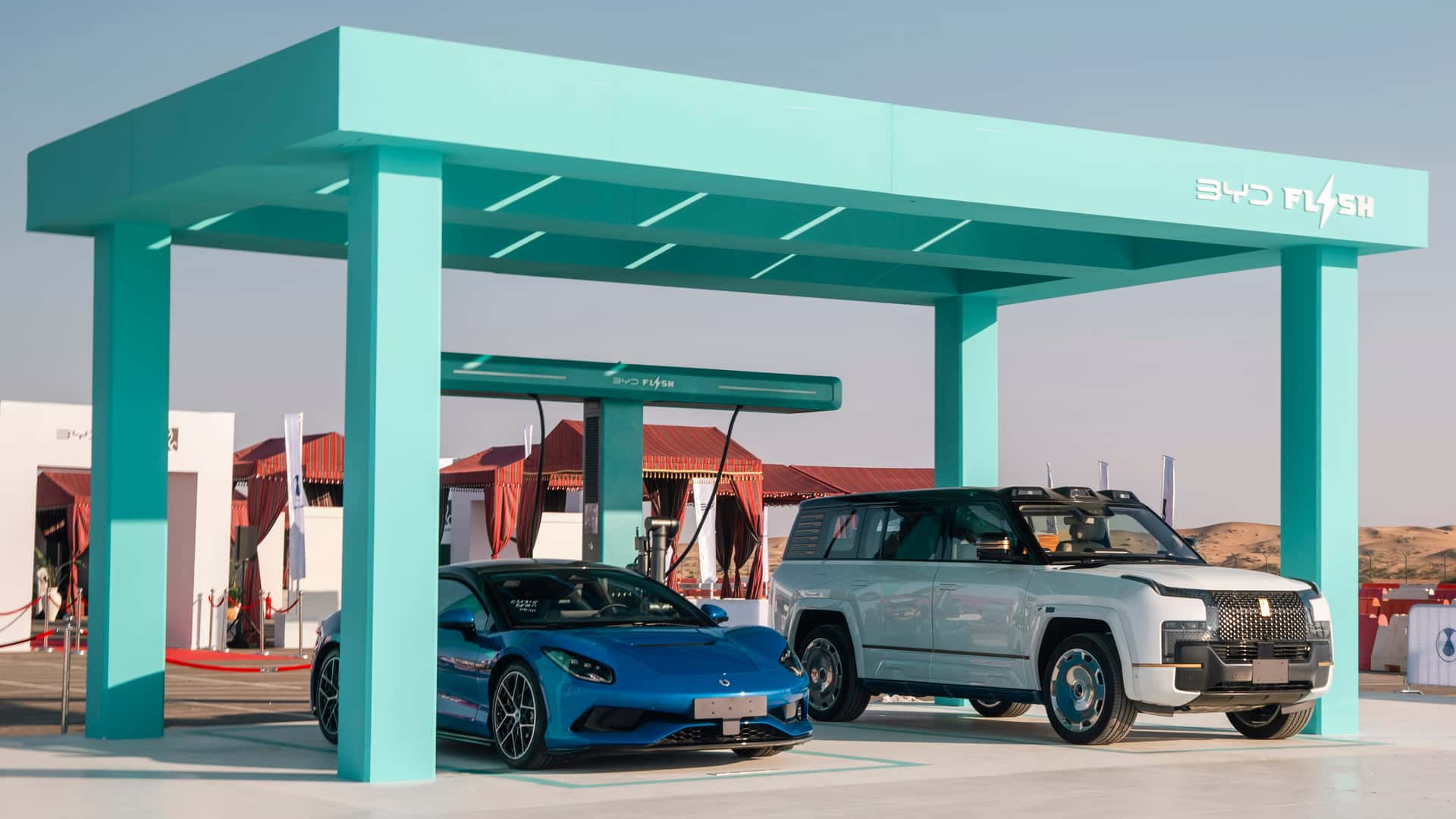
In a significant stride towards revolutionising electric vehicle (EV) charging infrastructure, BYD has unveiled a groundbreaking charging station designed for ultimate flexibility and efficiency. Demonstrated in the challenging environment of the Abu Dhabi desert, this innovative facility combines solar power generation, substantial battery energy storage, and advanced robotic automation to deliver high-speed charging capabilities, even in locations disconnected from the main electricity grid.
This pioneering system addresses one of the critical challenges of widespread EV adoption: ensuring robust and accessible charging infrastructure across diverse geographical settings. By leveraging renewable energy and intelligent design, BYD is paving the way for a more sustainable and universally accessible electric mobility future.

The Dawn of Off-Grid EV Charging Solutions
The core innovation behind BYD’s new desert charging site lies in its ability to operate autonomously. The system’s foundational components include an array of solar panels that harness the abundant energy of the sun and integrated battery storage units that store this generated electricity. This stored energy is then dispatched to the connected electric vehicles via BYD’s proprietary Flash Charging technology.
This integrated approach means that the station can function entirely independent of the electrical grid, offering a viable solution for deploying fast charging services in remote areas, developing regions, or locations where establishing a conventional grid connection is either impractical, prohibitively expensive, or time-consuming. It represents a paradigm shift from traditional charging models that are entirely reliant on established power networks.
Synergy of Solar Power and Battery Storage
The concept of battery-backed charging is gaining considerable traction within the EV industry, and for good reason. It allows charging stations to deliver significantly more power to vehicles than their immediate grid connection might otherwise permit. Furthermore, it plays a crucial role in mitigating peak demand on the grid, drawing power during off-peak hours and discharging it during high-demand periods, thereby enhancing grid stability.

Leading companies like Tesla, with its expansive Supercharger network featuring Megapack batteries, and specialists such as Electric Era and Beam Global, have already embraced this hybrid energy model. Even standard BYD Flash Charging stations that rely on grid connections utilise on-site energy storage to augment power delivery, ensuring consistent high-speed performance.
The T-shaped BYD Flash Chargers are robustly designed, each connected to two 185-kilowatt-hour (kWh) storage batteries, accumulating a total of 370 kWh of energy storage. These units are engineered to draw between 100 to 560 kilowatts (kW) of power from the grid, then channel it to the connected EV at a substantially higher rate. The chargers boast an impressive capacity to deliver up to 1,500 kW through a single cable, or up to 1,000 kW when both cables are simultaneously engaged, showcasing remarkable engineering prowess.
The integration of solar panels into this equation offers the compelling prospect of generating a significant, or even complete, portion of the required electricity directly on-site. However, specific details regarding the battery capacity and solar output for this particular desert installation have not yet been made public by BYD. This information is crucial for accurately assessing the number of vehicles the station can charge, and at what speed, relying solely on solar power without grid support.
Automating the Charging Experience with Robotic Precision
Beyond its innovative power source, the new BYD Flash Charging station also integrates a cutting-edge robotic arm designed to automate the charging process. This robotic arm meticulously plugs the charging cable into the EV, eliminating the need for human intervention. This feature, especially when combined with automated parking systems, ushers in an era of entirely hands-free and seamless EV charging.
The introduction of robotic charging not only enhances user convenience but also sets a precedent for future autonomous vehicle ecosystems. As self-driving cars become more prevalent, automated charging will be essential for their operational efficiency, allowing vehicles to autonomously navigate to a charging point and recharge without human oversight, further streamlining the electric mobility experience.
Unpacking BYD Flash Charging Technology and Performance
The impressive speed of BYD’s charging hardware is a central pillar of its value proposition. Utilising the latest 1,500-kW BYD Flash Chargers, compatible electric vehicles equipped with BYD’s second-generation Blade battery can achieve a charge from 10% to 70% in a mere five minutes. For an almost full charge, reaching 97%, the process takes approximately nine minutes.
These rapid charging times are transformative, effectively making the EV recharging experience comparable to, or even faster than, refuelling a conventional internal combustion engine vehicle. This capability directly addresses range anxiety and convenience concerns, which have historically been barriers to broader EV adoption.
Global Ambitions and Expanding Market Footprint
BYD’s commitment to advancing EV infrastructure is evident in its ambitious global expansion strategy for its BYD Flash Charging network. The company has articulated plans to establish 6,000 Flash Charging stations worldwide by the close of 2027. This aggressive rollout underscores BYD’s vision for a pervasive and efficient global charging ecosystem. While the exact number of these future stations that will feature solar power, off-grid functionality, or robotic arms remains unspecified, the overall goal is clear: to significantly bolster the availability of ultra-fast charging.
Europe is already witnessing the rollout of BYD Flash Charging facilities, with operational sites now established in Italy, Germany, France, and the United Kingdom. Further expansion into Canada is also anticipated in the near future, indicating a broad geographical reach for this advanced technology. This rapid international deployment highlights BYD’s intent to be a key player in the global EV charging landscape.
Compatible Vehicles and Real-World Demonstrations
Currently, the Denza Z9 GT is one of the vehicles sold in Europe capable of fully leveraging the immense power offered by the BYD Flash Charging system. During a controlled demonstration, this electric wagon impressively charged from 10% to 80% in just six minutes and 32 seconds, reaching a 97% charge level in nine minutes and 22 seconds. These real-world performance figures validate the efficacy and speed claims of the BYD Flash Charging technology, showcasing its practical benefits for EV owners.
The Broader Impact on Electric Vehicle Infrastructure
BYD’s foray into off-grid, solar-powered, and robot-assisted charging solutions marks a pivotal moment for the electric vehicle industry. This innovative approach promises to democratise access to fast charging, making it feasible in areas previously deemed challenging due to infrastructural limitations. It also significantly contributes to the sustainability goals of the EV sector by integrating renewable energy sources directly into the charging process, reducing reliance on fossil fuel-generated electricity.
The emphasis on automation, particularly with the robotic arm, previews a future where EV charging is not just fast but also entirely autonomous. This aligns perfectly with the burgeoning development of self-driving cars, where vehicles can manage their own charging logistics seamlessly. Such advancements are critical for the mass adoption of EVs, transforming the entire ownership experience.
As governments and corporations worldwide push for accelerated electrification of transport, solutions like the BYD Flash Charging system will be instrumental. They offer a blueprint for building resilient, sustainable, and highly accessible charging networks that can keep pace with the exponential growth of the global EV fleet. The implications extend beyond convenience, touching upon energy independence, environmental protection, and technological leadership in a rapidly evolving automotive landscape.
Conclusion
BYD’s latest EV charger, with its innovative blend of solar energy, battery storage, Flash Charging capabilities, and robotic automation, represents a significant leap forward in the evolution of electric vehicle infrastructure. By tackling the critical challenge of grid dependency and enhancing user experience through automation, BYD is not only showcasing its technological prowess but also setting new benchmarks for the industry. As these advanced charging solutions proliferate globally, they are poised to accelerate the transition to electric mobility, making fast, sustainable, and convenient EV charging a reality for a wider population.
Frequently Asked Questions About BYD’s Futuristic EV Charger
What is unique about BYD’s new EV charger?
BYD’s latest EV charger stands out by combining solar panels and battery storage, enabling it to operate off-grid. It also features a robotic arm for automated vehicle plugging and leverages high-speed Flash Charging technology, offering a comprehensive and futuristic solution for electric vehicle recharging.
How does the charger operate without a grid connection?
The system generates electricity using integrated solar panels and stores it in substantial on-site batteries. This stored energy is then used to power the BYD Flash Charging units, allowing the station to provide rapid charging services in remote areas or locations without a traditional power grid connection.
What are the charging speeds offered by BYD Flash Charging?
BYD’s Flash Chargers can deliver up to 1,500 kW using a single cable or 1,000 kW with two cables simultaneously. Compatible vehicles, like those with the second-generation Blade battery, can charge from 10% to 70% in approximately five minutes, or reach 97% in around nine minutes.
Is the robotic arm mandatory for charging?
The robotic arm is an optional feature designed to automate the charging connection, providing a hands-free experience. While it enhances convenience and supports future autonomous vehicle integration, specific details on its mandatory use across all upcoming BYD Flash Charging stations are yet to be fully disclosed.
Where is this new technology being deployed globally?
BYD demonstrated the initial system in Abu Dhabi and has ambitious plans to establish 6,000 BYD Flash Charging stations worldwide by the end of 2027. Currently, Flash Charging sites are operational in Europe, including Italy, Germany, France, and the United Kingdom, with Canada also slated for future deployments.
What type of vehicles can utilise BYD Flash Charging?
BYD Flash Charging technology is compatible with electric vehicles featuring BYD’s advanced battery architectures, such as the second-generation Blade battery. The Denza Z9 GT, a BYD-produced electric wagon, has demonstrated its ability to fully utilise the high-speed charging capabilities in real-world tests.