
Key Takeaways:
- BYD has introduced an advanced EV charging station integrating solar power, battery storage, and Flash Charging with a robotic arm, designed for grid-independent operation.
- The system aims to deliver ultra-fast charging even in remote locations where grid connectivity is challenging or non-existent, exemplified by its debut in the Abu Dhabi desert.
- Featuring a robotic arm, the charger automates the connection process, enhancing convenience and aligning with future autonomous parking systems.
- BYD’s Flash Chargers offer impressive speeds, capable of charging compatible vehicles from 10% to 70% in just five minutes, thanks to their 1,500 kW output and second-generation Blade batteries.
- The company plans a massive global expansion, targeting 6,000 Flash Charging stations worldwide by the end of 2027, signalling a significant push towards accessible and sustainable EV infrastructure.
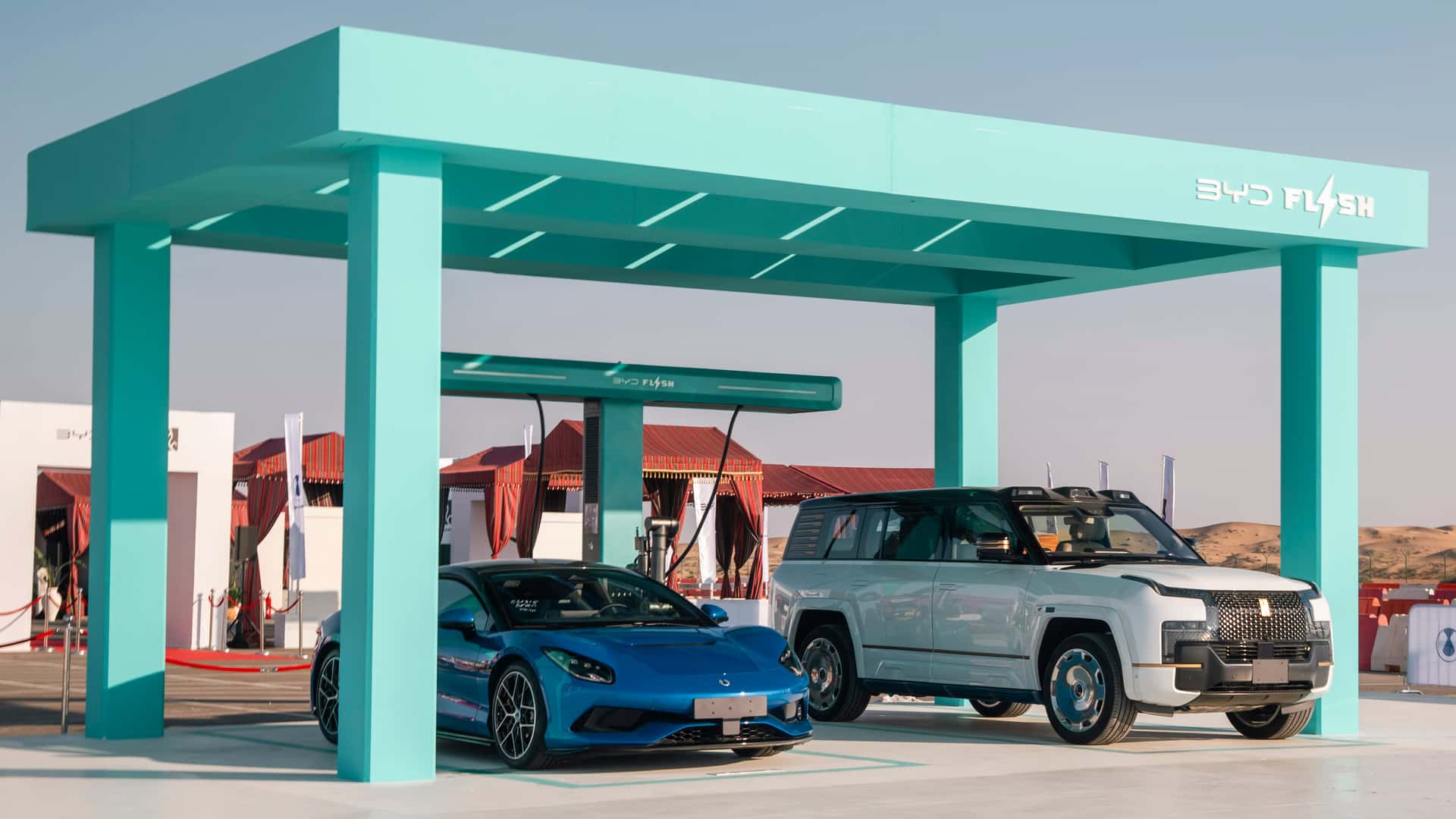
In a significant stride towards sustainable and accessible electric vehicle (EV) infrastructure, global automotive and battery giant BYD has unveiled a groundbreaking EV charging station that harnesses solar power, integrated battery storage, and ultra-fast Flash Charging technology. This innovative system, notably equipped with a robotic arm for autonomous vehicle connection, promises to bring high-speed charging capabilities to areas previously limited by grid access, marking a pivotal moment in the evolution of EV charging.

The system made its debut in the challenging environment of the Abu Dhabi desert, demonstrating its capability to operate entirely independently of conventional electricity grids. This deployment highlights BYD’s vision for a future where EV adoption is no longer constrained by geographical or infrastructural limitations, addressing a critical bottleneck in the global transition to electric mobility.
Addressing the Grid Challenge: BYD’s Off-Grid Solution
The rapid expansion of electric vehicles globally has brought into sharp focus the need for robust and widespread charging infrastructure. A persistent challenge remains the provision of adequate power to fast chargers, especially in remote locations or areas with underdeveloped grid networks. Conventional fast chargers demand substantial electricity inputs, often requiring significant grid upgrades that are both costly and time-consuming.
BYD’s new off-grid charging station directly confronts this issue by creating a self-sufficient energy ecosystem. The core principle is elegant in its simplicity: solar panels capture ambient energy, integrated batteries store this energy, and the advanced charger then efficiently delivers it to the electric vehicle. This holistic design ensures consistent power availability, mitigating reliance on an often overburdened or non-existent grid connection.

This approach isn’t entirely new within the industry, as several companies are exploring similar avenues. Tesla, for instance, has incorporated solar panels and its Megapack batteries at its largest Supercharger sites to supplement grid power and manage demand. Specialist firms like Electric Era and Beam Global also focus on battery-backed charging solutions, recognising the inherent benefits of energy storage in optimising power delivery and reducing peak grid loads. Even standard BYD Flash chargers, not located in remote deserts, already utilise on-site energy storage to enhance power output, underscoring a broader industry trend towards intelligent energy management in EV charging.
Technological Prowess: Flash Charging and Integrated Storage
At the heart of BYD’s offering is its proprietary Flash Charging technology, renowned for its exceptional speed and efficiency. The T-shaped Flash chargers are designed with formidable power delivery capabilities. Each unit is paired with two 185-kilowatt-hour (kWh) storage batteries, accumulating a total on-site capacity of 370 kWh. These batteries draw power from the grid at rates ranging from 100 to 560 kilowatts (kW), before dispatching it to vehicles at significantly higher rates.
The chargers can deliver an impressive 1,500 kW through a single cable or maintain a substantial 1,000 kW when two cables are in simultaneous use. This capacity positions BYD’s chargers among the fastest available, setting a new benchmark for rapid EV replenishment. However, while the standard Flash Charger specifications are robust, BYD has yet to release specific details regarding the battery capacity and solar output for the innovative desert installation. This lack of detailed technical data means the exact number of vehicles the station can charge or the speed at which it can operate solely on solar power remains to be fully clarified.
The speed benefits for compatible vehicles are truly transformative. Electric vehicles equipped with BYD’s second-generation Blade battery can achieve a charge from 10% to 70% in an astonishing five minutes, and reach 97% in just nine minutes when connected to a 1,500 kW Flash Charger. This dramatically reduces charging times, making the EV experience closer to conventional refuelling.
The Robotic Arm: Enhancing Convenience and Future Integration
Beyond its power generation and delivery capabilities, the BYD EV charging innovation introduces a notable advancement in user experience: a robotic arm. This automated feature is designed to plug the charging cable into the vehicle without human intervention, creating a seamless, hands-free charging experience. This integration works in tandem with automated parking systems, envisioning a future where vehicles can autonomously locate charging points and connect themselves, revolutionising convenience for EV owners.
The robotic arm not only adds a layer of futuristic appeal but also addresses practical challenges. It removes the physical effort of handling heavy charging cables, particularly for high-power DC fast chargers, and offers a more inclusive solution for drivers with mobility challenges. This step towards full automation in charging aligns perfectly with the broader trend of vehicle autonomy and smart city infrastructure.
Global Expansion and Market Impact
BYD’s ambitions for its Flash Charging infrastructure extend far beyond the Abu Dhabi desert. The company has articulated an aggressive global expansion strategy, aiming to establish 6,000 Flash Charging stations worldwide by the close of 2027. This includes a mix of configurations, though the exact proportion of stations featuring solar power, off-grid operation, or robotic arms has not been fully specified.
The expansion is already underway, with BYD Flash Charging sites operational across Europe in key markets such as Italy, Germany, France, and the United Kingdom. Future plans also include an imminent entry into the Canadian market. This strategic global rollout underscores BYD’s commitment to building a comprehensive charging ecosystem that supports its rapidly expanding EV lineup and accelerates global EV adoption.
One of the vehicles uniquely positioned to fully leverage the capabilities of these ultra-fast chargers is the Denza Z9 GT. During a recent demonstration, this electric wagon showcased its charging prowess, achieving a 10% to 80% charge in just six minutes and 32 seconds, and reaching 97% in nine minutes and 22 seconds. Such performance metrics are crucial for alleviating range anxiety and making electric vehicles a more viable option for long-distance travel and everyday use.
The Future of EV Charging: Sustainability and Accessibility
The BYD EV charging innovation represents a significant leap forward in addressing the dual challenges of charging speed and infrastructure accessibility. By combining renewable energy generation, efficient storage, and advanced automation, BYD is paving the way for a more sustainable and user-friendly EV ecosystem. This technology is particularly impactful for emerging markets or regions with unreliable grid infrastructure, where off-grid solutions can democratise access to electric mobility.
While specific details on the energy output and storage capacity of the desert installation are pending, the overarching concept promises to enhance trust in electric vehicles as a dependable mode of transport. The global rollout plan further solidifies BYD’s position as a leader not just in EV manufacturing but also in the critical charging infrastructure that underpins the electric revolution. As the world moves towards decarbonisation, innovations like BYD’s integrated charging system will be instrumental in accelerating the energy transition.
Frequently Asked Questions (FAQs)
What is unique about BYD’s new EV charger?
BYD’s new EV charger is unique because it integrates solar panels, battery energy storage, ultra-fast Flash Charging, and a robotic arm. This combination allows it to operate independently of the electricity grid, offering fast charging even in remote or undeveloped areas, enhancing sustainability and accessibility.
How fast can BYD’s Flash Chargers charge an EV?
Compatible electric vehicles, particularly those equipped with BYD’s second-generation Blade battery, can charge from 10% to 70% in approximately five minutes. A full charge up to 97% can be achieved in just nine minutes when using the 1,500 kW Flash Chargers.
What is the purpose of the robotic arm on the charger?
The robotic arm automates the charging process by plugging the cable into the EV. This feature enhances convenience, eliminates the need for manual connection, and integrates with future automated parking systems, making the charging experience seamless and hands-free for drivers.
Where was this new charging system first demonstrated?
The new, self-sufficient BYD EV charging innovation system was first demonstrated in the Abu Dhabi desert. This location was chosen to showcase its capability to operate without relying on a conventional electricity grid, proving its viability for remote deployments.
What are BYD’s plans for global expansion of these charging stations?
BYD has ambitious plans to establish 6,000 Flash Charging stations worldwide by the end of 2027. These stations are already being rolled out in Europe, including Italy, Germany, France, and the United Kingdom, with plans for expansion into Canada and other global markets.
Why is off-grid EV charging important for the future of electric mobility?
Off-grid EV charging is crucial as it allows for the deployment of charging infrastructure in areas lacking robust grid connections, such as remote highways or developing regions. It expands EV accessibility, reduces pressure on existing grids, and promotes sustainable energy use, accelerating global electric vehicle adoption.
Which BYD vehicle can fully utilise the 1,500 kW Flash Charger?
The Denza Z9 GT is currently one of the BYD vehicles designed to fully utilise the immense power of the 1,500 kW Flash Chargers. During demonstrations, it showcased exceptional charging speeds, reaching significant charge levels in under ten minutes.