
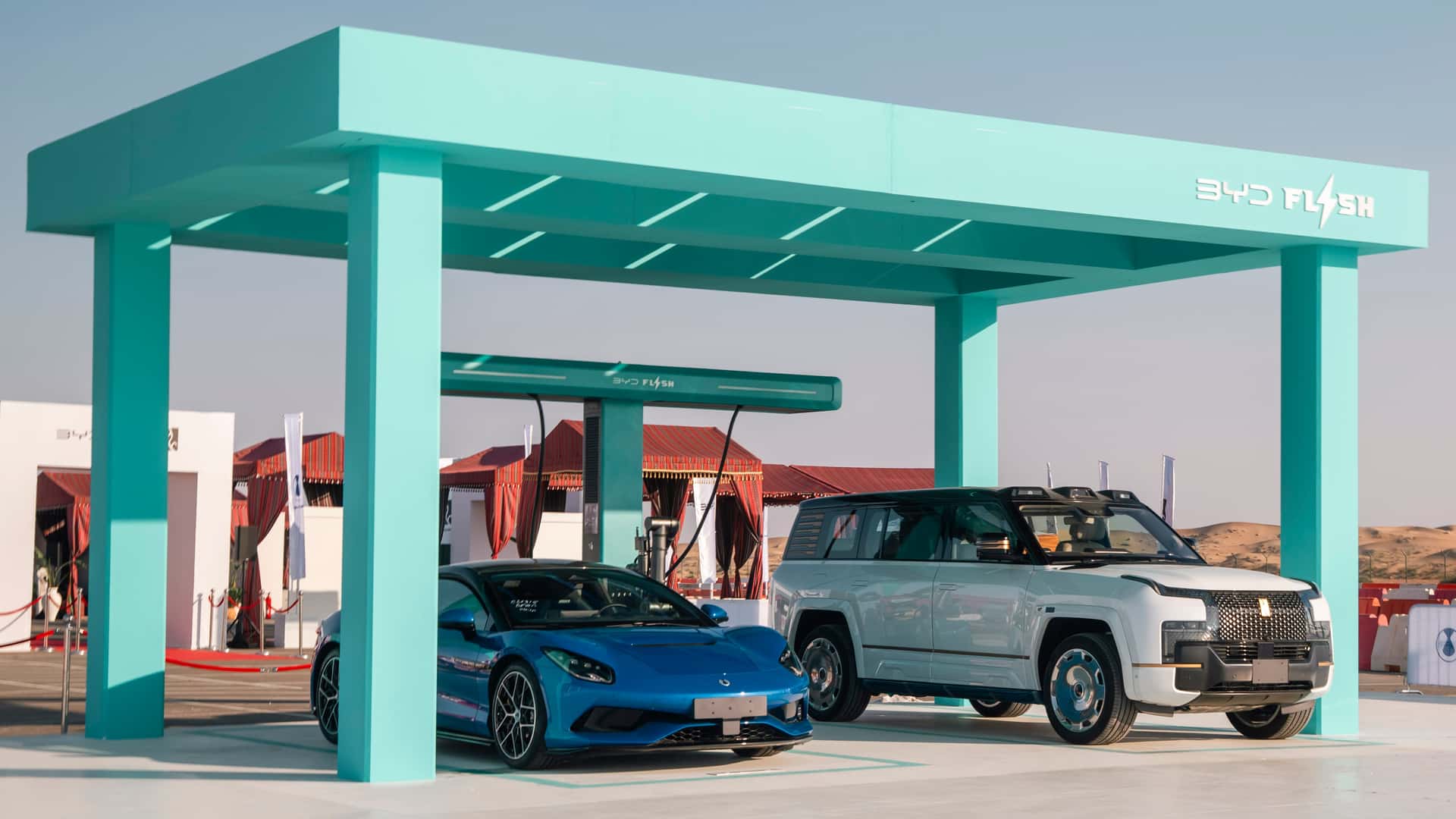
In a significant stride towards advancing electric vehicle (EV) infrastructure, Chinese automotive giant BYD has introduced a groundbreaking charging station prototype designed to operate independently of conventional electricity grids. This innovative system, showcased in the challenging environment of the Abu Dhabi desert, integrates solar panels, battery energy storage, high-speed Flash Charging capabilities, and a robotic arm for automated vehicle connection. This BYD EV charging innovation addresses critical challenges in expanding EV adoption, particularly in areas with limited grid access or unreliable power supply.
The system’s ability to generate and store its own electricity positions it as a potential game-changer for deploying fast-charging solutions in remote locations. It aims to streamline the charging experience, offering a glimpse into the future of autonomous and sustainable electric mobility.

Key Takeaways
- BYD has unveiled an advanced EV charging station combining solar energy, battery storage, and a robotic arm for off-grid, high-speed charging.
- The system is designed to provide fast charging in locations not connected to the main electricity grid, enhancing EV infrastructure accessibility.
- A robotic arm automates the charging process, working synergistically with automated parking for a hands-free user experience.
- While offering impressive Flash Charging speeds, specific off-grid battery capacity and solar output details for the desert installation remain undisclosed.
- BYD plans to deploy 6,000 Flash Charging stations globally by 2027, with Europe and Canada being key expansion regions.
Revolutionising Charging with Renewable Energy and Storage
The core proposition of BYD’s new charging facility is elegantly simple yet profoundly impactful: harness solar energy, store it in high-capacity batteries, and deliver it to electric vehicles via ultra-fast chargers. This integrated approach not only champions renewable energy solutions but also offers a pathway to energy independence for critical EV infrastructure.
The deployment in the Abu Dhabi desert serves as a potent demonstration of the system’s resilience and adaptability. In such environments, traditional grid connections are often prohibitively expensive or logistically complex. The BYD EV charging innovation, therefore, presents a viable and sustainable alternative for developing a robust charging network beyond existing urban centres.
The Role of Battery-Backed Charging in Modern Infrastructure
Battery-backed charging is rapidly becoming a standard feature in high-power charging stations worldwide. This trend is driven by its ability to augment the power delivered to EVs beyond what a direct grid connection might supply, especially during peak demand periods. Furthermore, on-site energy storage helps mitigate strain on the local electricity grid by smoothing out power demands and charging the batteries during off-peak hours.

Leading companies in the EV sector, including Tesla with its Megapack batteries at Supercharger sites, and specialized firms like Electric Era and Beam Global, have embraced battery energy storage systems. BYD’s own Flash chargers, even those connected to the grid, already utilize on-site energy storage to enhance power delivery, underscoring the effectiveness of this technology in optimizing charging efficiency and grid resilience.
Automated Charging and Unprecedented Speed
Central to the user experience of this advanced station is a robotic arm that automates the plugging-in process. This futuristic feature, combined with automated parking systems, transforms EV charging into a hands-free operation. Such autonomous charging technology not only enhances convenience but also lays the groundwork for fully automated parking and charging solutions in smart cities of the future.
The charging hardware itself boasts impressive specifications. Each T-shaped Flash charger is equipped with two 185-kilowatt-hour (kWh) storage batteries, providing a total capacity of 370 kWh. These units can draw power from the grid at rates ranging from 100 to 560 kilowatts (kW) and then unleash significantly higher power to the vehicle, delivering up to 1,500 kW through a single cable or 1,000 kW when both cables are simultaneously in use. This high-power direct current (DC) charging capability positions BYD at the forefront of fast-charging technology.
Unveiling Flash Charging Performance
The speed of BYD’s Flash chargers is a testament to the company’s advancements in both charging infrastructure and battery technology. Compatible electric vehicles featuring BYD’s second-generation Blade battery can achieve a charge from 10% to 70% in a remarkable five minutes, reaching 97% in just nine minutes. This performance is crucial for long-distance travel and rapid turnaround times, making EV ownership more practical and appealing.
A demonstration involving the Denza Z9 GT, an electric wagon, further underscored these capabilities. During the test, the vehicle charged from 10% to 80% in six minutes and 32 seconds, and achieved 97% charge in nine minutes and 22 seconds. Such speeds dramatically narrow the gap between refuelling a conventional internal combustion engine vehicle and charging an EV, addressing a common concern among potential electric car buyers.
Off-Grid Capabilities and Future Implications
The integration of solar panels into the charging equation means that a substantial portion, or potentially all, of the electricity can be generated on-site, offering true grid independence. This makes the BYD EV charging innovation particularly suitable for locations where extending the grid is impractical, such as remote industrial sites, highway rest stops in sparsely populated areas, or disaster relief zones where power infrastructure might be compromised.
However, BYD has not yet disclosed the specific battery capacity or the exact solar output for the Abu Dhabi desert installation. This lack of detailed technical data currently prevents a precise assessment of how many vehicles the station can charge, or how quickly, relying solely on solar power. Further information will be essential for understanding the full off-grid operational scope and economic viability of this advanced system.
Global Expansion of BYD’s Charging Network
BYD’s ambitious plans extend far beyond a single desert installation. The company has announced its intention to establish 6,000 Flash Charging stations worldwide by the close of 2027. This expansive global vision indicates a strong commitment to building a pervasive high-power charging network that can support the accelerating transition to electric mobility. While the company has not specified how many of these future stations will incorporate solar power, off-grid operation, or robotic arms, the initial deployment highlights the technological direction.
The expansion is already underway, with Flash charging sites operational in several European countries, including Italy, Germany, France, and the United Kingdom. Canada is also slated to receive these advanced charging facilities soon. As BYD continues its global market penetration with a growing portfolio of electric vehicles, the development of a robust and innovative charging infrastructure becomes a critical enabler for its worldwide success.
Conclusion
BYD’s new solar-powered, battery-backed, and robot-assisted EV charging station represents a significant leap forward in electric vehicle infrastructure. By addressing the fundamental challenges of grid dependency and charging convenience, this BYD EV charging innovation not only enhances the appeal of electric vehicles but also paves the way for sustainable and accessible electric mobility on a global scale. As these advanced charging solutions roll out worldwide, they are poised to accelerate the adoption of EVs and contribute substantially to a greener transportation future.
FAQ Section
What makes BYD’s new EV charger unique?
BYD’s latest EV charger integrates solar panels, battery energy storage, and a robotic arm, enabling it to operate independently of the electricity grid. This allows for rapid charging even in remote locations, combining renewable energy with autonomous technology for enhanced accessibility and convenience.
How fast can BYD’s Flash Charger charge an EV?
BYD’s Flash Chargers are exceptionally fast. Compatible vehicles equipped with BYD’s second-generation Blade battery can charge from 10% to 70% in just five minutes, and reach 97% in approximately nine minutes, significantly reducing charging times compared to conventional systems.
What is the purpose of the robotic arm in the charging station?
The robotic arm provides an automated, hands-free charging experience. It works in conjunction with automated parking systems to plug the charging cable into the electric vehicle, enhancing convenience and potentially improving safety and efficiency for users.
Can this new BYD charger operate completely off-grid?
Yes, the system is designed with solar panels and battery storage, allowing it to generate and store its own electricity. This enables off-grid operation, making fast charging feasible in areas where a direct connection to the main electricity grid is unavailable or challenging to establish.
What are BYD’s global expansion plans for these charging stations?
BYD plans a substantial global expansion, aiming to establish 6,000 Flash Charging stations worldwide by the end of 2027. These stations are already being deployed in parts of Europe and are soon coming to Canada, indicating a strategic push for broader EV infrastructure.
How much energy storage capacity do BYD’s Flash Chargers have?
Each T-shaped Flash charger unit is connected to two 185 kWh storage batteries, providing a total on-site energy storage capacity of 370 kWh. This battery capacity helps boost power delivery to electric vehicles and manages demand on the grid effectively.
What is the significance of the Abu Dhabi desert location for this deployment?
The Abu Dhabi desert serves as a strategic location to showcase the charger’s off-grid capabilities and resilience in harsh environments. It demonstrates the potential to provide reliable fast charging in areas where traditional grid infrastructure is difficult or costly to implement.