
The Evolving Landscape of Autonomous Driving Technology
For many commuters, the daily grind can feel like an endless chore, especially when navigating complex urban environments. Lucian Capellaro, for instance, faces a tedious daily drive through Laurel Canyon from the San Fernando Valley to Los Angeles’ west end. While colleagues extol the virtues of Tesla’s Full Self-Driving (FSD) feature, allowing their cars to navigate destinations autonomously, Capellaro harbored reservations, preferring alternatives to Tesla due to factors like design, interior quality, and body style.
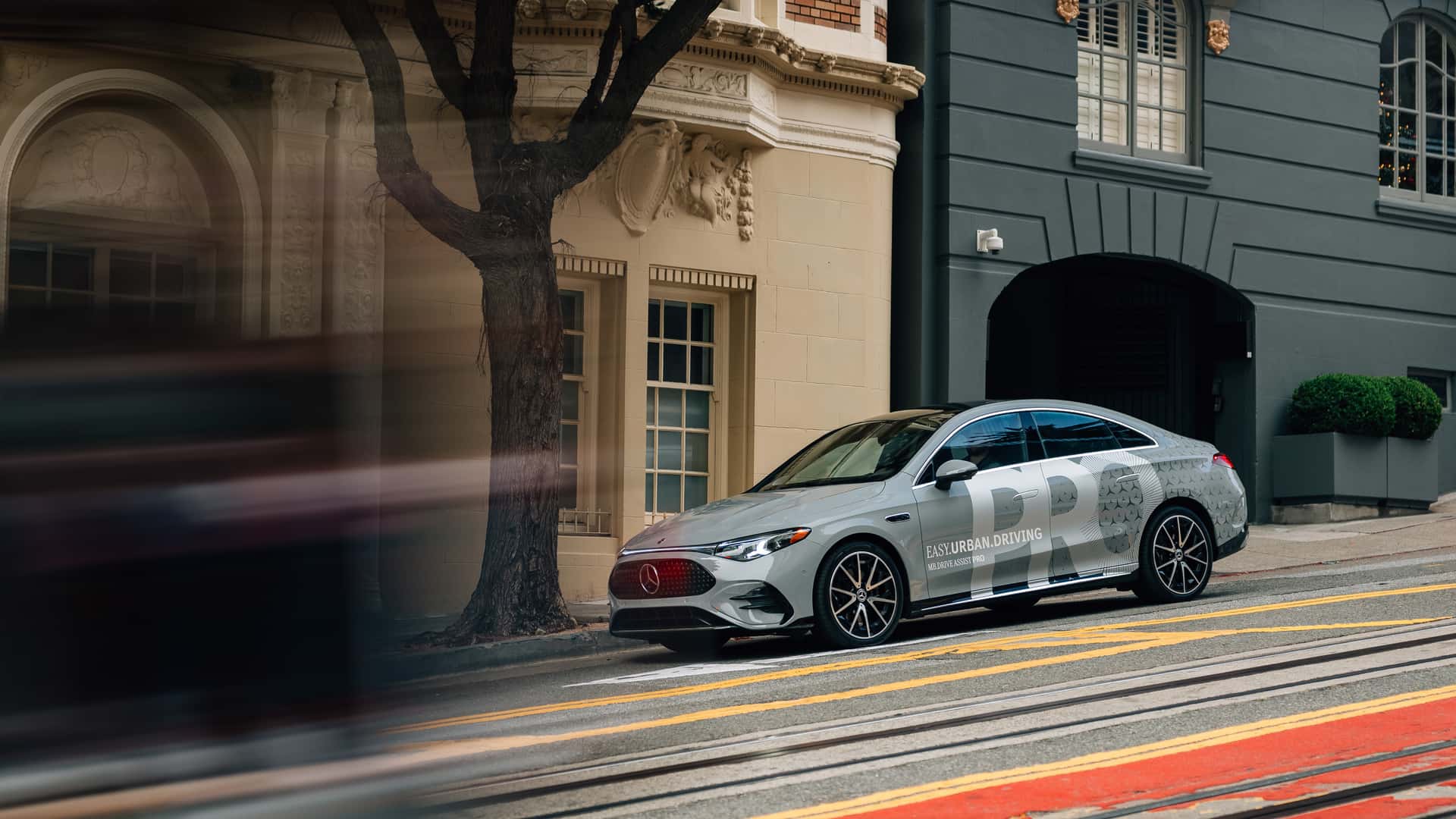
Mercedes-Benz is now poised to offer a compelling alternative. Its MB.Drive Assist Pro point-to-point automated driving system is scheduled for deployment in a significant number of the brand’s electric and internal combustion vehicles starting early next year. Owners of already-purchased eligible vehicles will be able to integrate this advanced system through an over-the-air update, signaling a major stride in the development of sophisticated driver assistance systems.
Mercedes MB.Drive Assist Pro: A Hands-On Approach to Autonomy
The introduction of Mercedes MB.Drive Assist Pro brings a new dynamic to the burgeoning field of autonomous driving technology. Similar to Tesla’s Full Self-Driving (Supervised) feature, the Mercedes system enables drivers to input a destination, allowing the vehicle to navigate and park itself. However, a crucial distinction sets the two systems apart, especially concerning operation on surface streets.
While MB.Drive Assist Pro, much like FSD, supports hands-free operation on controlled-access highways, it mandates that drivers maintain a hand on the steering wheel when traversing surface streets. This hands-on requirement on city roads is not indicative of the system’s inferiority but rather a reflection of Mercedes’ foundational philosophy regarding autonomous driving levels.
Adhering to SAE Autonomy Levels and Driver Responsibility
Mercedes-Benz’s decision to implement a hands-on requirement on urban roads is deeply rooted in its strict adherence to the Society of Automotive Engineers (SAE) definitions for autonomous driving levels. Both MB.Drive Assist Pro and Tesla FSD (Supervised) are classified as Level 2 systems, which Mercedes sometimes refers to as “Level 2 Plus Plus.” This classification inherently means the driver must supervise the system at all times and remains ultimately responsible for the vehicle’s operation.
The distinction between Level 2 and Level 3 autonomy is a significant one. Level 3 systems allow the driver to disengage from driving tasks under specific conditions, such as watching a movie or reading, with the vehicle assuming responsibility. Conversely, Level 2 systems demand constant driver oversight.
Jörg Burzer, Mercedes Chief Technology Officer, articulated this philosophical boundary: “There is a very important borderline between the levels. That borderline is that with Level 2 Plus Plus, you are responsible. At Level 3, the machine, the car, the software stack, is responsible.” This emphasis on driver accountability informs Mercedes’ design choices for its advanced driver assistance systems.
Navigating the Complexities of Urban Environments
The rationale behind Mercedes’ hands-on requirement on surface streets stems from the inherent complexities of urban driving. Controlled-access highways generally present fewer variables and more predictable conditions for autonomous systems to manage. In contrast, surface streets are characterized by a higher degree of chaos and unpredictability, involving pedestrians, cyclists, varied traffic laws, and dynamic road conditions.
According to Burzer, these complex scenarios necessitate continued driver engagement. This perspective resonates with some drivers, including Lucian Capellero, who, despite being a motorcycle rider, acknowledges the importance of quick reaction times. “Think about the reaction time it must be for someone to take their hands from off the wheel to on the wheel,” he commented. “I’d view my hand on the wheel as lessening the seconds of reaction time to something crazy happening.”
Mercedes’ customer research, particularly in Europe, supports this cautious approach. Burzer noted, “In the city, they like to have something, some regulation or some requirement that you have to have a hand on the wheel,” though he acknowledged uncertainty regarding U.S. customer preferences. When pressed on why a customer might choose Mercedes’ system over Tesla’s hands-off urban driving capability, Burzer consistently returned to regulatory interpretations and SAE autonomy levels, hinting at a future Level 3 system for truly hands-off operation anywhere.
User Perspectives: Hands-On Versus Hands-Off Driving
The philosophical divide between Mercedes and Tesla on driver engagement leads to varied reactions among users of advanced self-driving features. Many Tesla FSD users already perceive their vehicles as achieving a higher degree of autonomy than Mercedes’ Level 2 interpretation suggests, largely dismissing strict adherence to SAE definitions in favor of real-world functionality.
Antonio Hidalgo, a Los Angeles resident and frequent FSD user, exemplifies this sentiment. He recounted occasions where he could take a nap while driving, noting that system flaws are now primarily limited to parking. For Hidalgo, the prospect of switching to a Mercedes system that requires hands-on control on city streets, even in a more luxurious car, was not appealing: “If the (Mercedes system) worked the same but I had to keep my hand on the wheel … You know, I probably wouldn’t (make the switch). I mean, I think I would be interested in having a nicer car with a better interior. But no.”
Mharlon Barrientos, an FSD user in Indianapolis, echoed this perspective. After initially hovering his hand over the wheel, system updates and experience have allowed him to drive completely hands-off in urban settings. He states, “Having a hand on the wheel as a requirement would be a bit of a step back to the feel of full autonomous driving that I’ve gotten used.” His previous Model Y version also required a hand on the wheel, highlighting a regression in perceived autonomy if he were to switch to Mercedes’ current offering.
Technological Approaches: Sensor Fusion vs. Camera-Centric Systems
Beyond the philosophical differences, Mercedes-Benz distinguishes its MB.Drive Assist Pro through its multi-faceted sensor suite. While Tesla’s FSD (Supervised) primarily relies on cameras to perceive its environment, Mercedes employs a more redundant approach, integrating five radar sensors and 12 ultrasonic sensors alongside cameras to feed raw data to its Nvidia-powered onboard computer.
Christoph von Hugo, Mercedes’ Head of Active Safety, emphasized the enhanced performance and safety benefits of this sensor fusion. He subtly critiqued singular reliance on cameras, stating, “Different sensor inputs increases performance and safety.” Von Hugo added that Mercedes intends to incorporate LiDAR technology, in addition to cameras, radar, and ultrasonic sensors, before progressing to Level 3 capability. Notably, Mercedes had briefly offered a Level 3 system in the U.S. which has since been phased out, indicating their cautious and evolving strategy.
However, the technological sophistication alone may not be the primary driver for consumer adoption. Mharlon Barrientos noted that the underlying technology is not a significant selling point on its own. “I honestly haven’t even thought about the tech behind it, so I’m not so sure knowing that there’s radar and ultra-sonic sensors (on the window sticker) would be a huge selling point,” he said. He believes that real-world performance and trust built over mileage would ultimately sway his decision.
Future Outlook and Consumer Acceptance
Despite the differing approaches, consumer loyalty to existing systems is not absolute. Barrientos, for example, is not inextricably linked to Tesla or FSD. He articulated that while FSD’s functionality is appreciated, it ranks lower than overall vehicle attributes such as functionality, comfort, and value. He still values the tactile experience of driving, stating, “I still like to feel the mechanics and have the feel of actually driving a car.” This sentiment suggests that a compelling overall package from Mercedes, even with the hands-on requirement, could attract some drivers.
Lucian Capellero remains open to experiencing MB.Drive Assist Pro firsthand. He pondered its potential advantages over his wife’s BMW i4, which offers adaptive cruise control and hands-free highway driving in traffic jams. If the Mercedes system can competently navigate the challenging routes like Laurel Canyon with minimal driver intervention—requiring only a hand resting on the wheel—he finds the prospect of true point-to-point navigation appealing.
The critical question remains whether MB.Drive Assist Pro can deliver performance comparable to Tesla FSD, even with its hands-on urban driving stipulation. Early passenger-seat experiences in San Francisco offered promising insights, but a comprehensive review is anticipated. The debate over whether a hands-on requirement ultimately enhances safety or detracts from the autonomous driving experience will continue to shape consumer perceptions and the future trajectory of driver assistance technologies.
Frequently Asked Questions (FAQ)
What is Mercedes MB.Drive Assist Pro?
Mercedes MB.Drive Assist Pro is an advanced point-to-point automated driving system designed to navigate and park vehicles. It is set to be rolled out in many Mercedes electric and internal combustion models starting early next year, with over-the-air updates for eligible existing vehicles.
How does MB.Drive Assist Pro differ from Tesla’s Full Self-Driving (FSD)?
The primary difference is the hands-on requirement. While both systems offer hands-free driving on controlled-access highways, MB.Drive Assist Pro mandates drivers keep a hand on the wheel when operating on surface streets, a distinction not strictly enforced by Tesla FSD (Supervised).
Why does Mercedes require hands on the wheel for city driving?
Mercedes adheres strictly to SAE Level 2 autonomy definitions, which classify MB.Drive Assist Pro as a driver-supervised system. Due to the high complexity and unpredictability of urban environments, Mercedes maintains that drivers must remain engaged and responsible, hence the hands-on requirement on city streets.
What are SAE levels of autonomous driving?
The Society of Automotive Engineers (SAE) defines six levels of driving automation from 0 (no automation) to 5 (full automation). Level 2 systems require continuous driver supervision, while Level 3 allows for conditional hands-off driving, with the vehicle taking responsibility under specific conditions.
What sensors does MB.Drive Assist Pro use?
MB.Drive Assist Pro employs a comprehensive sensor suite for environmental perception. It utilizes cameras, five radar sensors, and 12 ultrasonic sensors. This multi-sensor approach is designed to enhance performance and safety by providing redundant data inputs to the vehicle’s Nvidia-powered computer.
Will existing Mercedes vehicles be able to get MB.Drive Assist Pro?
Yes, Mercedes plans to enable MB.Drive Assist Pro functionality on already-purchased eligible vehicles through over-the-air updates. This allows a broader range of current Mercedes owners to access the new autonomous driving features once available.
How do users of Tesla FSD view the hands-on requirement?
Many current Tesla FSD users express skepticism or disinterest in a system that requires hands-on control for city driving. They often report being accustomed to a hands-off experience in urban settings and prioritize perceived autonomy over strict adherence to technical definitions, potentially making a switch less appealing.