
While much of the public discourse around electric vehicles (EVs) often centres on battery technology and range, the sophisticated electric motors propelling these vehicles are equally crucial and diverse. These aren’t monolithic components; instead, automakers deploy a variety of designs, each meticulously engineered to balance efficiency, performance, packaging constraints, and cost considerations. Understanding the nuances of different EV motor types is key to appreciating the engineering marvels beneath the sleek exteriors of modern electric cars.
The fundamental distinction among these motors lies in how their rotating component, the rotor, generates its magnetic field. Some motors rely on permanent magnets for this crucial function, while others achieve magnetism through electrically powered coils or the principle of induction. While magnetism underpins all electric motor operation, the methods of its generation and utilisation vary significantly, impacting an EV’s characteristics.
Key Takeaways
- EV motors are not uniform; distinct types offer varied balances of efficiency, performance, and cost.
- The primary difference in EV motor types is how the rotor generates its magnetic field: via permanent magnets, electrical excitation, or induction.
- Permanent-Magnet Synchronous Motors (PMSMs) offer high efficiency and power density but rely on costly rare earth elements.
- Induction Motors are robust, cost-effective, and avoid rare earths, but are generally less efficient and have lower power density than PMSMs.
- Electrically Excited Synchronous Motors (EESMs) provide adjustable magnetic fields, offering excellent control and avoiding rare earths, though at the cost of added complexity and energy for excitation.
- Many modern all-wheel-drive EVs combine different motor types to optimise performance, efficiency, and resource independence.
The Core Mechanism: How Electric Motors Propel EVs
At the heart of every electric vehicle’s propulsion system is the electric motor, a device that transforms electrical energy into mechanical motion. This fundamental transformation is governed by the interaction of magnetic fields. Despite their varied designs, all EV motors share a common architectural foundation.
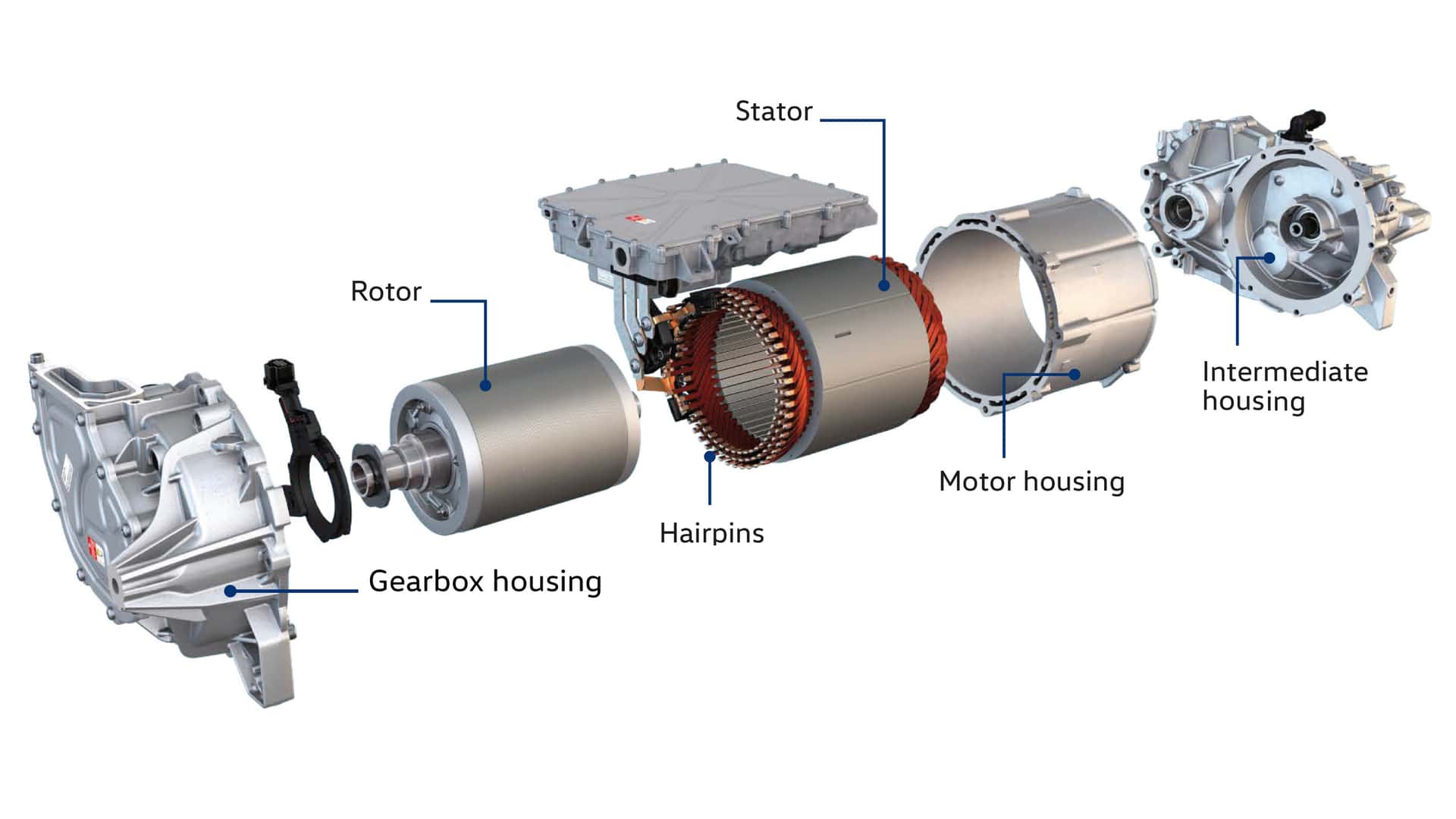
An EV motor comprises two primary components: the stationary outer section known as the stator and the rotating inner section called the rotor. The rotor is mechanically linked to a shaft, which transmits power to the vehicle’s wheels, typically through reduction gearing. The motor receives direct current (DC) power from the high-voltage battery pack.
Crucially, an inverter unit converts this DC into precisely controlled alternating current (AC). This AC is then fed into the coils of the stator in a carefully timed sequence, generating a powerful, rotating magnetic field. The rotor, guided by its own magnetic field, continuously follows this moving magnetic force, thereby producing the rotational motion necessary to drive the vehicle.

The term ‘synchronous’ describes motors where the rotor spins in perfect unison with the stator’s rotating magnetic field. Both permanent-magnet and electrically excited motors fall into this category. In contrast, induction motors operate with a slight speed differential, or ‘slip,’ between the stator’s magnetic field and the rotor’s rotation.
Permanent-Magnet Synchronous Motors (PMSMs): Efficiency at a Cost
The Permanent-Magnet Synchronous Motor (PMSM) stands out as one of the most prevalent EV motor types. In this design, powerful permanent magnets are either surface-mounted or embedded within the rotor structure. These magnets inherently provide the rotor’s magnetic field, requiring no external electrical input to maintain their magnetism.
The principle of operation is elegantly simple: the stator’s externally powered, rotating magnetic field exerts a continuous pull on the rotor’s permanent magnets, compelling the rotor to spin in synchronisation. This direct and unwavering magnetic interaction is a cornerstone of the PMSM’s high performance.
A significant advantage of PMSMs is their exceptional efficiency and power density. They can generate substantial power from a relatively compact and lightweight package, making them ideal for the main drive motors in many electric vehicles. Their efficiency benefits from the fact that no electrical energy is expended to create the rotor’s magnetic field, thereby avoiding resistive losses associated with powering rotor windings.
However, this superior performance often comes with a geopolitical and environmental caveat. The powerful magnets used in these motors typically incorporate rare earth elements, such as neodymium and dysprosium. The extraction and processing of these materials raise environmental concerns, and their sourcing can expose manufacturers to supply chain vulnerabilities and significant price volatility, reflecting their strategic importance and concentrated global supply.
Induction Motors (Asynchronous Motors): Robust and Resource-Independent
Also known as asynchronous motors, induction motors present an alternative design that foregoes permanent magnets on the rotor. Instead, their rotors contain conductive bars, typically made of copper or aluminium, which are connected at both ends by rings. This characteristic configuration often leads to the informal moniker of a ‘squirrel cage’ rotor, owing to its resemblance to a rodent’s exercise wheel.
The operational principle of an induction motor is based on electromagnetic induction. As the stator’s rotating magnetic field sweeps past the rotor’s conductive bars, it induces an electric current within them. This induced current, in turn, creates the rotor’s own magnetic field. The interaction between the stator’s field and the rotor’s induced field then generates torque, driving the rotor.
A distinctive feature of induction motors is the necessity of ‘slip.’ The rotor must always turn slightly slower than the stator’s magnetic field. This difference in speed is crucial for inducing the current in the rotor bars that generates its magnetic field. If the rotor were to catch up completely with the stator’s field, the relative motion required for induction would cease, and no torque would be produced.
Induction motors boast several advantages, including their robust construction and the complete absence of rare-earth magnets, mitigating the environmental and supply chain concerns associated with PMSMs. Furthermore, when unpowered, an induction motor can spin with minimal drag, which is a key attribute in certain multi-motor configurations.
The trade-off for these benefits is generally lower efficiency and power density compared to PMSMs, particularly under varying load conditions. Generating current within the rotor bars inevitably produces resistive heat, leading to energy losses. Despite this, induction motors remain a popular choice for specific roles in multi-motor setups.
For instance, in many all-wheel-drive EVs, induction motors are strategically employed on the less frequently engaged axle, often the front. This setup allows for efficient primary propulsion from a permanent-magnet motor on the main drive axle, with the induction motor providing additional power and traction on demand, while disengaging with minimal drag when not required. Manufacturers like Audi, Tesla, and General Motors have successfully implemented this strategy in various EV models.
Electrically Excited Synchronous Motors (EESMs): Adjustable Magnetism and Control
The Electrically Excited Synchronous Motor (EESM) represents a third significant category of EV motor types, offering a sophisticated balance between efficiency and resource independence. Unlike PMSMs, EESMs do not rely on permanent magnets. Instead, their rotor carries coils that are supplied with electricity, effectively transforming the rotor into an electromagnet.
The core innovation here is the ability to precisely control the strength of the rotor’s magnetic field by adjusting the electrical current fed to its coils. This dynamic adjustability provides engineers with an additional degree of freedom to optimise motor operation across a wide range of speeds and loads. The term ‘excited’ simply refers to the rotor being energised by electricity, forming a controllable magnetic pole.
This design inherently avoids the use of rare earth elements, addressing critical supply chain and environmental considerations. EESMs can be designed to achieve high efficiencies, particularly noteworthy for their ability to maintain strong performance even at very high rotational speeds. This makes them attractive for applications demanding consistent power delivery across a broad operational spectrum.
The main trade-offs for EESMs include increased complexity due to the need for a mechanism to supply electricity to the rotating rotor coils (e.g., slip rings and brushes, though modern designs often employ brushless excitation systems). Furthermore, the energy consumed to excite the rotor’s magnetic field represents an additional loss mechanism compared to PMSMs, although this can be offset by the gains from optimised control.
Leading automakers are embracing EESMs for their strategic advantages. BMW, for example, has integrated these motors into its latest sixth-generation EV powertrains, citing their energy efficiency in everyday driving and robust power delivery at high RPMs. Similarly, Renault has opted for EESMs in vehicles like the Renault 5 E-Tech, explicitly highlighting the reduced reliance on rare earths and external magnet suppliers as a key driver for this choice.
Strategic Combinations: Optimising Performance and Resources
The existence of diverse EV motor types is not merely an academic exercise; it underpins the intelligent engineering choices made by automakers to deliver optimal performance, efficiency, and sustainability. Rather than confining themselves to a single motor technology, many electric vehicles employ hybrid motor architectures, combining different types to leverage their respective strengths.
The Audi Q6 E-tron Quattro serves as a prime example of this strategic blending. It features a permanent-magnet synchronous motor on the rear axle, which serves as the primary propulsion unit, capitalising on its high efficiency for routine driving. Complementing this, an induction motor is placed on the front axle, providing additional power and all-wheel-drive traction when required, while offering minimal drag when inactive.
This approach highlights a nuanced understanding of vehicle dynamics and energy management. The PMSM delivers consistent, efficient power, while the induction motor offers a cost-effective, rare-earth-free solution for auxiliary propulsion, disengaging smoothly to conserve energy. This hybrid strategy allows automakers to tailor an EV’s power delivery to specific driving conditions, optimising both performance and range.
Another innovative combination can be seen in certain BMW all-wheel-drive setups, which pair an electrically excited synchronous motor on the rear axle with a front induction motor. This configuration further underscores the flexibility in motor selection, aiming to achieve high overall efficiency and dynamic performance without dependence on rare earth elements.
Even among vehicles utilising primarily permanent-magnet motors, intelligent design choices are made to mitigate potential drawbacks. Some new Mercedes-Benz EVs, for instance, employ a permanent-magnet front motor but incorporate a mechanical disconnection mechanism. This system allows the front motor to be decoupled from the wheels when not needed, effectively eliminating the drag and associated energy losses that would occur if it were passively spinning, thereby significantly enhancing overall efficiency.
The continuous evolution in EV motor types reflects an ongoing pursuit of engineering excellence. Automakers are not just focused on maximising power but also on optimising energy use, reducing material costs, and fostering resource independence. As electric mobility expands, the variety of motor designs will continue to play a pivotal role in shaping the capabilities and sustainability of future EVs.
Frequently Asked Questions About EV Motor Types
What are the primary EV motor types?
The main EV motor types are Permanent-Magnet Synchronous Motors (PMSMs), Induction Motors (also known as Asynchronous Motors), and Electrically Excited Synchronous Motors (EESMs). Each type differs in how its rotor creates a magnetic field, impacting efficiency, performance, and material use.
Why do some EVs use permanent magnets?
Permanent-Magnet Synchronous Motors (PMSMs) are highly efficient and offer excellent power density, meaning they can produce significant power from a compact, lightweight unit. They are often chosen for main drive motors due to their strong performance across various speeds.
What are the benefits of Induction Motors in EVs?
Induction Motors are robust, cost-effective, and do not use rare earth elements, making them environmentally and geopolitically advantageous. They also exhibit very low drag when not powered, making them suitable for auxiliary roles in all-wheel-drive configurations.
How do Electrically Excited Synchronous Motors (EESMs) work?
EESMs use electrical current to create an adjustable electromagnet on their rotor, rather than relying on fixed permanent magnets. This allows for dynamic control over the magnetic field strength, optimising efficiency and performance across different operating conditions, while also avoiding rare earths.
Why do some EVs combine different motor types?
Automakers combine different EV motor types to capitalise on their unique strengths and mitigate weaknesses. For example, pairing a highly efficient PMSM with a low-drag induction motor in an all-wheel-drive setup can optimise overall efficiency, performance, cost, and resource independence.
Are rare earth elements essential for all EV motors?
No, rare earth elements are not essential for all EV motor types. While Permanent-Magnet Synchronous Motors typically rely on them for high performance, Induction Motors and Electrically Excited Synchronous Motors are designed to operate without any rare earth materials, offering more sustainable alternatives.
Which EV motor type is the most efficient?
Permanent-Magnet Synchronous Motors (PMSMs) are generally considered highly efficient due to their inherent magnetic field, avoiding excitation losses. However, Electrically Excited Synchronous Motors (EESMs) can also achieve high efficiency, especially when their adjustable magnetic field is precisely controlled for optimal operation across various speeds and loads.