
Key Takeaways
- BYD has introduced a pioneering electric vehicle (EV) charging station that integrates solar power, substantial battery storage, and advanced Flash Charging technology.
- This system, demonstrated in the Abu Dhabi desert, is engineered for potential off-grid operation, making high-speed EV charging accessible in locations lacking robust grid connections.
- A robotic arm streamlines the charging process, automating vehicle plug-in and working in conjunction with parking systems for a hands-free user experience.
- Each BYD Flash Charger unit is supported by 370 kilowatt-hours (kWh) of on-site battery storage, capable of delivering up to 1,500 kW to compatible EVs.
- While BYD plans 6,000 Flash Charging stations globally by 2027, the specific technical details and off-grid capabilities of individual installations, like the desert prototype, remain partially undisclosed.
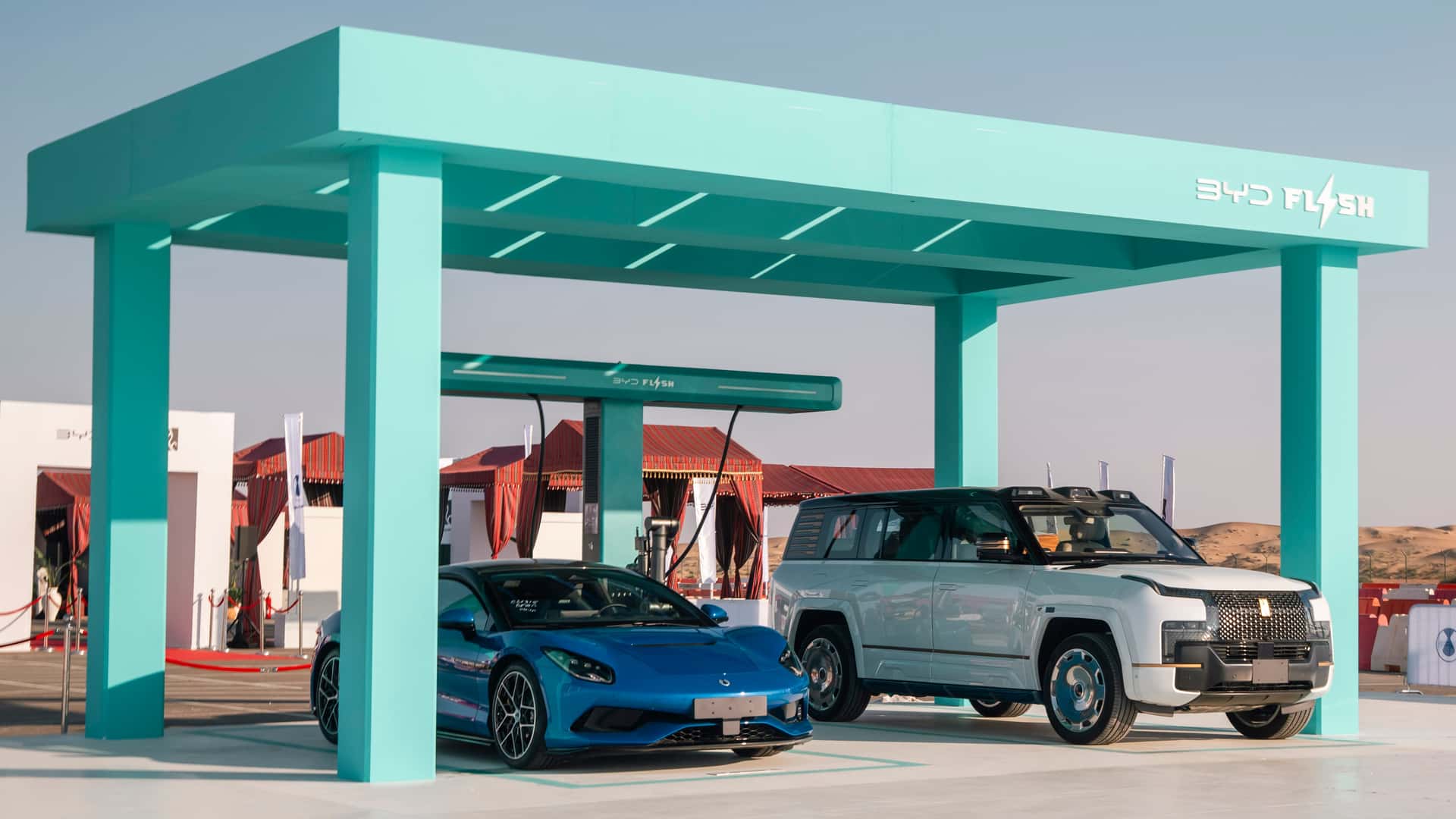
In a significant advancement for electric vehicle infrastructure, automotive giant BYD has unveiled a groundbreaking charging station designed to operate independently of conventional electricity grids. This innovative system combines high-capacity solar panels, sophisticated battery storage, ultrafast Flash Charging capabilities, and an autonomous robotic arm to deliver power. The prototype, showcased in the demanding environment of the Abu Dhabi desert, represents a strategic move to address the critical challenge of providing rapid EV charging in remote or underserved areas where grid connectivity is either unreliable or non-existent.
BYD’s latest offering reimagines the traditional charging model, offering a self-sustaining ecosystem for electric mobility. By harnessing renewable energy and efficient storage, the company aims to democratise access to fast charging, ensuring that the transition to electric vehicles is not constrained by existing energy infrastructure limitations. This development could fundamentally alter how EV charging networks are deployed globally, extending their reach far beyond urban centres.

Revolutionising Charging: Solar Power, Battery Storage, and Automation
The core principle behind BYD’s new charging hub is elegantly simple yet technologically complex. Solar panels capture sunlight, converting it into electricity, which is then stored in large-scale battery banks. This stored energy powers the Flash Charger units, delivering a consistent and powerful charge to electric vehicles. This setup provides an essential buffer, allowing the station to mitigate fluctuations in solar generation and manage peak demand efficiently.
The integration of a robotic arm elevates the user experience by automating the physical connection between the charger and the vehicle. This hands-free operation enhances convenience and could potentially integrate seamlessly with future autonomous parking systems, further streamlining the charging process. This automation not only improves efficiency but also addresses potential ergonomic challenges for drivers, making EV charging more accessible and user-friendly for a wider demographic.
The Strategic Imperative for Battery-Backed Charging
Battery-backed charging solutions are increasingly becoming a cornerstone of modern EV infrastructure, and for good reason. These systems enable charging stations to provide higher power outputs than their direct grid connections might otherwise permit. This is particularly crucial for ultra-fast charging, which demands substantial instantaneous power that existing grids in many locations may struggle to supply consistently without significant upgrades.

Furthermore, on-site energy storage helps in load management, reducing the strain on the grid during periods of high electricity demand. By drawing power from the grid during off-peak hours and discharging from batteries during peak times, these stations can optimise energy consumption and potentially lower operational costs. Industry leaders like Tesla, with its Megapack batteries at major Supercharger sites, and specialised companies such as Electric Era and Beam Global, are actively deploying similar battery-assisted charging solutions, underscoring the growing importance of this technology in scaling EV charging infrastructure.
Unpacking BYD Flash Charging Capabilities and Speed
BYD’s Flash Charging technology is central to the station’s high-speed capabilities. Each T-shaped Flash Charger is equipped with two 185 kWh storage batteries, aggregating to a substantial 370 kWh of total on-site energy storage. These units are designed to draw power from the grid within a range of 100 to 560 kilowatts (kW), but critically, they can deliver power to vehicles at a significantly higher rate.
The chargers boast an impressive maximum output of up to 1,500 kW when utilising a single charging cable. Even when two cables are simultaneously engaged, the system can still deliver up to 1,000 kW, showcasing its robust capacity for concurrent high-speed charging. Such power levels are among the highest in the industry, marking a significant stride in reducing charging times to durations comparable to traditional fuel-ups.
Unprecedented Charging Speed for Compatible EVs
For electric vehicles equipped with BYD’s cutting-edge second-generation Blade battery technology, the Flash Chargers offer remarkable performance. Compatible cars can achieve a charge from 10% to 70% in an astonishing five minutes. Pushing the charge further, these vehicles can reach 97% battery capacity in just nine minutes. These figures highlight BYD’s commitment to overcoming range anxiety and convenience concerns, making long-distance EV travel more feasible and less time-consuming.
A recent demonstration involving the Denza Z9 GT, currently the only vehicle sold in Europe capable of fully leveraging the Flash Charger’s immense power, underscored these capabilities. During the test, the electric wagon charged from 10% to 80% in a mere six minutes and 32 seconds, reaching 97% in nine minutes and 22 seconds. This real-world performance validates the transformative potential of BYD Flash Charging in mainstream electric mobility.
Global Expansion and Addressing Energy Challenges
BYD has articulated an ambitious vision for the global deployment of its Flash Charging network. The company aims to establish approximately 6,000 Flash Charging stations worldwide by the close of 2027. This aggressive expansion plan signals BYD’s intent to become a dominant player in the global EV charging infrastructure market, moving beyond its strong vehicle manufacturing base.
However, the specific composition of these upcoming stations remains somewhat flexible. BYD has not yet clarified how many of these planned stations will incorporate the full suite of features, including integrated solar power generation, dedicated off-grid operation capabilities, or the robotic charging arm. This nuanced approach suggests that the company may tailor deployments to regional needs and existing infrastructure, providing flexibility in its global rollout strategy.
The Promise of Off-Grid Charging for Remote Accessibility
The ability of these new BYD Flash Charging stations to potentially operate independently of the electricity grid holds profound implications, particularly for regions with underdeveloped or unreliable power infrastructure. Imagine remote highways, national parks, or developing regions suddenly gaining access to rapid EV charging, completely independent of costly and time-consuming grid extensions.
The Abu Dhabi desert installation serves as a powerful proof of concept for this vision. While BYD has yet to disclose the precise battery capacity and solar output specifics for this particular desert site, which would clarify its full off-grid operational capacity, the underlying technology points towards a future where charging access is not dictated by proximity to a power line but by the availability of sunlight and sufficient battery storage.
Market Presence and Future Outlook
BYD’s Flash Charging infrastructure is already making inroads into key international markets. European countries, including Italy, Germany, France, and the United Kingdom, have seen the deployment of these advanced charging sites. This expansion into Europe positions BYD not just as an EV manufacturer but as a comprehensive e-mobility solutions provider, competing directly with established charging network operators.
Canada is also slated to receive BYD Flash Charging stations in the near future, indicating a broad North American strategy. As more compatible vehicles like the Denza Z9 GT become available in these markets, the full benefits of this ultra-fast charging technology will be realised by a growing number of EV owners, solidifying BYD’s reputation for innovative and practical electric mobility solutions.
Challenges and Technical Ambiguity
Despite the revolutionary aspects of BYD’s new off-grid Flash Charging station, certain technical details remain undisclosed. Specifically, the company has not provided comprehensive figures regarding the total battery storage capacity or the peak solar power output of the Abu Dhabi desert installation. This lack of detailed information makes it challenging to fully assess the station’s sustained off-grid performance, including the number of vehicles it can charge consecutively or the speed at which it can replenish its internal battery banks solely through solar generation.
Understanding these specifics is crucial for evaluating the economic viability and practical scalability of such fully independent charging hubs. Future disclosures from BYD will likely shed more light on these aspects, offering a clearer picture of the long-term potential and operational parameters of these cutting-edge EV charging solutions.
Frequently Asked Questions (FAQ)
What is BYD’s new EV charging innovation?
BYD has introduced an advanced EV charging station that combines solar panels, high-capacity battery storage, Flash Charging technology, and a robotic arm. This system is designed to potentially operate off-grid, providing fast charging capabilities even in locations without a strong connection to the main electricity network.
How does the off-grid capability work?
The system harnesses solar energy via integrated panels, storing the generated electricity in large battery banks. This stored power then fuels the Flash Chargers. This setup allows the station to function independently, mitigating reliance on the grid and making high-speed charging feasible in remote areas or during power outages.
What role does the robotic arm play?
The robotic arm automates the physical plugging-in of the charging cable to the electric vehicle. This feature enhances user convenience, reduces manual effort, and offers a hands-free charging experience, potentially integrating with future autonomous parking systems for seamless operation.
How fast is BYD Flash Charging?
BYD’s Flash Chargers can deliver up to 1,500 kW using a single cable or 1,000 kW with two cables simultaneously. Compatible EVs with second-generation Blade batteries can charge from 10% to 70% in just five minutes and reach 97% capacity in nine minutes, significantly reducing charging times.
What is the battery capacity of the BYD Flash Charger units?
Each T-shaped BYD Flash Charger is connected to two 185 kilowatt-hour (kWh) storage batteries, providing a total of 370 kWh of on-site energy storage. This substantial capacity enables the delivery of high power outputs to electric vehicles even when the grid connection is limited.
Where is BYD planning to deploy these stations?
BYD plans to establish 6,000 Flash Charging stations worldwide by the end of 2027. These stations are already being deployed in Europe (Italy, Germany, France, UK) and are slated for Canada, demonstrating a significant global expansion strategy for its advanced EV charging infrastructure.