
Welcome back to Critical Materials, your daily roundup for all things electric and tech in the automotive space.
One note for our regular readers: Starting next Monday, February 9, the full Critical Materials roundup will only be available as a newsletter. Sign up below to get our EV news and analysis in your inbox each morning.
Get Critical Materials in your inbox.
The must-read auto and tech briefing, every weekday.
Sign up here.
On today’s agenda: Tesla launched a new, cheaper Model Y—but is it enough? Plus, Volvo anticipates its electric vehicles will soon be more affordable than gasoline cars, and Rivian’s robotics venture is beginning to take shape.
Tesla’s Strategy: Doubling Down on the Model Y
Tesla’s response to a dip in sales over the past couple of years has largely centered on introducing new variations of its best-selling vehicle, the Model Y. This strategy is understandable, given the crossover’s status as Tesla’s top seller and the most popular electric vehicle globally. However, questions linger about how sustainable this approach is for long-term growth.

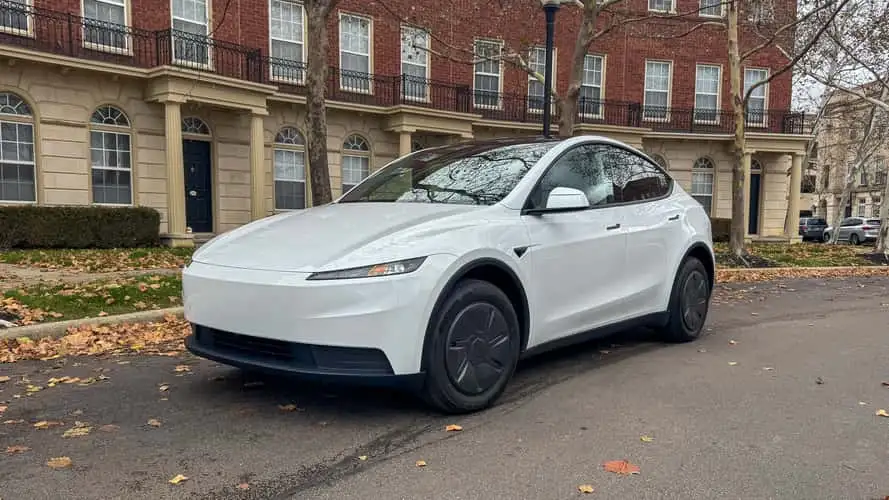
Last year saw Tesla launch its first refresh of the Model Y, aiming to stimulate sales, and introduce a larger Model YL in China. In October, the company unveiled what it described as “new” and “more affordable” models. These “Standard” versions of the Model 3 and Model Y featured less premium materials and omitted the FM radio. The Model Y variant also received styling adjustments.
In January, the automaker reintroduced a seven-seat Model Y to the U.S. market. This week, Tesla quietly began offering an all-wheel-drive version of this more accessibly priced Model Y, dropping the “Standard” designation. The Model Y All-Wheel Drive is priced at $41,990 and offers an EPA-estimated range of 294 miles.
Industry analysts express skepticism that a proliferation of Model Y trims can sustain Tesla’s market relevance. They argue that the company needs entirely new models. Data supports this view: despite these efforts, Tesla’s global vehicle deliveries fell by 8.6% last year, impacting revenue. The addition of all-wheel drive to this new Model Y trim, compared to the original single-motor “Standard” cars, could potentially provide a sales boost.
CEO Elon Musk has indicated that Tesla’s future may lie beyond being solely a car company, citing the reallocation of resources from the Model S and X to focus on Optimus robot production. Paradoxically, Tesla’s latest earnings report also states the company’s belief that it can “win the autos market of the future,” a goal that appears at odds with its current Model Y-centric strategy.
Volvo Predicts EV Price Parity with Gas Cars Within Five Years
The automotive industry is closely watching for “price parity,” the point at which electric vehicles become cost-competitive with traditional gasoline cars. In China, plug-in vehicles are already cheaper than their gasoline counterparts, contributing to “new energy vehicles” capturing over 50% market share. Norway has also seen a similar trend, with generous incentives making EVs highly attractive, leading to a near-extinction of new gasoline vehicle sales.
While the U.S. and Europe have not yet reached this milestone, Volvo’s CEO anticipates it is on the horizon. Håkan Samuelsson recently informed reporters that EVs would “probably” cost less than combustion vehicles within the next five years, a development expected to significantly accelerate EV adoption. Samuelsson’s remarks were reported by The Drive.
The long-term outlook suggests a potential inversion where gasoline car sales decline to a point where their production becomes uneconomical, further solidifying EVs as the dominant powertrain. However, this shift is expected to take longer than the five-year timeframe for price parity.
Rivian’s Robotics Venture, Mind Robotics, Clarifies Its Mission
During a recent discussion, Colin McKerracher, head of clean transport at BloombergNEF, highlighted humanoid robots, such as Tesla’s Optimus, as potential “wild cards” that could influence the EV transition. Companies like Xpeng and BMW are actively developing or acquiring AI-powered robots for their manufacturing processes.
Rivian established its own “physical AI” company late last year. A recently updated mission statement from Mind Robotics has provided more clarity on its objectives and potential benefits for the EV startup. “Our beachhead is automotive manufacturing, an environment that demands both human-like efficiency, and the ability to navigate high-variability workflows,” the company stated. “We are targeting complex tasks such as wire harness assembly, precision part placement, kitting, and sequencing, that have traditionally resisted automation.”
The specific form factor of these robots remains unclear. Mind Robotics described its platform as “a friendly robotic platform designed for safe, effective collaboration alongside humans,” adding that it is “not building single-task machines” and is focused on “a solution that can generalize across core tasks and be deployed across an entire plant.”
The Debate Over Humanoid Robots in Manufacturing
The development of advanced robotics, particularly humanoid robots like those being pursued by Tesla and potentially Rivian, is a subject of ongoing discussion. The complexity of replicating human-like dexterity, such as five-fingered hands, presents significant engineering challenges. Some experts suggest that focusing on intelligent robots with non-humanoid forms might offer a more practical and efficient path to automation for tasks that have historically been difficult to automate.