
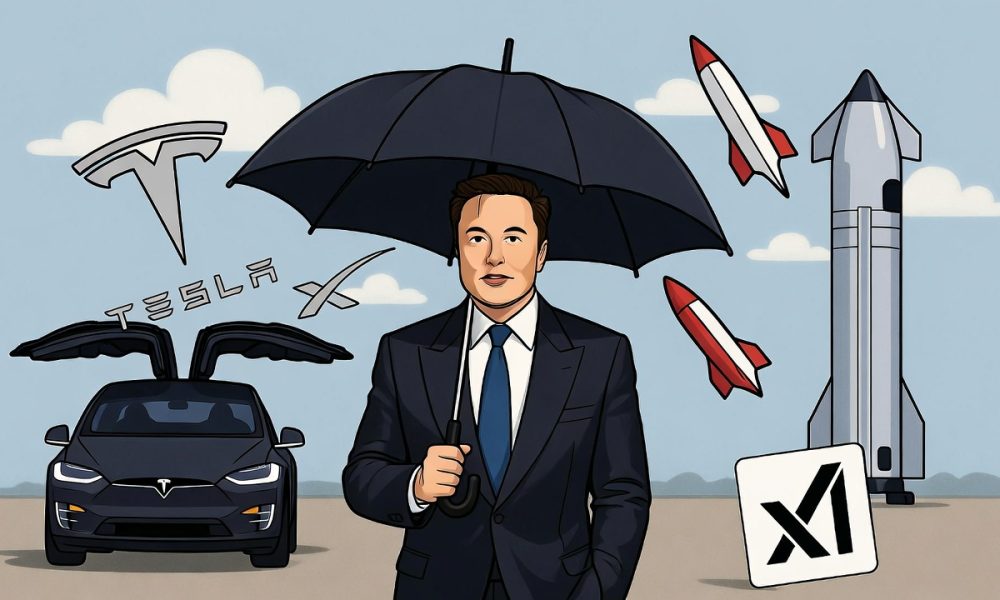
In a significant development that could reshape the landscape of artificial intelligence and space exploration, speculation is mounting that Tesla may be the next company to join a burgeoning conglomerate spearheaded by CEO Elon Musk. This follows the confirmed merger between SpaceX and Musk’s artificial intelligence venture, xAI, earlier this week.
Consolidation Underway for Musk’s Companies
The convergence of SpaceX and xAI marks a pivotal step in Musk’s long-held vision to unite his diverse enterprises under a single umbrella. The strategic alignment aims to leverage SpaceX’s launch capabilities with xAI’s advanced AI models, particularly in the development of space-based data centers that require substantial energy resources. Musk himself has previously noted the increasing trend of synergy among his companies, stating in November, “My companies are, surprisingly in some ways, trending toward convergence.”

Analysts See Tesla as a Natural Fit
Following the SpaceX-xAI integration, industry analysts are widely predicting Tesla’s inclusion in this expanding ecosystem. Dan Ives of Wedbush expressed in a recent note that there is a “growing chance” Tesla could merge with the new entity within the next 12 to 18 months. “In our view, there is a growing chance that Tesla will eventually be merged in some form into SpaceX/xAI over time,” Ives stated. “The view is this growing AI ecosystem will focus on Space and Earth together… and Musk will look to combine forces.”
Building the Ultimate AI Ecosystem
A potential triple merger involving Tesla, SpaceX, and xAI could create a formidable force, dubbed the “Musk Trinity.” This would integrate Tesla’s strengths in physical AI, including its Robotaxi, Optimus humanoid robot, and Full Self-Driving technology, with SpaceX’s orbital infrastructure via Starlink and its vision for space-based computing. xAI would contribute its cutting-edge AI models, such as Grok. This synergy could accelerate real-world AI applications, from global autonomy powered by satellite networks to massive AI training facilitated by solar-optimized orbital data centers. The unified entity, potentially branded as “X,” could emerge as a leader in multiplanetary AI-native technology.
Financial and Structural Considerations
The merger offers significant financial and structural advantages. SpaceX’s substantial valuation, bolstered by the xAI integration, could provide a financial lifeline for xAI’s high cash burn rate, mitigating the need for constant external fundraising. For Tesla, joining the conglomerate could streamline its significant capital expenditures on projects like the Dojo supercomputers, Robotaxis, and Optimus. Furthermore, Tesla’s recent $2 billion investment in xAI strengthens the financial ties.

From a leadership perspective, the merger could address Musk’s current uneven ownership stakes. While he holds approximately 13% of Tesla, his stake increases with his compensation package achievements. In contrast, he owns about 43% of the private SpaceX. A combined entity could potentially increase his ownership in the merged company to around 26%, granting him greater voting power and strategic alignment across his ventures. This structure could also facilitate a private-to-public transition for SpaceX, potentially through a reverse merger via Tesla, bypassing traditional IPO scrutiny while accessing public market liquidity.
Potential Timeline and Announcement Triggers
While Ives projects a 12-18 month timeline, fueled by Musk’s consistent hints at convergence, some speculate a merger could occur sooner, possibly before June 30, 2026. However, longer horizons, extending to 2027 or beyond, might allow for the maturation of key Tesla projects like the Robotaxi rollout and Optimus scaling, alongside regulatory developments. The SpaceX-xAI merger is seen as a preliminary step, with a potential SpaceX IPO serving as a valuation benchmark before any integration with Tesla. The full triple convergence would depend on the successful demonstration of synergies.
Prediction markets offer another indicator, with Polymarket showing a 12-24% probability of a Tesla-SpaceX merger announcement by June 30, 2026. Despite the promising outlook, the path forward is not without risks. Valuation disparities between Tesla’s public market multiples and SpaceX-xAI’s privately assessed value present challenges. Ultimately, the success of this ambitious consolidation hinges on Musk’s ability to execute at scale, potentially creating a transformative, vertically integrated AI-space-robotics giant.
Note: Reports earlier this week also indicated that Elon Musk denied rumors of SpaceX developing a phone, stating, “Reuters lies relentlessly” and “We are not developing a phone.” Additionally, the FCC has accepted SpaceX’s filing for a “SpaceX Orbital Data Center system,” proposing up to one million satellites for space-based computing, a move that has opened for public comment.