
Key Takeaways
- ABB E-Mobility has introduced the OM M-Series power cabinet, a new megawatt-capable DC fast charger system.
- The system can deliver up to 1.2 megawatts (MW) to a single electric vehicle or dynamically allocate power to as many as 24 EVs.
- Boasting an industry-leading power density of 625 kilowatts per square meter, the OM M-Series optimizes space utilization for charging networks.
- Its modular design allows sites to scale their charging capacity from 200 kW up to 1.2 MW, ensuring future-proofing and cost-effective upgrades.
- This advancement by ABB positions it at the forefront of the global race to develop high-power megawatt EV charging technology, crucial for accelerating the electrification of heavy-duty and passenger vehicle fleets.
In a significant leap forward for electric vehicle (EV) infrastructure, Swiss technology powerhouse ABB E-Mobility has unveiled its groundbreaking OM M-Series power cabinet. This innovative DC fast charger system marks a pivotal moment in the evolution of EV charging, capable of delivering power output that firmly places it in megawatt territory.
The new system addresses the escalating demand for faster and more efficient charging solutions, especially as EV technology continues to advance. Its introduction is poised to reshape the landscape of public and commercial charging networks, providing unprecedented power and flexibility.

Defining the Megawatt Threshold in EV Charging
The OM M-Series power cabinet represents a paradigm shift in EV charging capabilities. With the appropriate dispenser, this cutting-edge system can supply an impressive 1.2 megawatts of power to a single electric vehicle. This level of power is crucial for the next generation of heavy-duty electric trucks and buses, which require rapid charging to minimize downtime and enhance operational efficiency.
Beyond individual vehicle charging, the system demonstrates remarkable versatility. It can dynamically allocate its substantial power capacity to simultaneously charge up to 24 electric vehicles. This feature is particularly valuable for high-traffic charging hubs, fleet depots, and urban charging stations, ensuring optimal utilization and reduced waiting times for a diverse range of EVs.
Industry-Leading Power Density and Space Optimization
One of the standout features of ABB’s new power cabinet is its industry-leading power density. Rated at an exceptional 625 kilowatts per square meter, the OM M-Series is engineered to maximize efficiency in space-constrained environments.

This high power density allows charging network operators to deploy substantial charging capacity within limited footprints, making it ideal for urban centers, highway rest stops, and other locations where space is at a premium. The compact design facilitates easier installation and scalability without requiring extensive real estate, directly impacting the expansion of global EV infrastructure.
A Flexible Ecosystem of Dispenser Solutions
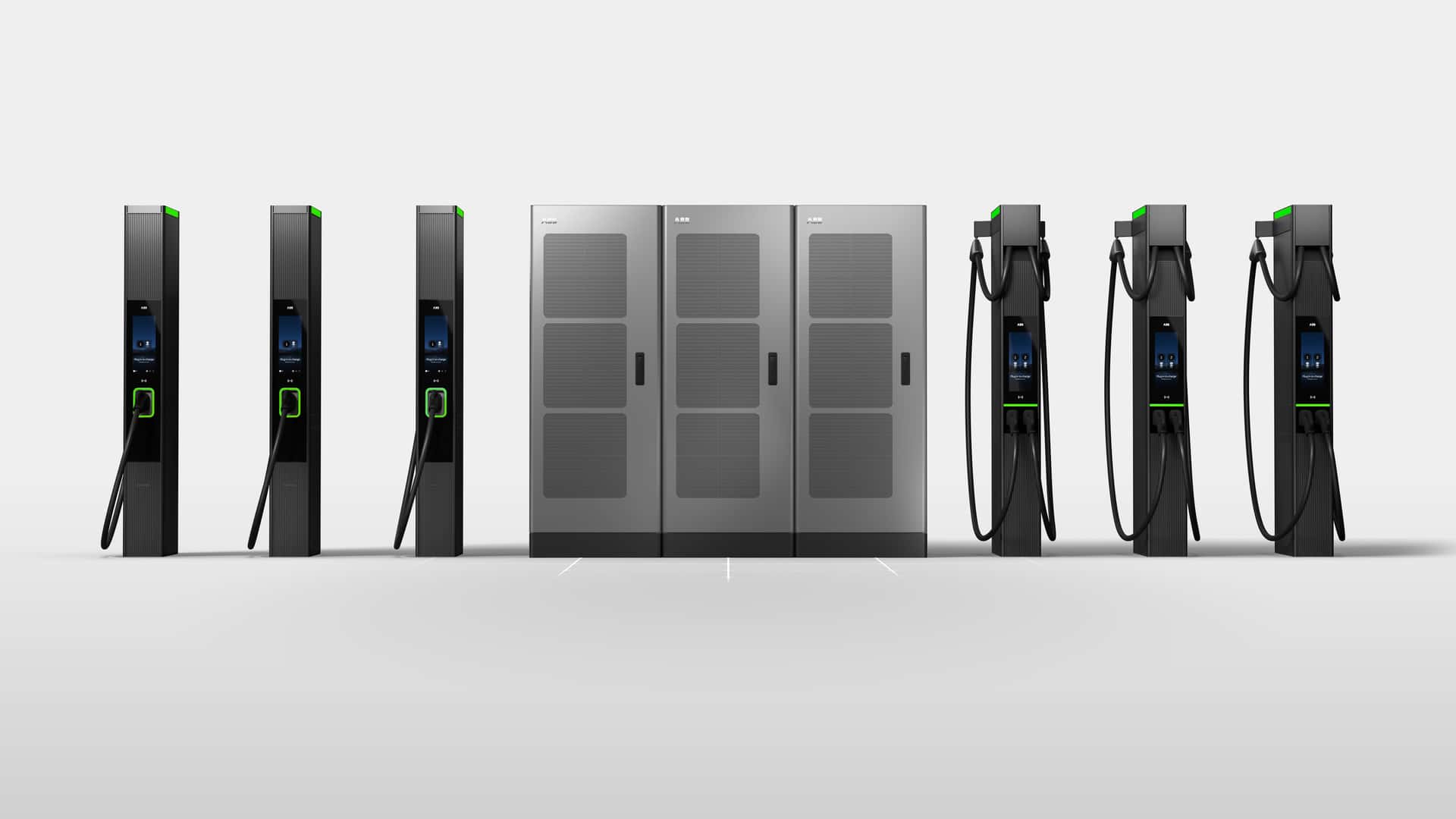
The OM M-Series power cabinet is designed as the core of a highly customizable charging setup, compatible with several of ABB’s advanced dispensers. This modularity ensures that charging networks can tailor their configurations to meet specific site requirements and diverse vehicle charging needs, embodying the essence of modern megawatt EV charging technology.
For heavy-duty applications requiring the absolute maximum power, the OM Ultra dispenser is the compatible choice. It can output up to 1,500 amps at voltages reaching 980 volts through a single liquid-cooled Megawatt Charging System (MCS) cable. This robust solution is specifically engineered to cater to large electric trucks and other commercial vehicles.
Passenger electric vehicles benefit from the versatility of the OM Solo dispenser. This option can deliver up to 800 kW to a single EV, boasting an 800-amp peak current. It features a single liquid-cooled cable, configurable with either a Combined Charging System (CCS) or a North American Charging Standard (NACS) connector, accommodating various market standards.
Further catering to different vehicle types and charging preferences, the OM Solo also comes in variants. A version with a phase-cooled CCS cable reduces the output to 600 amps, while an air-cooled NACS cable variant can deliver up to 375 amps. For locations needing to serve multiple vehicles simultaneously, ABB offers the OM Duo dispenser, equipped with two outlets, each capable of delivering up to 800 amps.
Modular Design for Scalable EV Infrastructure
Recognizing that charging demands evolve, ABB has engineered the OM M-Series with a highly modular architecture. This allows site operators to commence with a smaller power cabinet and progressively expand capacity as utilization rates increase and the fleet of electric vehicles grows.
The base unit, the M200, delivers 200 kW of power. It can be seamlessly upgraded to the M400 (400 kW) or the M800 (800 kW) by simply adding more cabinets. This flexible approach minimizes initial investment costs and ensures that charging infrastructure can adapt efficiently to future demands without significant overhauls.
The inherent design advantage means that dispensers only need to be connected to the power cabinet, significantly reducing the complexity and expense associated with future upgrades. This cost-efficiency is a critical factor for the widespread deployment of advanced megawatt EV charging technology across diverse geographies.
The Accelerating Race for Megawatt Charging Solutions
The advent of modern electric vehicles capable of charging at rates exceeding 300 kilowatts underscores the urgent need for a corresponding upgrade in charging infrastructure. ABB E-Mobility’s entry into the megawatt charging space is part of a broader industry trend, reflecting a global commitment to developing ultra-fast EV charging technology.
Several other prominent players are also making significant strides in this domain. Alpitronic, for instance, offers a megawatt-capable split DC charging system that can deliver up to 600 kW to a single EV. Tesla’s latest Supercharger setups are designed to output up to 1.2 MW, catering to its growing fleet of high-performance vehicles.
Chinese manufacturer BYD is also deeply invested in high-power charging, featuring its 1.5 MW Flash chargers. This collective push by industry leaders like ABB, Tesla, Alpitronic, and BYD signifies a concerted effort to overcome charging speed limitations, thereby accelerating global EV adoption and supporting a sustainable transportation future.
The Broader Impact on Electric Mobility
The introduction of the ABB OM M-Series power cabinet holds significant implications for the future of electric mobility. By providing robust, scalable, and high-density charging solutions, ABB is not merely selling equipment; it is enabling the expansion of reliable EV infrastructure that can keep pace with technological advancements in electric vehicles.
This development is crucial for combating range anxiety, promoting the electrification of commercial fleets, and making long-distance EV travel more convenient and efficient. As global efforts toward decarbonization intensify, advancements in megawatt EV charging technology become indispensable tools in the transition to sustainable transport systems worldwide.
Frequently Asked Questions (FAQ)
What is the ABB OM M-Series power cabinet?
The ABB OM M-Series is a new, megawatt-capable DC fast charger system designed for electric vehicles. It serves as the central power unit for various charging configurations, delivering high-speed energy to a wide range of EVs, from passenger cars to heavy-duty trucks.
How much power can the OM M-Series deliver?
The system is capable of delivering up to 1.2 megawatts (MW) of power to a single electric vehicle. It also offers dynamic power allocation, allowing it to distribute power efficiently among up to 24 connected electric cars simultaneously, optimizing charging times for multiple users.
What is unique about its power density?
The OM M-Series boasts an industry-leading power density of 625 kilowatts per square meter. This feature is critical for urban environments and space-constrained sites, enabling operators to deploy significant charging capacity within a minimal physical footprint, enhancing the efficiency of EV infrastructure.
What types of vehicles can use this charger?
The system is versatile, supporting a broad spectrum of EVs. With the OM Ultra dispenser and an MCS connector, it can charge large electric trucks. For passenger EVs, it supports CCS and NACS connectors through the OM Solo and OM Duo dispensers, offering solutions for various vehicle classes and international standards.
Is the OM M-Series system scalable?
Yes, the system is designed with modularity in mind. Charging sites can begin with smaller power cabinets, such as the M200 (200 kW), and easily expand their capacity by adding M400 (400 kW) or M800 (800 kW) modules. This ensures cost-effective upgrades and adaptability to future demand without extensive overhauls.
How does this compare to other fast chargers on the market?
ABB’s OM M-Series positions itself among the most powerful fast chargers globally, reaching 1.2 MW. Competitors like Tesla also offer 1.2 MW Superchargers, while BYD has 1.5 MW Flash chargers, and Alpitronic provides systems up to 600 kW. ABB’s solution contributes significantly to the industry’s push for high-power megawatt EV charging technology.