
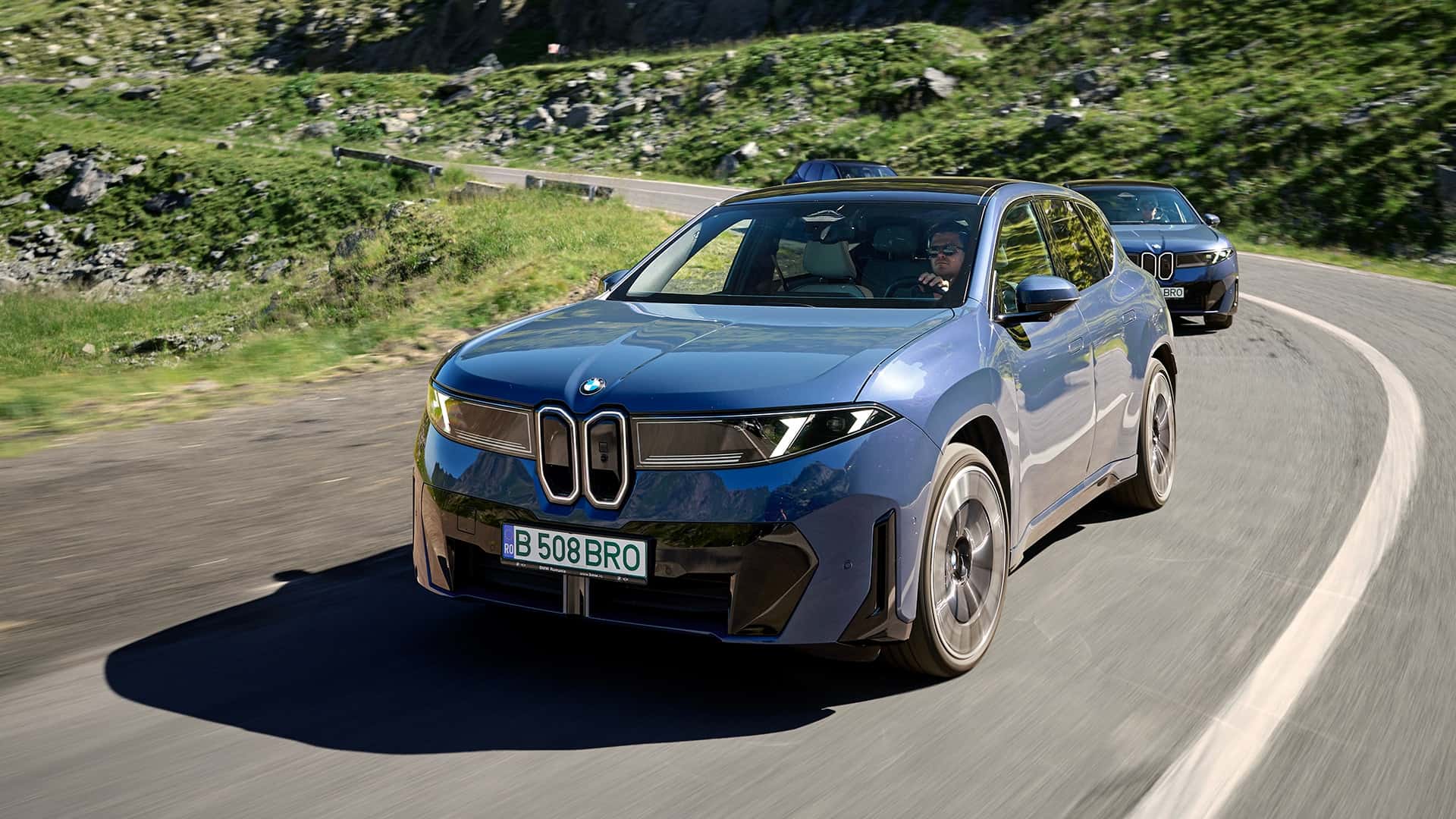
Key Takeaways
- A rigorous 500-mile journey across Romania, including mountain passes and highways, challenged the BMW iX3’s range capabilities.
- The test, conducted without hypermiling, demonstrated the electric SUV’s impressive real-world efficiency and accurate range predictions.
- The BMW iX3, featuring a 108.7-kWh battery, consistently maintained a significant energy buffer, mitigating traditional range anxiety.
- Its dynamic performance on challenging mountain roads, coupled with efficient cruising, positions the iX3 as a highly compelling electric vehicle for diverse driving conditions.
- The experience suggests that for well-engineered EVs like the iX3, the concern of range anxiety for long-distance travel is becoming increasingly outdated.
The notion of range anxiety, a persistent concern for many contemplating the switch to electric vehicles, faced a formidable challenge during a recent extensive road trip across Romania. A BMW iX3, equipped with its substantial battery, embarked on a demanding journey spanning over 500 miles, designed to thoroughly evaluate its real-world capabilities and, crucially, its `BMW iX3 range` under varied and challenging conditions. The objective was not merely to confirm the vehicle’s ability to complete such a trip, but to ascertain if it could do so without necessitating compromises in driving style, speed, or meticulous route planning around charging infrastructure.
This expedition navigated a diverse landscape, from expansive highways and winding country roads to the exhilarating, swift ascents and descents of Romania’s highest mountain passes. The rigorous test aimed to demonstrate how effortlessly long-distance travel can be achieved in BMW’s latest electric SUV, pushing the boundaries of what is typically expected from an EV in terms of sustained performance and energy management.

The Romanian Expedition: A Rigorous Test of Endurance
A Challenging Itinerary Across Varied Terrains
The proposed itinerary was precisely the kind of journey often perceived to induce nervousness in electric vehicle drivers: traverse Romania from its southern capital, Bucharest, to Șona, a small village renowned for its contemporary art scene and unique ‘pyramids’ in the country’s central region. The return leg was designed to be even more challenging, incorporating an ascent and descent of the iconic Transfăgărășan, one of Europe’s most spectacular and demanding mountain roads.
This comprehensive route, spanning approximately 220 miles on the first day and slightly more on the return, presented a fantastic opportunity to scrutinize BMW’s efficiency and `BMW iX3 range` claims. The journey offered a balanced mix of driving environments, predominantly featuring open-road cruising on national arteries and sections of highway, complemented by the intense, dynamic demands of a high-altitude mountain pass on the second day. This diversity was crucial for obtaining a holistic understanding of the vehicle’s performance.
Methodology: Driving Without Compromise
In line with journalistic integrity and a commitment to real-world testing, the driver adopted a conventional approach, refraining from any hypermiling techniques typically employed to maximize electric vehicle range. The intent was to operate the `BMW iX3` as one would a traditional combustion-engine vehicle, prioritising normal driving dynamics over extreme efficiency. This methodology ensured that the results would accurately reflect the experience of an average driver, providing credible insights into the practical `BMW iX3 range`.

Consequently, the test did not aim to replicate BMW’s own extraordinary range record, where an iX3 covered over 620 miles (1,000 km) on a single charge during a drive from Hungary to Germany. Instead, it focused on whether the electric SUV could handle demanding, uncompromised driving while still providing a comfortable buffer, thereby addressing common concerns about electric vehicle travel.
Day One: Sustained Efficiency on Diverse Roads
Initial Departure and Range Estimates
The journey commenced from Bucharest in the early morning. The `BMW iX3 xDrive50` started with a robust 97% charge in its expansive 108.7-kWh battery, displaying an initial range prediction of 353 miles (568 km). These figures provided a baseline against which real-world consumption and remaining `BMW iX3 range` could be measured throughout the demanding trip.
It is worth noting the variance in official `BMW iX3 range` estimates: in Europe, this variant boasts a claimed WLTP range of 500 miles (805 km), while in the U.S., the EPA rates it at up to 434 miles (698 km). The test would provide valuable data to contextualize these laboratory figures against actual driving conditions.
Mid-Journey Performance and Energy Consumption
The initial segment of the first day involved primarily extra-urban driving, with speeds maintained around 62 mph (100 km/h), preceded by a brief highway stint. By the midway point of this leg, the `BMW iX3` had covered 112 miles (180.4 km), achieving an average displayed efficiency of 3.31 miles/kWh (18.8 kWh/100 km). This early performance indicated a promising blend of power delivery and energy conservation.
As the route transitioned to narrower, slower country roads, the vehicle’s efficiency further improved, showcasing its adaptability to varying traffic conditions and speed limits. These mixed conditions allowed for a more comprehensive assessment of the electric SUV’s energy management systems and how they contribute to the overall `BMW iX3 range`.
Overnight Stop and Remaining Charge Analysis
Upon reaching the overnight stop, the `BMW iX3` had successfully traversed 217.5 miles (350.1 km). Impressively, it had maintained an average efficiency of 3.53 miles/kWh (17.6 kWh/100 km) and still retained a substantial 40% battery charge. The onboard range estimate suggested an additional 173 miles (279 km) of travel were still available.
This significant remaining `BMW iX3 range` prompted consideration of attempting the entire return journey without an overnight charge. However, the prospect of tackling the Transfăgărășan mountain road dynamically overshadowed the desire for a hypermiling experiment. Therefore, the vehicle was charged overnight, ensuring peak performance for the challenging ascent the following morning, reinforcing the commitment to driving without compromise.
Day Two: Conquering the Transfăgărășan Pass
Pre-Mountain Preparations and Range Optimism
The second day began with the `BMW iX3` at a 98% charge. Based on the previous day’s efficient driving, the range prediction had recalibrated to an optimistic 437 miles (703 km). This renewed confidence was essential as the journey was set to embark on the most demanding section of the trip: the legendary Transfăgărășan mountain road.
Departing from the picturesque town of Sibiu, the electric SUV began its ascent towards the base of the mountain pass. During the initial slow-speed cruise leading up to the twists and turns, the iX3 demonstrated remarkable frugality, achieving an average efficiency of approximately 4.44 miles/kWh (14 kWh/100 km). This efficiency was particularly noteworthy for a heavy, dual-motor SUV weighing over 5,000 pounds (2.3 tons), boasting 463 horsepower, and capable of startling acceleration.
Dynamic Driving and SUV Agility
Engaging Sport mode transformed the `BMW iX3 range` test into a dynamic performance evaluation. The electric SUV felt unmistakably like a true BMW, adeptly concealing its considerable mass through the mountain’s numerous bends. It exhibited minimal understeer and responded eagerly to accelerator inputs, allowing for precise adjustments to its line.
The low-mounted battery pack played a crucial role in eliminating much of the top-heavy sensation typically associated with hustling a 5,000-pound SUV. Around the Transfăgărășan’s demanding switchbacks, the iX3 remained planted, neutral, and surprisingly willing to be driven hard, demonstrating a level of agility that belied its size and family-oriented design. Its driving experience proved more engaging and pleasant than that of its combustion-engine equivalent, the BMW X3, offering a testament to the advantages of electric powertrain integration.
Double Ascent and Remaining Power
One ascent to the summit proved insufficient for a comprehensive evaluation of the `BMW iX3 range` and performance. After reaching Bâlea, the driver descended to Cârțișoara for lunch, then promptly turned around to conquer the entire road a second time. This involved gaining approximately 5,200 feet (1,580 meters) in elevation once more, subjecting the vehicle to prolonged, strenuous climbing.
Despite these intense demands, upon emerging onto the southern side of the mountain – roughly 100 miles (160 km) into the day’s driving – the battery still displayed a reassuring 57% charge. The trip computer indicated an average consumption of 2.1 miles/kWh (29.6 kWh/100 km), a figure that had briefly touched 1.64 miles/kWh (37.8 kWh/100 km) during the most aggressive segments. This average encompassed the drive from Sibiu, two energetic mountain ascents, and the significant regenerative braking during the descent between them, highlighting the efficiency gains from kinetic energy recovery.
Photo by: Radu Chindriș/BMW Romania
Return Journey and Final Verdict on EV Performance
Homeward Bound with Ample Reserve
Following the rigorous mountain pass traversal, the journey continued down the other side of the Transfăgărășan. Despite heavier traffic conditions, the `BMW iX3` completed the entire return trip to Bucharest without requiring any additional charging. Upon arriving home, the vehicle still had 16% of its battery charge remaining, a remarkable feat considering the day’s driving.
The return leg alone spanned approximately 250 miles (400 km) and included about 90 miles (150 km) of highway driving performed at a sustained speed of 87 mph (140 km/h). This final figure served as perhaps the most compelling demonstration of the `BMW iX3 range` and its real-world usability, proving its capabilities beyond simulated or ideal conditions.
Overcoming Range Anxiety: A Definitive Statement
The entire 500-mile odyssey across Romania, punctuated by challenging terrain and spirited driving, concluded without any of the compromises traditionally associated with long-distance EV travel. There was no need to reduce speeds, switch off climate control, or constantly monitor energy consumption. Even after fully exploiting the iX3’s significant performance and capable chassis on one of Romania’s most demanding roads – twice – a meaningful energy buffer remained upon reaching the final destination.
This experience unequivocally demonstrates why the `BMW iX3` stands out as such a compelling electric vehicle for road trips. While its enormous 108.7-kWh battery certainly contributes to its impressive `BMW iX3 range`, capacity alone does not tell the full story. The vehicle masterfully combines strong real-world efficiency, highly reliable and not overly optimistic range predictions, and effortless performance, all without compelling the driver to constantly obsess over conserving energy.
The Future of EV Travel: Confidence and Capability
The `BMW iX3` proves to be both quick and genuinely enjoyable when presented with interesting roads, seamlessly transitioning back into an efficient long-distance cruiser afterward. While range anxiety may persist in regions with nascent charging infrastructure, in an electric vehicle capable of covering such extensive distances with a substantial range in reserve, the excuses for not embracing electric mobility become increasingly difficult to justify.
This comprehensive test drive validates the evolving landscape of electric vehicle technology, where models like the `BMW iX3` are not just eco-friendly alternatives but highly capable, dynamic, and practical machines ready for the demands of diverse and challenging long-distance journeys. The era where electric vehicles inherently meant compromise for extended travel is rapidly drawing to a close, replaced by a new standard of confidence and capability.
Photo by: Radu Chindriș/BMW Romania
Frequently Asked Questions About the BMW iX3 Range and Performance
What was the primary objective of the BMW iX3 road trip in Romania?
The primary goal was to assess the BMW iX3’s real-world range and efficiency over a challenging 500-mile journey across Romania, including mountain passes and highways, without adopting hypermiling techniques. It aimed to determine if long-distance EV travel could be effortless and free from range anxiety.
What battery capacity does the BMW iX3 xDrive50 feature?
The BMW iX3 xDrive50, as tested, is equipped with a large 108.7-kWh battery. This substantial capacity is a key factor in its impressive `BMW iX3 range` and ability to cover extensive distances without frequent charging stops.
How did the BMW iX3 perform on the Transfăgărășan mountain road?
The iX3 demonstrated exceptional dynamic performance on the Transfăgărășan, feeling planted and agile despite its weight. Its low-mounted battery contributed to neutral handling, making it genuinely enjoyable to drive, even surpassing the feel of its combustion counterpart, the BMW X3.
What were the efficiency figures observed during the test?
Efficiency varied, with an average of 3.53 miles/kWh (17.6 kWh/100 km) on day one’s mixed roads. Even after two energetic mountain ascents on day two, the average consumption for that segment was 2.1 miles/kWh (29.6 kWh/100 km), showcasing efficient energy management.
Did the driver experience range anxiety during the 500-mile trip?
No, the driver explicitly stated that range anxiety felt outdated during the trip. The `BMW iX3 range` capabilities, combined with reliable predictions and a comfortable energy buffer, allowed for uncompromised driving, even after demanding mountain sections.
How much charge remained after the entire journey?
After covering approximately 250 miles on the second day, including highway speeds and two strenuous mountain ascents, the BMW iX3 arrived back in Bucharest with a comfortable 16% battery charge still remaining, affirming its robust `BMW iX3 range`.
What makes the BMW iX3 a compelling road-trip EV?
The BMW iX3 is compelling due to its enormous battery, strong real-world efficiency, reliable range prediction, and effortless performance. It combines dynamic driving enjoyment with efficient long-distance cruising, making it highly suitable for diverse and extended journeys.