
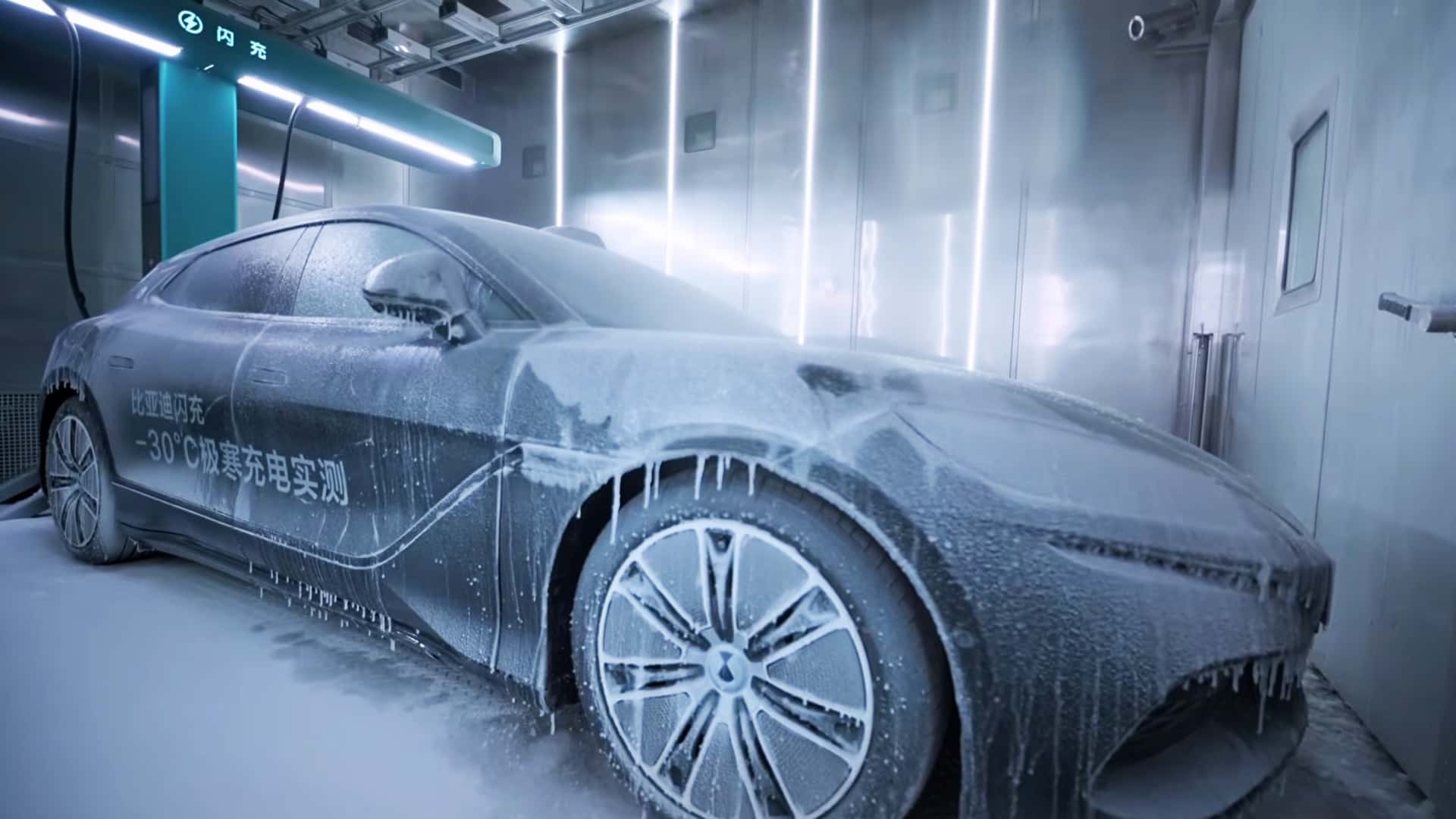
In a significant stride for electric vehicle technology, Chinese automotive giant BYD has demonstrated a groundbreaking charging feat, successfully replenishing its Denza Z9GT luxury EV from 20% to 97% in just 12 minutes, even after the vehicle was subjected to a brutal 24-hour deep freeze at -22°F (-30°C). This remarkable achievement underscores the robustness of BYD’s second-generation Blade Battery and its formidable Flash charging technology, positioning it as a potential game-changer for electric mobility in diverse climatic conditions.
The test, documented in a newly released video, aimed to unequivocally prove that BYD’s high-speed charging solutions can perform optimally even when conventional batteries typically struggle with power delivery and acceptance in extreme cold. This development is crucial for enhancing the appeal and practicality of electric vehicles globally.

A New Benchmark for EV Charging in Harsh Conditions
The Denza Z9GT, a luxury EV recently debuted in Europe, was at the heart of BYD’s rigorous demonstration. The vehicle endured an entire day in temperatures plummeting to -22°F, ensuring every component, especially its advanced battery pack, was thoroughly chilled. Following this prolonged exposure to freezing conditions, the vehicle was connected to a powerful BYD Flash charger.
The results were compelling: the car’s state of charge escalated rapidly from 20% to an impressive 97% within a mere 12 minutes. This performance not only validates BYD’s claims regarding its next-generation charging capabilities but also sets a new benchmark for cold-weather electric vehicle charging efficiency. The rapid influx of electrons at such extreme temperatures is a testament to the sophisticated thermal management systems integrated within BYD Flash charging technology and its LFP (lithium iron phosphate) battery architecture.
The Power of Second-Generation Blade Batteries
At the core of this achievement lies BYD’s second-generation Blade Battery technology, paired with its latest-generation Flash chargers. This synergistic combination enables DC fast charging at an astounding rate of up to 1,500 kilowatts. Under ideal conditions, BYD’s newest electric vehicles are capable of charging from 10% to 70% in approximately five minutes, and from 10% to 97% in less than ten minutes.

The Blade Battery itself is renowned for its innovative cell-to-pack design, which enhances volumetric efficiency and safety. Its LFP chemistry offers inherent advantages in terms of thermal stability and longevity, making it a suitable candidate for extreme operating environments. The successful deep-freeze test of the Denza Z9GT further solidifies the Blade Battery’s reputation for resilience and performance under duress, a critical factor for the widespread adoption of electric vehicles.
Overcoming the Cold-Weather Charging Hurdle
Cold temperatures traditionally pose significant challenges for electric vehicle performance, particularly affecting battery range and charging efficiency. Lithium-ion batteries tend to be less efficient in cold weather, leading to slower charging times and reduced available power. This phenomenon often results in “range anxiety” for EV owners in colder climates.
BYD’s demonstration with the Denza Z9GT directly addresses this long-standing industry concern. By proving that its BYD Flash charging technology can maintain rapid charging speeds even after prolonged exposure to extreme freezing temperatures, the company is effectively mitigating one of the most prominent barriers to electric vehicle adoption. This capability is vital for markets experiencing harsh winters, ensuring that EVs remain practical and convenient year-round.
Implications for Global EV Adoption
The ability to charge an electric vehicle quickly and efficiently in sub-zero temperatures has profound implications for global EV adoption. It bolsters consumer confidence, especially for those residing in regions with diverse or challenging climates, where reliable cold-weather performance is non-negotiable. This advancement can help accelerate the transition away from fossil fuels by making the electric vehicle ownership experience more seamless and comparable to, if not superior to, conventional gasoline vehicles.
Decoding Range and Charging Protocol
Post-charge, the Denza Z9GT’s range meter indicated nearly 626 miles (1,009 kilometers). It is important to note that this figure likely refers to China’s CLTC (China Light-Duty Vehicle Test Cycle) testing procedure. The CLTC cycle is known to be geared more towards city driving conditions, where speeds are generally lower, which can result in higher stated ranges compared to more rigorous highway-focused testing procedures like those used in the Western hemisphere, such as EPA or WLTP standards.
Regarding the 97% charge cutoff, BYD Chairman Wang Chuanfu has shed light on this deliberate strategy. He has stated that the company intentionally incorporates a 3% buffer during charging tests. This margin ensures that the vehicle retains capacity for regenerative braking immediately after a quick Flash charging session. Without this buffer, a fully charged battery would have nowhere to store the energy recovered from regenerative braking, potentially canceling the function until the battery’s state of charge naturally decreases.
Benchmarking Against Industry Leaders
BYD’s rapid charging performance stands out when compared to other high-performance electric vehicles on the market. For instance, Mercedes-AMG’s latest EV, the GT, is capable of accepting up to 600 kW from a DC fast charging station. According to the German automaker, this allows it to charge from 10% to 80% in 11 minutes under ideal conditions. While impressive, this is still in ideal conditions and at a lower power input than BYD’s 1,500 kW system.
Similarly, America’s fastest-charging EV, the Lucid Gravity SUV, underwent an independent test by InsideEVs contributor and State of Charge YouTube channel host Tom Moloughney. In that test, the Lucid Gravity charged from 0% to 50% in 12.5 minutes. While these are commendable figures, BYD’s ability to nearly fully charge (20% to 97%) in just 12 minutes, especially under extreme freezing conditions, highlights a significant technological advantage in the realm of BYD Flash charging technology.
The Road Ahead for BYD Flash Charging Technology
The successful cold-weather charging demonstration of the Denza Z9GT by BYD marks a pivotal moment in the evolution of electric vehicle technology. It not only showcases the advanced capabilities of BYD’s second-generation Blade Batteries and 1,500 kW Flash chargers but also directly addresses a critical concern for potential EV buyers in colder regions. By making EV recharging as quick and reliable as conventional refuelling, even in adverse conditions, BYD is paving the way for a more seamless and widespread adoption of electric vehicles.
As BYD continues to innovate and expand its presence globally, the impact of its BYD Flash charging technology on consumer experience and the overall electric mobility landscape is expected to be substantial. This achievement solidifies BYD’s position as a frontrunner in battery and charging infrastructure development, promising a future where range anxiety and cold-weather performance concerns become relics of the past for electric vehicle owners.
Key Takeaways
- BYD’s new Denza Z9GT EV, featuring second-generation Blade Battery and Flash charging technology, demonstrated remarkable cold-weather charging performance.
- After being deep-frozen at -22°F (-30°C) for 24 hours, the luxury EV charged from 20% to 97% in just 12 minutes.
- This achievement showcases BYD’s 1,500-kilowatt Flash chargers and advanced lithium iron phosphate (LFP) battery’s resilience, addressing a key challenge for electric vehicle adoption in diverse climates.
- The technology aims to make EV recharging as quick as conventional fuel stops, potentially revolutionizing the user experience and mitigating range anxiety.
- The 97% charge cutoff is a deliberate design choice, allowing for immediate regenerative braking capability post-charge.
FAQ Section
What is BYD Flash charging technology?
BYD Flash charging technology combines BYD’s second-generation Blade Batteries with high-power DC fast chargers capable of delivering up to 1,500 kilowatts. This system is designed to significantly reduce electric vehicle charging times, making them comparable to the speed of refueling a gasoline car. It represents a major leap in battery and charging infrastructure development, aiming to enhance the practicality of EVs.
How did the Denza Z9GT perform in extreme cold?
The Denza Z9GT, equipped with BYD’s latest charging technology, was deep-frozen at -22°F (-30°C) for 24 hours. Following this, it successfully charged from 20% to 97% in just 12 minutes. This demonstration highlights the system’s exceptional ability to maintain rapid charging speeds and efficiency even under severe freezing conditions, a common challenge for many conventional EV batteries.
What is the significance of the Blade Battery in this achievement?
The second-generation Blade Battery, with its lithium iron phosphate (LFP) chemistry, is crucial for this performance. LFP batteries are known for their enhanced thermal stability, safety, and longevity. Their robust design, combined with BYD’s advanced thermal management systems within the Flash charging technology, allows for efficient and rapid charging even in extreme temperatures, directly addressing a key barrier to EV adoption.
Why did BYD charge the EV to 97% instead of 100%?
BYD Chairman Wang Chuanfu explained that the 97% charge cutoff is a deliberate design choice to maintain a 3% buffer in the battery. This buffer ensures that the vehicle’s regenerative braking system remains fully functional immediately after a rapid charging session. Without this space, a fully charged battery would have no capacity to absorb energy from regenerative braking, potentially disabling the feature.
How does BYD’s charging speed compare to other premium EVs?
BYD’s 12-minute charge from 20% to 97% at -22°F is highly competitive. For comparison, the Mercedes-AMG GT can charge from 10% to 80% in 11 minutes under ideal conditions with a 600 kW charger. The Lucid Gravity SUV achieved 0% to 50% in 12.5 minutes in an independent test. BYD’s ability to nearly fully charge at extreme temperatures showcases a leading edge in cold-weather ultra-fast charging technology.
What does this mean for the future of electric vehicles?
This breakthrough signifies a major step forward for the electric vehicle industry. Rapid and reliable charging, especially in challenging cold environments, directly tackles range anxiety and convenience concerns that many consumers have. It makes electric vehicles a more viable and attractive option for a wider global audience, accelerating the transition to sustainable transportation and solidifying BYD’s leadership in battery and charging innovation.