
Key Takeaways:
- A California-based startup, PowerStation Charging, has launched its inaugural
off-grid EV charging station
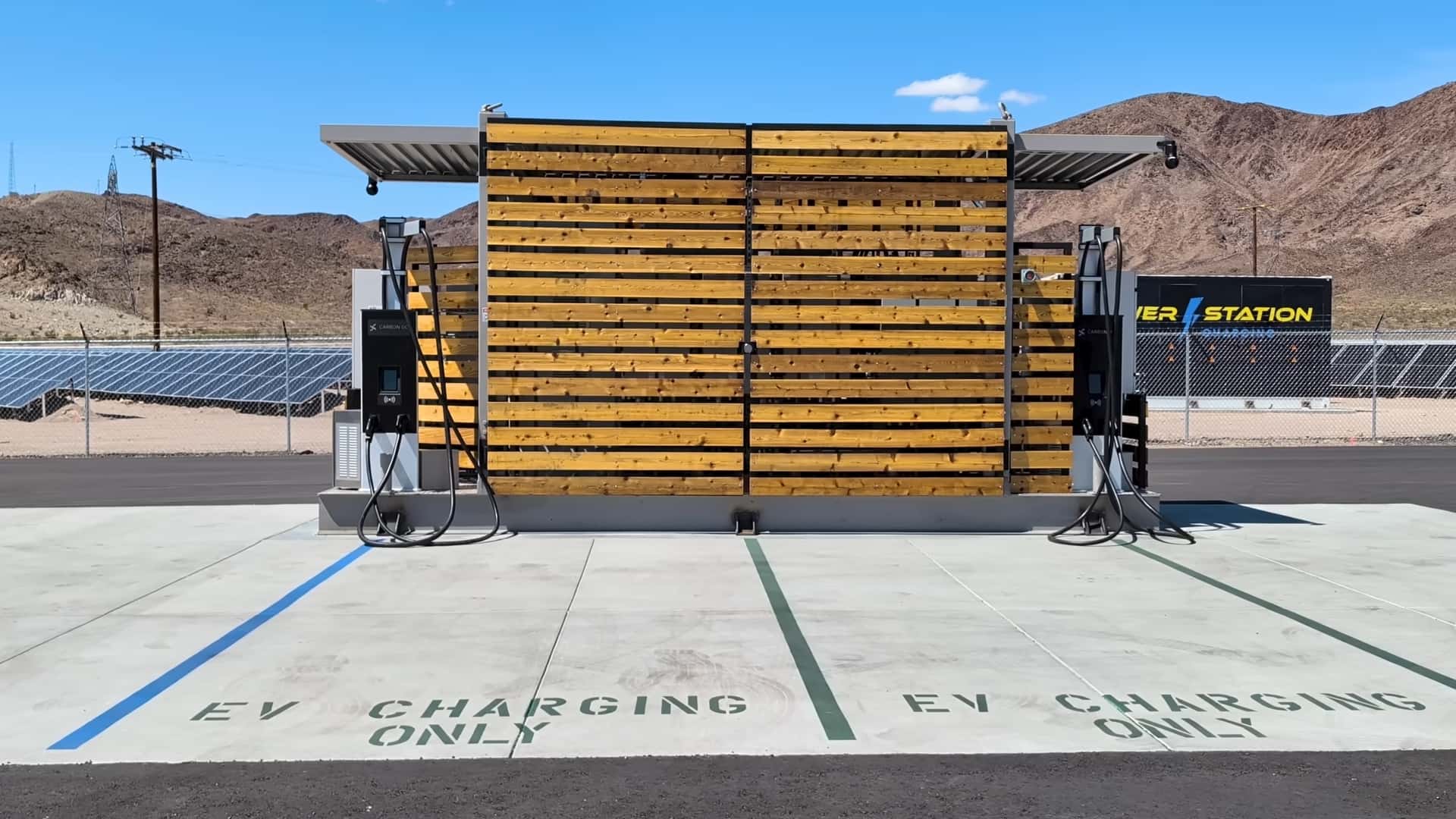
in Baker, California, relying entirely on solar power and a substantial battery energy storage system.
- This innovative station, located off I-15, features 1,080 solar panels delivering up to 640 kilowatts to a 3.4-megawatt-hour battery pack, ensuring 24/7 operation without a grid connection.
- Currently equipped with four CCS1 ports sharing 360 kW, the station plans to add six NACS ports and increase shared output to 600 kW later this summer.
- Charging at this pioneering
off-grid EV charging station
is free for electric vehicle owners until May 31, 2026, after which dynamic pricing between $0.30/kWh and $0.45/kWh will be implemented.
- PowerStation Charging has announced plans for three additional solar-powered DC fast charging stations, with one near Barstow on I-15 opening this year and two more on I-10 and I-8 by 2027.
Pioneering Off-Grid EV Charging in California
In a significant stride towards sustainable electric vehicle (EV) infrastructure, a California startup, PowerStation Charging, has officially activated its first completely
off-grid EV charging station
. Situated strategically at the Rasor Road exit off I-15 in Baker, California, this facility marks a pivotal development in the quest for energy-independent charging solutions, offering motorists a novel way to power their electric vehicles.
The innovative station operates entirely independently of the conventional electrical grid. This self-sufficient model is powered by an extensive array of 1,080 solar panels, capable of generating up to 640 kilowatts of electricity. This robust solar output feeds directly into a formidable 3.4-megawatt-hour (MWh) battery pack, designed to guarantee uninterrupted power supply around the clock, even during periods of minimal or no sunlight.
The operational capability of this
off-grid EV charging station
was recently highlighted when YouTuber Scott Allison documented his experience recharging his Kia EV9 there. His video provided a real-world glimpse into the station’s efficiency and user-friendly nature, demonstrating its potential to serve the growing number of EV drivers on critical interstate routes.
Current Capacity and Future Expansion Plans
Currently, PowerStation Charging’s pilot location is outfitted with four CCS1 ports, which collectively deliver a shared output of 360 kW. This design allows for flexible power distribution: a single EV can harness the full output for rapid charging, while multiple vehicles simultaneously connected will share the available power, receiving a proportionate segment of the total output.
The company has ambitious plans for expansion at this site. Later this summer, the station is set to integrate six additional NACS (North American Charging Standard) ports, broadening its compatibility for a wider range of electric vehicles. Concurrently, the total shared power output is projected to increase to 600 kW, further enhancing charging speeds and capacity.
Beyond charging infrastructure, PowerStation Charging is also developing an 8,000-square-foot underground bunker at the site. This facility is envisioned to include a lounge and restrooms, providing essential amenities for travelers during their charging stops and elevating the overall user experience at the
off-grid EV charging station
.
Accessible and Initially Free Charging Services
A distinctive feature of PowerStation Charging’s inaugural
off-grid EV charging station
is its commitment to accessibility and affordability, at least for an initial period. The startup emphasizes that no dedicated app or membership is required for users to avail themselves of the charging services, streamlining the process for all electric vehicle owners.
Moreover, the company has announced that charging at this innovative facility will be entirely free of charge until May 31, 2026. This extended period of complimentary service is expected to incentivize EV adoption and draw considerable attention to the benefits of solar-powered, grid-independent charging. Following this cutoff date, a dynamic pricing model will be introduced, with rates fluctuating between $0.30/kWh and $0.45/kWh, contingent on prevailing demand and the intensity of solar energy availability.
Expanding the Off-Grid Network Across Key Interstates
PowerStation Charging’s vision extends beyond its initial installation in Baker. The company’s official website outlines plans for the development of three additional solar-powered DC fast charging stations, signaling a robust commitment to expanding its distinctive off-grid network across critical transportation corridors in California.
The immediate expansion includes a second
off-grid EV charging station
slated to open later this year on the I-15 corridor, located near Barstow. This strategic placement aims to replicate the success and utility of the first station along another high-traffic segment of the interstate. Looking further ahead, two more stations are scheduled to become operational by 2027, with planned locations on the I-10 and I-8, further enhancing the accessibility of sustainable charging infrastructure across the state.
These planned developments underscore a clear strategy to address range anxiety and charging infrastructure gaps, particularly in areas where grid connections might be challenging or costly to establish. By leveraging solar power and advanced battery storage, PowerStation Charging is paving the way for a more resilient and environmentally friendly charging ecosystem.
A Growing Trend in Renewable-Powered EV Infrastructure
The emergence of PowerStation Charging’s grid-independent facility is not an isolated incident but rather a significant indicator of a broader trend within the United States. There is an accelerating movement towards the deployment of renewable-fed and battery-backed charging stations, demonstrating a concerted effort to decouple EV infrastructure from conventional grid dependencies.
This paradigm shift is driven by multiple factors, including the increasing demand for sustainable energy solutions, the desire for enhanced grid resilience, and the economic benefits associated with generating and storing proprietary power. Such off-grid solutions offer immunity to power outages, reduce strain on local grids, and can potentially lower operational costs over time by mitigating peak demand charges.
A notable example of this trend is Tesla’s colossal Supercharger station, which commenced operations late last year in Lost Hills, California. This facility, recognized as Tesla’s largest, is designed to energize up to 164 electric vehicles concurrently, operating entirely on solar power complemented by extensive battery storage. The Lost Hills station boasts an impressive 11 MW of solar panels, thoughtfully integrated to double as canopies that provide shade for parked vehicles. This solar generation capacity is paired with 10 Megapack batteries, collectively offering a formidable 39 MWh of energy storage.
These large-scale deployments, both from established players like Tesla and innovative startups like PowerStation Charging, highlight a shared vision for a more robust and sustainable EV charging landscape. They showcase the technical viability and economic attractiveness of leveraging renewable energy sources to power the future of transportation, thereby reducing the carbon footprint associated with vehicle charging.
The Future of Electric Vehicle Charging: Resilience and Sustainability
The development of advanced
off-grid EV charging stations
represents a crucial evolutionary step in the electric vehicle revolution. By integrating high-capacity solar arrays with substantial battery storage, these stations not only provide reliable power but also contribute significantly to the broader goals of energy independence and environmental sustainability. Such innovative infrastructure is particularly vital in regions where grid expansion is complex or costly, or where energy resilience is a paramount concern.
The ability to operate without a direct grid connection offers numerous advantages. It enhances the reliability of charging services, making them less susceptible to grid fluctuations, blackouts, or natural disasters. Furthermore, it paves the way for deploying charging facilities in remote or underserved areas, thereby expanding the reach of the EV charging network and making electric vehicles a more viable option for a larger segment of the population.
As the global transition to electric mobility gains momentum, the emphasis on renewable energy integration within charging infrastructure will only intensify. Projects like PowerStation Charging’s solar-powered station serve as practical demonstrations of how sustainable technologies can effectively support and accelerate this transition, contributing to a cleaner and more resilient energy future for transportation.
FAQ Section
Q1: What is an
off-grid EV charging station
?
A1: An
off-grid EV charging station
is a facility that operates independently of the main electrical grid, generating its own power, typically through renewable sources like solar panels, and storing it in batteries to charge electric vehicles. This setup provides energy independence and resilience.
Q2: How does PowerStation Charging’s new facility operate without a grid connection?
A2: PowerStation Charging’s station in Baker, California, uses 1,080 solar panels to generate up to 640 kilowatts of electricity. This power is then stored in a massive 3.4-megawatt-hour battery pack, allowing the station to provide fast charging services 24/7, even when sunlight is not available.
Q3: Will charging at this
off-grid EV charging station
always be free?
A3: No, charging will be free until May 31, 2026. After this date, prices will vary dynamically between $0.30/kWh and $0.45/kWh. The final price will depend on factors such as charging demand and the amount of solar energy being generated at that specific time.
Q4: What types of charging ports are available at the station, and are there plans for expansion?
A4: Currently, the station features four CCS1 ports sharing a 360 kW output. PowerStation Charging plans to expand its capabilities by adding six NACS ports and increasing the shared power output to 600 kW later this summer. This will cater to a broader range of EVs.
Q5: Are there plans for more
off-grid EV charging station
s from PowerStation Charging?
A5: Yes, PowerStation Charging has announced plans for three additional solar-powered DC fast charging stations. One is scheduled to open near Barstow on I-15 later this year, with two more planned for I-10 and I-8 in 2027, expanding their innovative network.
Q6: How does this initiative fit into the broader trend of EV charging infrastructure?
A6: This initiative aligns with a growing trend of developing renewable-fed and battery-backed charging stations in the U.S. It mirrors efforts by companies like Tesla, which operates a large solar-powered Supercharger station, demonstrating a shift towards more sustainable and resilient EV charging solutions independent of the traditional power grid.