
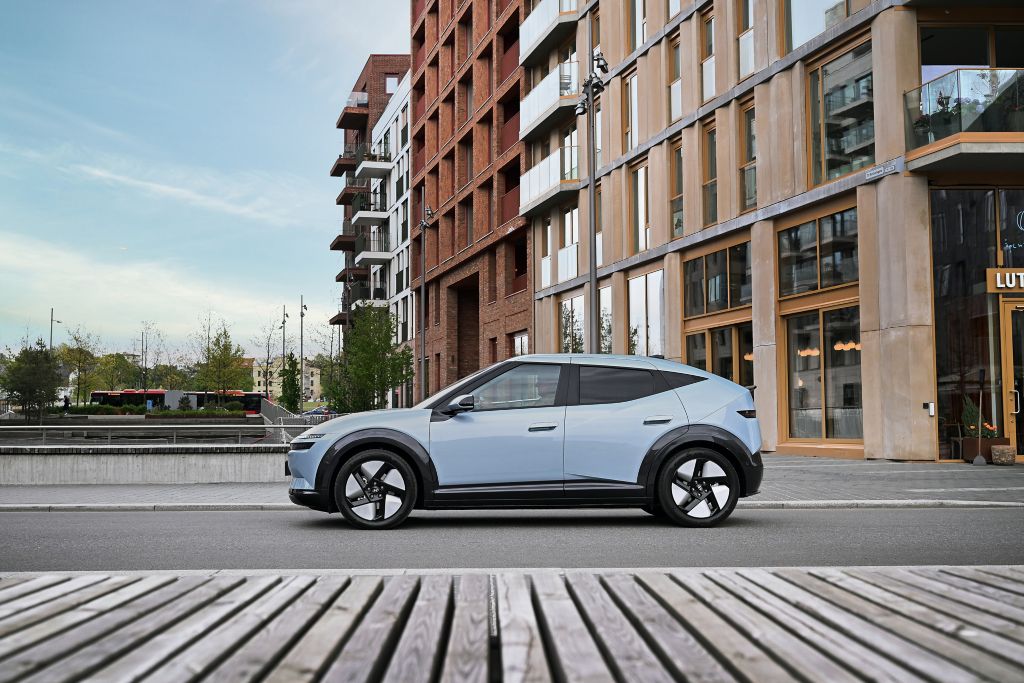
Australia is set to welcome the highly anticipated Hyundai Ioniq 3 small electric hatchback in the first half of next year. While official local pricing and specifications are still under wraps, recent announcements for the UK market offer a significant preview of what Australian consumers can expect from this new contender in the burgeoning electric vehicle segment.
As a key indicator for the Australian automotive landscape, the UK pricing and variant details suggest that the Ioniq 3 could arrive with a strategically trimmed-down lineup compared to larger global markets. This approach is common in Australia, where manufacturers often focus on specific trims best suited for local demand, ensuring a competitive and compelling offering.
Key Takeaways (TL;DR)
- The Hyundai Ioniq 3 is slated for an Australian launch in the first half of 2025, aiming to fill a critical gap in the small electric passenger car segment.
- UK pricing starts at £22,245, including 20% VAT. This translates to a projected Australian starting price potentially below the $40,000 mark (excluding Luxury Car Tax), making it a highly competitive option.
- The Ioniq 3 distinguishes itself with a retro-inspired design, a practical interior balancing screens with physical controls, and robust features like a 483 km WLTP range (from its 61 kWh battery) and a 750 kg towing capacity.
- Positioned as a versatile ‘all-rounder’, the Hyundai Ioniq 3 is designed to appeal to couples and small families seeking a capable electric vehicle that deviates from the prevalent SUV form factor.
Projected Pricing and Market Positioning for Australia
In the UK, the Hyundai Ioniq 3’s on-road pricing commences at £22,245. This figure incorporates their 20% Value Added Tax (VAT). Considering Australia’s Goods and Services Tax (GST) stands at 10%, a direct conversion suggests a highly attractive starting price for the Australian market. Industry analysts anticipate that the Hyundai Ioniq 3 could launch with an entry-level price point comfortably below the ‘magic’ $40,000 threshold, before on-road costs.
This potential pricing strategy would position the Ioniq 3 as a formidable competitor in the entry-level EV space. A sub-$40,000 price point is often critical for market penetration, making electric vehicle ownership more accessible to a broader demographic and potentially accelerating EV adoption across the country.
Addressing Australia’s Small Car Void
The arrival of the Hyundai Ioniq 3 is particularly significant given the current state of the Australian automotive market. There is a palpable shortage of compact passenger car options, especially within the electric vehicle segment. For years, manufacturers have predominantly focused on introducing a multitude of medium to large SUVs and utility vehicles, limiting consumer choice for those seeking smaller, more agile vehicles.

This market imbalance means that consumers looking for specific features or a particular style often find themselves restricted to only a couple of vehicle segments. Furthermore, many of the small passenger cars currently available, particularly electric ones, tend to adopt a ‘scaled-down SUV’ aesthetic. Examples include the Cupra Born, BYD’s Dolphin and Atto 2, Smart’s #1 and #3, Geely EX2, and the MG4.
For buyers specifically seeking a non-Chinese option in the mid-range small car category, choices have been even more constrained. The Cupra Born, for instance, was one of the few alternatives but is no longer available new in Australia and was priced in the $60,000 range. The introduction of the Hyundai Ioniq 3, therefore, could address a long-standing demand from what appears to be a multitude of frustrated buyers in this segment.
Distinctive Design and User-Centric Interior
The Hyundai Ioniq 3 is poised to become a game-changer not just for its market positioning but also for its distinctive design philosophy. Particularly in its N-line guise, featuring a striking red exterior paired with an iconic black interior, the vehicle exudes an almost 1970s retro style. This aesthetic sets it apart from the predominantly boxy and often homogeneous designs seen in the SUV-dominated landscape.
With its low, curving bonnet and a gracefully raked rear roofline, the Ioniq 3 offers a refreshing visual contrast to the larger, more utilitarian vehicles that frequently crowd Australian roads today. This unique styling is anticipated to be a significant draw for consumers yearning for a vehicle with more character and a less conventional appearance.
Inside, the Ioniq 3 thoughtfully integrates a combination of features that many modern buyers are now advocating for. Eschewing the minimalist aesthetic often seen in contemporary vehicles, which can sometimes result in a lack of visible or tactile controls, the Ioniq 3 prioritises user experience. It includes a dedicated screen positioned directly in front of the driver, providing essential information at a glance.
Complementing this, an array of physical buttons and stalks are present for managing basic, frequently used functions, enhancing both safety and convenience. A sizeable central infotainment screen remains available for navigation, multimedia, and other advanced functionalities. This balanced approach in interior design suggests a strong focus on ergonomics and practicality, catering to drivers who value both modern technology and intuitive physical controls.
Performance and Practicality: An All-Rounder EV
Beyond its urban appeal, the Hyundai Ioniq 3 is designed to be more than just a city car. Most versions available are equipped with a robust 61 kWh battery, which provides a commendable WLTP (Worldwide Harmonised Light Vehicle Test Procedure) driving range of 483 kilometres. This substantial range makes the Ioniq 3 a highly capable vehicle for longer journeys, whether it’s an occasional regional trip or an interstate adventure with two or three occupants.
The vehicle’s dimensions further underscore its practicality. At 4.15 metres long, the Ioniq 3 is not diminutive, offering a comfortable balance between compact maneuverability for city driving and sufficient interior space for passengers. This contrasts with ultra-compact models such as the Hyundai Inster or Honda Super-ONE.
Boot space is generously proportioned at 441 litres, providing ample room for daily essentials, groceries, or luggage. When additional cargo capacity is required, the rear seats can be folded down, expanding the total volume to an impressive 1,213 litres. This flexibility makes the Hyundai Ioniq 3 highly adaptable to various lifestyle needs.
Further enhancing its versatility are a tow rating of 750 kg, options for an interior V2L (Vehicle-to-Load) socket, and V2X (Vehicle-to-Everything) capabilities. The V2L functionality allows users to power external appliances directly from the car’s battery, turning the vehicle into a mobile power source—a feature highly valued for camping or outdoor activities. Combined, these attributes firmly position the new Hyundai Ioniq 3 as an almost perfect all-rounder car, ideal for couples or small families seeking an efficient, capable, and adaptable electric vehicle.
Ioniq 3 UK Specifications: What to Expect Down Under
While specific Australian variants and features are yet to be finalised, the UK market offers insights into the core specifications likely to be adopted for Australia. Key variants in the UK include a range of trims, indicating different levels of standard equipment and optional packages. These often encompass variations in wheel size, interior finishes, and advanced driver-assistance systems (ADAS).
The technical specifications released for the UK market highlight the efficiency and performance of the Hyundai Ioniq 3. Most models feature the aforementioned 61 kWh battery, which is central to its competitive range. This battery powers an electric motor that delivers capable performance for both urban and highway driving. Details regarding charging capabilities, including fast charging rates, are also part of the UK specification, signaling robust infrastructure compatibility. The structural integrity and safety features, common across Hyundai’s global offerings, are expected to meet stringent Australian standards, ensuring occupant protection and peace of mind for buyers. As the Australian launch draws closer, further details tailored to the local market will undoubtedly emerge, confirming the final product offering.
Frequently Asked Questions (FAQ)
When is the Hyundai Ioniq 3 expected in Australia?
The Hyundai Ioniq 3 is anticipated to arrive in Australia during the first half of 2025. Official launch dates and specific availability details will be announced closer to its release.
What is the estimated starting price for the Ioniq 3 in Australia?
Based on UK pricing and a conversion factoring Australia’s 10% GST, the Hyundai Ioniq 3 is projected to have a starting price potentially just under the $40,000 mark, excluding on-road costs.
How does the Ioniq 3’s design differ from current EVs?
The Ioniq 3 features a distinctive, almost 1970s retro-inspired design with a low, curving bonnet and raked roofline, providing a refreshing contrast to the prevalence of SUV-like electric vehicles.
What is the driving range of the Hyundai Ioniq 3?
Most versions of the Hyundai Ioniq 3 are equipped with a 61 kWh battery, offering a WLTP driving range of 483 kilometres. This makes it suitable for both daily commutes and longer regional trips.
Is the Ioniq 3 suitable for families?
With its 4.15-metre length, 441 litres of boot space (expandable to 1,213 litres), 750 kg tow rating, and V2L/V2X options, the Hyundai Ioniq 3 is positioned as a versatile all-rounder, well-suited for couples and small families.
Will the Australian Ioniq 3 lineup be the same as the UK?
Australia typically receives a slightly trimmed-down line-up compared to larger markets. While core specifications like the 61 kWh battery and 483 km range are expected, the exact variants and features may be adapted for the Australian market.