
Key Takeaways
- Ionna and Walmart are aggressively expanding their EV fast charging networks across the U.S. and Canada.
- Both companies are introducing significantly lower prices compared to established players like Tesla and Electrify America.
- Ionna averages $0.37 per kWh, while Walmart averages $0.43 per kWh, according to Chargenomics data.
- This strategic pricing could mark the beginning of a major price war, benefiting electric vehicle owners with more affordable charging options.
- The shift signals a new era for EV charging, moving from network build-out to competitive pricing and enhanced amenities.
The landscape of electric vehicle (EV) charging is undergoing a transformative shift, as new entrants like Ionna and retail giant Walmart embark on aggressive expansion strategies coupled with highly competitive pricing. This dual approach is set to challenge established networks such as Tesla Supercharger and Electrify America, potentially ushering in a new era of affordability and accessibility for EV owners.
For years, the primary objective for the EV industry was simply to establish a widespread charging infrastructure. Now, with networks becoming more ubiquitous and reliable, the focus is increasingly shifting towards making EV fast charging more economical. Ionna and Walmart appear to be at the forefront of this critical evolution, driving down costs for consumers.
Aggressive Network Expansion and Pricing Strategies
Both Ionna and Walmart are rapidly scaling their respective EV fast charging footprints. Walmart, which initially partnered with Electrify America to host charging stations at its store parking lots, has observed the positive impact on store traffic and customer loyalty. This experience has spurred the company to invest in and expand its proprietary charging network.
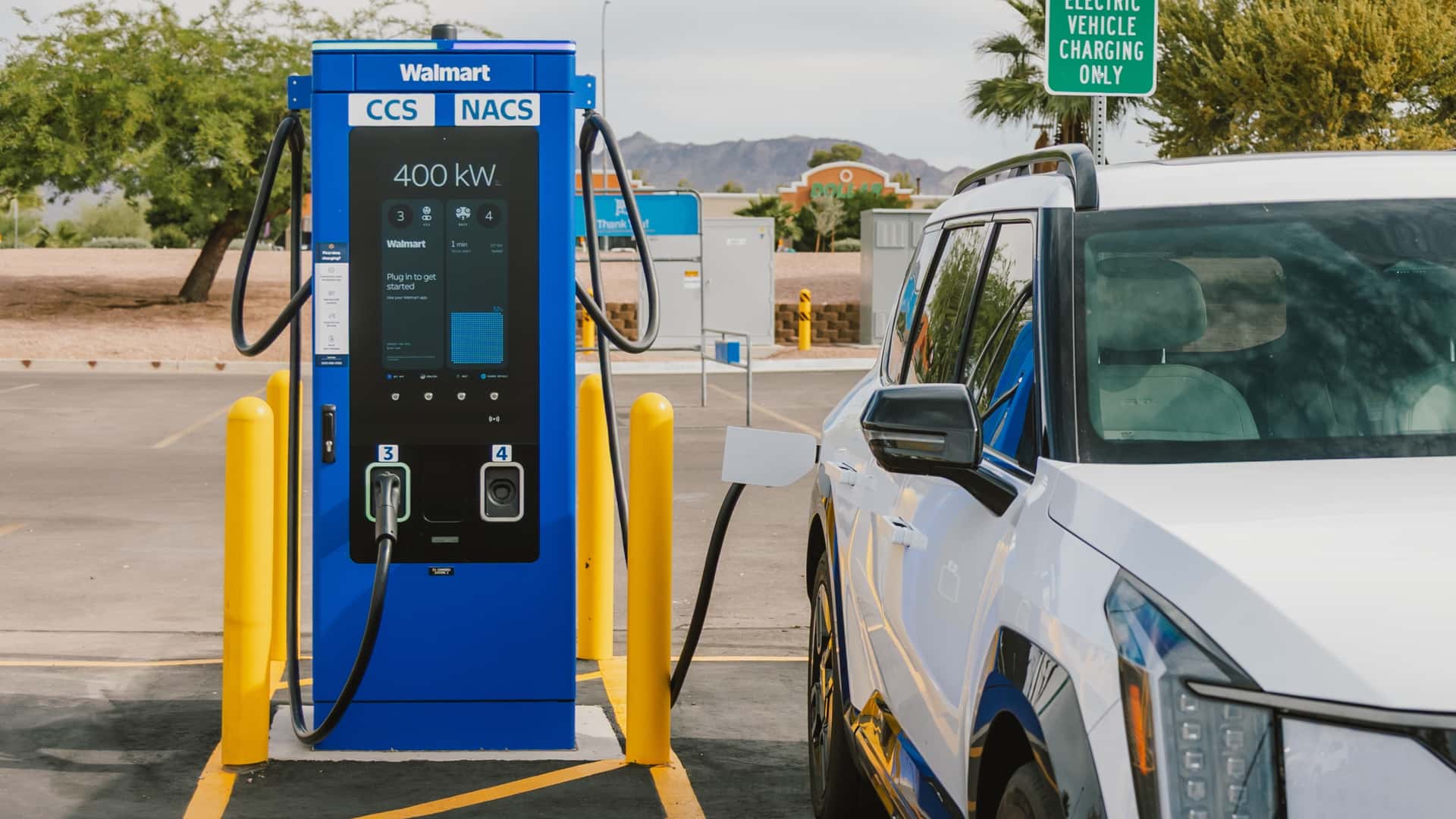
Walmart’s new stations are equipped with advanced 400-kW Alpitronic chargers, supporting both NACS (North American Charging Standard) and CCS (Combined Charging System) plugs. To further incentivize usage, Walmart+ customers receive a 10% discount on charging services. The company has demonstrated a swift deployment, installing hundreds of these EV fast charging units over the past few months.
Ionna, on the other hand, boasts an even more ambitious vision. This joint venture is backed by a consortium of eight prominent automakers: BMW, General Motors, Honda, Hyundai, Kia, Mercedes-Benz, Stellantis, and Toyota. Their collective goal is to alleviate range anxiety among potential EV buyers by committing to build 30,000 fast chargers across the U.S. and Canada by 2030.
Many of Ionna’s planned EV fast charging stations are designed to offer amenities akin to traditional gas stations, including convenience stores and restrooms, alongside universal CCS and NACS plug compatibility. The company has also initiated a robust deployment schedule, installing a significant number of stations in a short period.
Undercutting Established Market Leaders
The core strategy employed by both Ionna and Walmart to attract drivers from incumbent networks like Tesla, Electrify America, and EVGo is competitive pricing. According to data analyzed by Loren McDonald, CEO and chief analyst at Chargenomics, these new players are offering substantially lower rates for EV fast charging.
Chargenomics data indicates that Ionna charges an average of $0.37 per kilowatt-hour (kWh) for electricity, positioning it as the most affordable among the 17 networks analyzed. Walmart follows closely, ranking as the fourth cheapest, with an average price of $0.43 per kWh. Shell Recharge and Rocky Mountain Power were noted as slightly more economical than Walmart in specific contexts.
In contrast, established networks like Tesla and Electrify America currently charge an average of $0.56 per kWh. This pricing disparity means that a driver utilising an Ionna EV fast charging station could realise savings of approximately 40% compared to charging at an Electrify America location.
Loren McDonald highlighted that such aggressive pricing is crucial for new entrants to disrupt the market and overcome consumer inertia. He explained: “They’re the new kid on the block. You and me and the everybody on LinkedIn in the EV industry know who Ionna is. But your average new driver who goes down to the Hyundai dealer or Ford dealer and gets an EV, they have no idea what an ‘Ionna’ is. They’ve heard of Tesla. They’ve probably heard of Electrify America, maybe EVGo.”
McDonald further noted Ionna’s strategy of offering significant holiday and new-station discounts, sometimes reducing prices to as low as $0.20 per kWh for limited periods. This tactical pricing is designed to build brand awareness and attract a new customer base aggressively.
Walmart’s Strategic Imperatives Beyond Direct Revenue
Walmart’s motivation for entering the EV fast charging market extends beyond direct revenue from charging sessions. McDonald explained: “Walmart, obviously, is in the business for a very different reason.”
With thousands of stores across the U.S., Walmart possesses vast real estate in the form of expansive parking lots, which effectively means free land for charger installation. The company’s immense scale also enables it to negotiate highly favourable terms with equipment suppliers and utility providers, significantly reducing installation and operational costs for its EV fast charging infrastructure.
Crucially, the presence of EV fast charging stations at Walmart stores serves as a powerful customer acquisition and retention tool. While the stereotypical demographic of EV drivers may not traditionally align with Walmart’s core customer base, these charging stations can attract new clientele. The primary goal is to encourage EV owners to spend the 40 minutes required for a typical fast charge inside the store, potentially making purchases.
“The stereotypical demographic and psychographic of EV drivers is not like, Walmart customers, right? So they can attract a new customer base and then, the key for them obviously is getting people inside the store for 40 minutes, spending $50 or $100, not just the $22 out front,” McDonald elaborated.
Understanding EV Fast Charging Costs and Comparisons
The emergence of competitive pricing by Ionna and Walmart signals a critical turning point for the EV fast charging industry. For years, the focus was on alleviating range anxiety by building out networks, often at substantial cost. This resulted in higher prices, as chargepoint operators needed to recoup investments and cover high utility demand charges.
To illustrate the cost implications, consider a 2024 Chevy Blazer EV with an EPA range of 279 miles. Fully charging this vehicle at an average rate of $0.56 per kWh would cost approximately $47.60. For comparison, driving the same distance in a gas-powered 2024 Chevy Blazer AWD, with an average fuel efficiency, would consume about 12.68 gallons of gasoline. At the U.S. average of $4.07 per gallon (at the time of analysis), this equates to $51.61. While the EV remains slightly cheaper, the difference is not always substantial at current fast charging rates.
However, prices for EV fast charging can vary significantly. In areas with high electricity costs, a full charge at a premium Tesla Supercharger could reach $0.74 per kWh, translating to a cost of $62.90 for a complete charge. This demonstrates that fast charging prices are not uniformly low and can even exceed the cost of gasoline in certain high-price regions, even when local gas prices are also elevated.
It is important to note that DC fast charging represents only a fraction of overall EV charging habits. Over 90% of EV charging occurs at home, where electricity is considerably cheaper, averaging $0.18 per kWh in American homes. This makes home-charged EVs significantly more economical to run than any gasoline-powered vehicle. Moreover, Level 2 public chargers, which are much more common, also offer lower prices due to less expensive equipment and reduced demand charges compared to high-output DC fast chargers.
The Evolving Landscape of EV Charging Competition
The high costs associated with DC fast charging have historically been accepted as the industry prioritised network expansion over price competition. Operators focused on scale and availability, often burning through cash without the immediate pressure to compete on price. As the industry matures, this dynamic is rapidly changing, leading to a much more competitive environment.
The market is witnessing a diversification of strategies among EV fast charging providers:
- Mercedes-Benz High Power Charging is differentiating itself by focusing on premium amenities and reservation systems to enhance the customer experience.
- BP is investing in large-scale charging hubs, aiming for high capacity and broad accessibility.
- New entrants like Rove are positioning themselves as premium providers, offering elevated charging experiences.
- Established players such as Tesla, Electrify America, and EVGo continue to grow their networks and push membership programmes to retain their customer base.
Against this backdrop, Walmart and Ionna are aggressively expanding their EV fast charging offerings and directly challenging the status quo with their low-price leadership. This intensified competition is ultimately a boon for electric vehicle owners.
As providers vie for market share, the industry is transitioning into an era where consumers can expect not only more accessible and reliable EV fast charging options but also a wider range of amenities and, critically, more competitive pricing. This positive trajectory signifies a maturation of the EV charging ecosystem, promising a better experience for current and future electric vehicle users.
FAQ Section
Q1: Why are Ionna and Walmart offering lower EV fast charging prices?
Both companies are new entrants aggressively expanding their networks and aiming to attract customers. Ionna, backed by automakers, seeks to build brand awareness, while Walmart uses chargers to drive store traffic and leverages its scale for cost efficiencies. Lower prices are a key incentive to shift consumer habits.
Q2: How much cheaper are Ionna and Walmart’s EV fast charging rates?
According to Chargenomics, Ionna averages $0.37 per kWh, and Walmart averages $0.43 per kWh. This compares to an average of $0.56 per kWh for Tesla and Electrify America, representing potential savings of around 40% for drivers at Ionna compared to Electrify America.
Q3: What types of plugs do Walmart and Ionna’s chargers support?
Walmart’s new stations feature 400-kW Alpitronic chargers that support both NACS (North American Charging Standard) and CCS (Combined Charging System) plugs. Ionna’s stations are also equipped with both CCS and NACS plugs to ensure broad compatibility for a wide range of electric vehicles.
Q4: What amenities do Ionna’s EV fast charging stations offer?
Ionna aims to provide a comprehensive charging experience, with many of its stations featuring gas-station-like amenities. These include convenience stores and restrooms, designed to make the charging stop more comfortable and convenient for drivers during their wait.
Q5: Is this pricing competition good for EV owners?
Yes, increased competition among EV fast charging providers is highly beneficial for EV owners. It drives networks to offer not only lower prices but also improved reliability, more convenient locations, and enhanced amenities, ultimately making EV ownership more attractive and cost-effective.
Q6: How does fast charging compare to home charging costs?
DC fast charging is generally more expensive than home charging. The average American home electricity cost is $0.18 per kWh, making home charging significantly cheaper. Fast charging costs are higher due to expensive infrastructure, high utility demand charges, and the convenience of rapid power delivery on the go.