
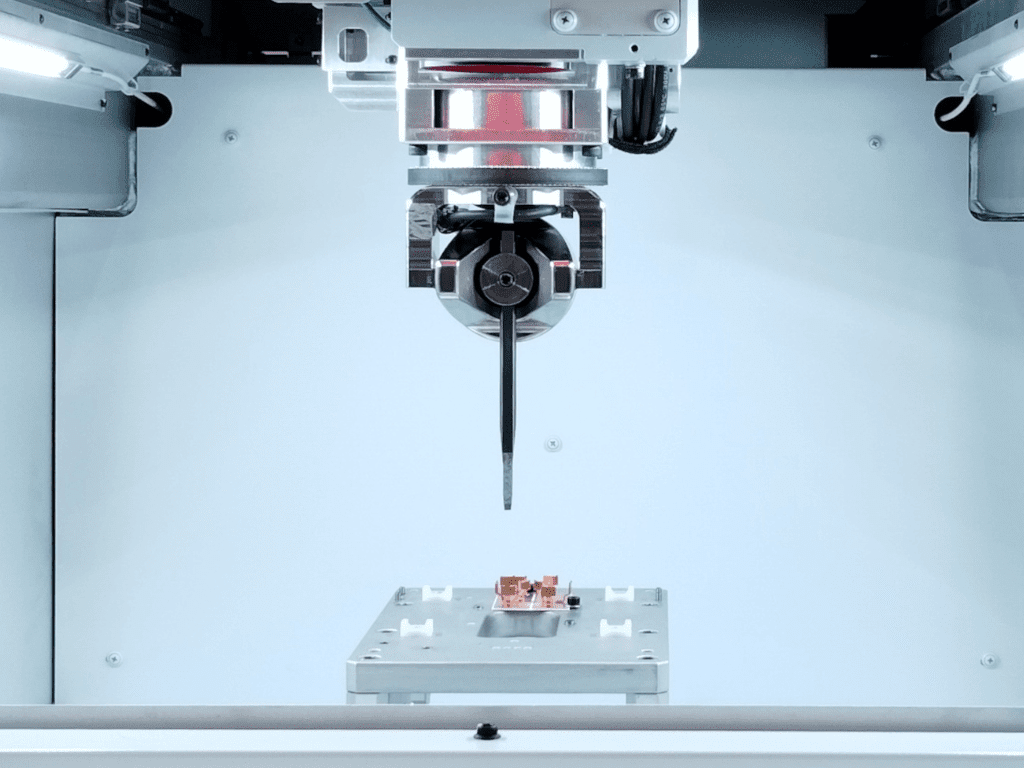
In a significant development for the power electronics industry, Kulicke & Soffa (K&S) has unveiled the ASTERION-TW, an innovative ultrasonic terminal welding system. This new addition to its ASTERION platform represents a crucial advancement in solid-state interconnect options, specifically designed to address the demanding requirements of next-generation power module manufacturing.
The ASTERION-TW system is engineered to meet the stringent reliability standards of critical sectors, including transportation, renewable energy, and data centers. These industries often encounter limitations with conventional mass-reflow processes, which rely on heat-based joining methods. K&S’s new system bypasses these challenges by utilizing ultrasonic welding, a method that ensures robust bonds without the need for external heat.

Revolutionizing Terminal Welding with Ultrasonic Technology
At the core of the ASTERION-TW’s innovation is its ultrasonic welding capability. Unlike traditional techniques that involve melting materials, this system forms bonds by applying high-frequency ultrasonic vibrations under pressure. This solid-state joining process enables the bonding of copper terminals up to 2 mm thick, a capability essential for high-power applications.
A key advantage of this heat-free approach is the elimination of external heat sources, adhesives, consumables, and chemical byproducts. This not only streamlines the manufacturing process but also contributes to a cleaner, more efficient production environment, addressing growing industry demands for sustainable practices in advanced power module manufacturing.
Precision Engineering for Enhanced Performance
The ASTERION-TW system is built with precision in mind, featuring a high-resolution linear motor positioning system. This advanced motion control ensures exceptional accuracy, boasting a weld placement repeatability of ±40 µm (3σ). Such precision is paramount in the intricate world of power module assembly, where even minor deviations can impact overall performance and reliability.

Further enhancing its versatility, the system offers ±180° weld head rotation and a generous 150 mm vertical stroke. This allows for unparalleled access into deep cavities, accommodating diverse module designs and complex layouts. The substantial 300 mm x 300 mm work area provides ample space for various components, facilitating high-volume production.
For operations requiring even greater automation and efficiency, an optional material-handling package is available. This package integrates an inline pallet conveyor equipped with high-force clamping mechanisms and an integrated cleaning station, ensuring a seamless and precise workflow for advanced power module manufacturing lines.
The Strategic Advantages of Solid-State Joining
The rising prominence of ultrasonic terminal welding in power electronics is largely attributed to its inherent benefits as a solid-state joining process. This method fundamentally differs from reflow soldering, where materials are joined by melting the bulk interface. The ultrasonic approach ensures that the materials are bonded without undergoing a phase change, preserving their original properties.
In practical terms, this significantly reduces thermal exposure to sensitive components within the power module. Minimizing heat stress helps prevent material degradation and improves the long-term reliability of the final product. Furthermore, the solid-state nature of the process simplifies the materials stack, offering greater flexibility in design and making it easier to adapt interconnect schemes as module designs evolve to meet future technological demands.
Beyond technical advantages, Kulicke & Soffa highlights the environmental benefits of the ASTERION-TW. The process is touted as a greener manufacturing option due to its lower energy consumption, zero emissions, and improved recyclability of assembled components. This aligns with global efforts towards more sustainable industrial practices, making it an attractive solution for environmentally conscious manufacturers in advanced power module manufacturing.
Expanding the Power Interconnect Portfolio
The ASTERION-TW system seamlessly integrates into Kulicke & Soffa’s extensive power interconnect lineup, reinforcing the company’s commitment to providing comprehensive solutions for the power electronics sector. This portfolio already includes the well-regarded AVALINE clip attach systems, the foundational ASTERION wire and ribbon wedge bonding platform, and ASTERION-PW for pin welding.
The introduction of ASTERION-TW underscores K&S’s strategic vision to offer a diverse range of interconnect technologies that cater to the evolving needs of advanced power module manufacturing. By continuously expanding its offerings, the company aims to provide manufacturers with the tools necessary to innovate and produce highly reliable power modules for a variety of high-growth markets.
Ivy Qin, General Manager of Ball & Wedge Bonding at Kulicke & Soffa, commented on the launch, stating, “ASTERION-TW reflects our commitment to deliver high performance interconnect solutions through engineering excellence and close collaboration with our customers.” This statement emphasizes the company’s dedication to innovation driven by customer needs and industry collaboration, ensuring that its solutions remain at the forefront of technological advancement.
Impact on Critical Industries and Future Outlook
The implications of the ASTERION-TW for industries such as transportation, renewable energy, and data centers are profound. In the automotive sector, particularly with the rapid expansion of electric vehicles (EVs), the demand for highly reliable and efficient power modules is skyrocketing. The ASTERION-TW offers a manufacturing pathway to produce these critical components with enhanced durability and performance, crucial for battery pack design and manufacturing.
Similarly, in renewable energy systems like solar inverters and wind power converters, the longevity and efficiency of power modules directly impact energy generation and grid stability. The heat-free welding process contributes to more robust modules capable of withstanding harsh operating conditions. For data centers, where uninterrupted operation and energy efficiency are paramount, the advanced interconnects facilitated by ASTERION-TW can lead to more reliable and powerful computing infrastructure.
Kulicke & Soffa’s ASTERION-TW represents a significant step forward in the methodology of advanced power module manufacturing. By providing a solid-state, heat-free welding solution, it addresses critical challenges faced by manufacturers in high-reliability applications. This innovation not only enhances product performance and reliability but also aligns with the global push for more sustainable and efficient manufacturing processes, solidifying K&S’s position as a leader in power electronics solutions.