
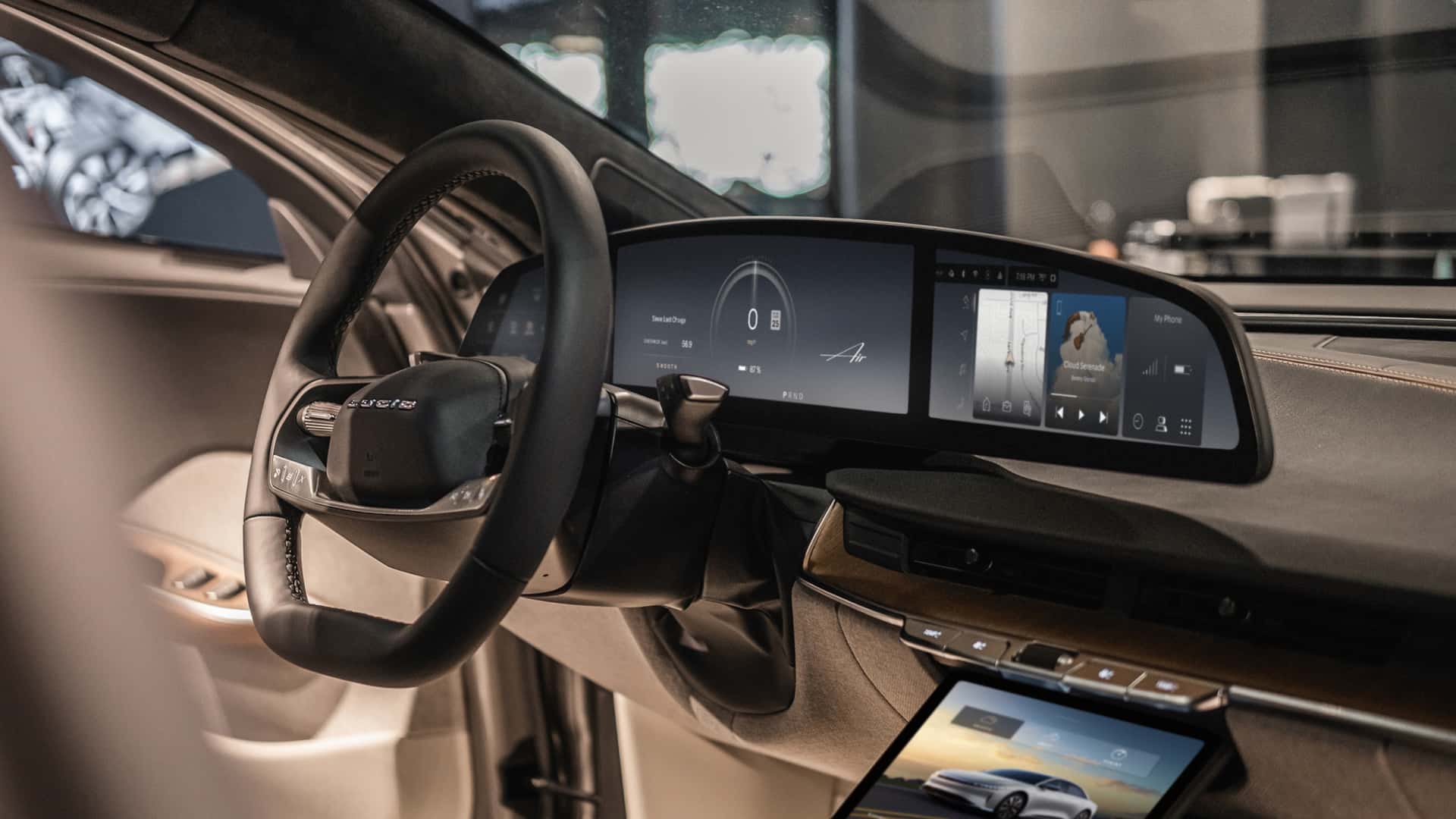
Lucid Motors has officially rolled out a significant overhaul for the infotainment system in its Air luxury electric sedan, aiming to deliver a faster, more intuitive, and ultimately more engaging digital experience for drivers. Dubbed UX 3.0, this comprehensive update introduces a suite of enhancements, ranging from a redesigned home screen to improved navigation and seamless smartphone integration.
While new 2025-and-newer Lucid Air models will receive this advanced system via a complimentary over-the-air (OTA) software update, owners of earlier 2022, 2023, and certain 2024 models will need a hardware upgrade. This essential processor replacement comes with a price tag of $950 in the United States, including installation, to unlock the full capabilities of the new infotainment architecture.
Key Takeaways: Lucid Air UX 3.0 Update
- Lucid Air’s infotainment system receives a major UX 3.0 update, promising faster and more intuitive operation.
- New features include redesigned home screen cards, enhanced multitasking, advanced route planning, and improved Apple CarPlay/Android Auto.
- For 2025-and-newer Lucid Air models, UX 3.0 is a free over-the-air software update (version 2.11.0).
- Owners of 2022, 2023, and select 2024 Lucid Air vehicles will require a $950 processor hardware upgrade to access UX 3.0.
- The hardware retrofit addresses a processor change implemented midway through the 2024 model year.
- A key improvement allows independent operation of the upper Cockpit and lower Pilot Panel displays, enhancing usability.
Elevating the In-Car Digital Experience
In the fiercely competitive luxury electric vehicle (EV) market, the infotainment system is no longer just a convenience feature; it is a core differentiator. It influences everything from daily commutes to long-distance road trips, defining how drivers interact with their vehicle. Lucid Motors’ UX 3.0 update for the Air sedan reflects a strategic move to refine this critical aspect, aligning with the brand’s premium positioning.
The update aims to bridge the gap between a vehicle’s advanced hardware and its human-machine interface (HMI). Lucid’s commitment to an exceptional digital experience is evident in its continuous development, ensuring its vehicles remain at the forefront of automotive technology and user satisfaction. The UX 3.0 update is a testament to this ongoing dedication.
Redesigned Interface and Enhanced Functionality
At the heart of UX 3.0 is a fundamentally redesigned user interface. Drivers will immediately notice a refreshed home screen, now featuring intuitive swipeable cards. These dynamic tiles provide quick access to frequently used features, streamlining the interaction process and reducing menu diving.
A simple swipe on these tiles expands the full application onto the lower, vertically-oriented “Pilot Panel.” This design choice ensures that essential information and controls are always within easy reach, without cluttering the primary driving display. Furthermore, new quick controls allow drivers to swipe down from the top of the Pilot Panel to access popular settings instantly, minimizing distractions on the road.
Advanced Navigation and EV-Specific Route Planning
For electric vehicle owners, efficient route planning is paramount. UX 3.0 significantly upgrades the navigation system to better cater to the unique requirements of EV travel. The enhanced feature now allows drivers to set preferences for charging networks, desired arrival range, and even charging adapter compatibility.
This level of customization helps alleviate range anxiety and simplifies long-distance journeys. By integrating these specific parameters, the Lucid Air infotainment system guides drivers through optimized routes, including convenient charging stops tailored to their personal preferences and the vehicle’s capabilities.
Seamless Multitasking Across Dual Displays
One of the most anticipated improvements in the Lucid Air infotainment update is the newfound independence of the vehicle’s dual screens. Previously, the upper “Cockpit” display and the lower “Pilot Panel” display were largely linked, limiting multitasking capabilities.
With UX 3.0, this limitation is removed. Drivers can now fluidly navigate between different applications across both screens. For instance, the navigation map can be prominently displayed on the upper screen, while the lower Pilot Panel can be simultaneously used to control media, adjust climate settings, or manage other vehicle functions. This independent operation significantly enhances convenience and driver focus.
Improved Smartphone Integration: Apple CarPlay and Android Auto
Modern drivers rely heavily on their smartphone ecosystems. Recognizing this, Lucid has focused on refining its integration of Apple CarPlay and Android Auto within UX 3.0. The company states that these popular features should now operate with greater reliability, offering a more consistent and stable connection.
Beyond reliability, the visual experience has also been upgraded. Apple CarPlay and Android Auto interfaces will now appear larger and more prominently on the Lucid Air’s distinctive crescent-shaped screen, making them easier to read and interact with while driving. This ensures a more immersive and user-friendly experience for those who prefer to project their smartphone’s interface.
The Hardware Imperative: A $950 Processor Upgrade
While the UX 3.0 software update is a transformative step, not all Lucid Air owners will receive it as a simple over-the-air download. Lucid Motors has confirmed that 2025-and-newer models will automatically get the update via software version 2.11.0, incurring no additional cost for the owner.
However, for early adopters and owners of 2022, 2023, and some 2024 Lucid Air models, a hardware retrofit is necessary. This involves replacing the infotainment processor at a cost of $950 in the U.S., a fee that includes both the new processor and its installation.
The reason behind this requirement stems from a mid-production change to the infotainment system’s core hardware. Lucid transitioned to a second-generation infotainment processor midway through the 2024 model year. Vehicles produced before this switch require the upgrade to handle the increased processing demands and advanced features of the UX 3.0 software.
This situation highlights a common challenge in the rapidly evolving automotive technology landscape, where continuous improvements in software often necessitate more powerful underlying hardware. Lucid has indicated that details regarding pricing and availability for other international markets will be released in due course.
Aligning with the Lucid Gravity Experience
The introduction of UX 3.0 for the Lucid Air also serves to harmonize the user experience across the company’s product line. This updated digital interface closely mirrors the advanced system that first debuted in the Lucid Gravity SUV. This strategic move ensures brand consistency and a familiar, high-quality digital environment for customers transitioning between Lucid models or owning multiple vehicles from the manufacturer.
By bringing the Air’s infotainment system up to par with the Gravity, Lucid reinforces its commitment to delivering a cohesive and cutting-edge experience across its luxury EV portfolio. This standardization can also simplify future software development and support, benefiting both the company and its clientele.
The Future of In-Car Technology at Lucid
This significant infotainment update underscores Lucid’s broader commitment to pioneering in-car technology. In an era where vehicle software is as critical as its powertrain, continuous innovation in the user interface and overall digital experience is non-negotiable for luxury manufacturers.
The UX 3.0 rollout demonstrates Lucid’s capability to deliver substantial improvements post-purchase through software and, when necessary, targeted hardware upgrades. This approach is vital for maintaining the relevance and desirability of its vehicles in a dynamic market characterized by rapid technological advancements.
As the automotive industry increasingly shifts towards software-defined vehicles, updates like UX 3.0 will become more frequent and impactful. Lucid Motors is positioning itself to be a leader in this evolution, ensuring its vehicles offer not just exceptional performance and range, but also a sophisticated and enjoyable digital environment for drivers and passengers alike.
Frequently Asked Questions (FAQs)
What is the Lucid Air UX 3.0 update?
UX 3.0 is a major software and, for some models, hardware update to the Lucid Air’s infotainment system. It introduces a redesigned interface, enhanced navigation, improved multitasking across screens, and more reliable Apple CarPlay and Android Auto integration for a faster and more intuitive user experience.
Which Lucid Air models will receive UX 3.0?
All Lucid Air models are eligible for the UX 3.0 update. New 2025-and-newer models will receive it as a free over-the-air software update. Earlier 2022, 2023, and some 2024 models will require a hardware processor upgrade to enable the full functionality of UX 3.0.
Do I need to pay for the UX 3.0 update?
For 2025-and-newer Lucid Air models, the UX 3.0 software update is provided free of charge via an over-the-air download. However, owners of 2022, 2023, and certain 2024 models will incur a $950 charge in the U.S. for the necessary processor hardware upgrade, which includes installation.
Why do older Lucid Air models require a hardware upgrade?
Older Lucid Air models require a hardware upgrade because Lucid transitioned to a more advanced second-generation infotainment processor midway through the 2024 model year. The new UX 3.0 software is designed to leverage the capabilities of this newer processor, necessitating an upgrade for vehicles equipped with the earlier hardware.
What are the key new features of UX 3.0?
Key features include a redesigned home screen with swipeable app cards, quick controls accessible from the Pilot Panel, enhanced route planning with charging preferences, improved Apple CarPlay and Android Auto reliability and display size, and the ability to run different applications simultaneously on the upper Cockpit and lower Pilot Panel screens.
How does UX 3.0 improve multitasking?
UX 3.0 significantly improves multitasking by allowing drivers to use the upper Cockpit display and the lower Pilot Panel independently. For example, navigation can be on the top screen while media controls or other apps are managed on the bottom screen, enhancing driver convenience and reducing the need to switch between full-screen applications.