
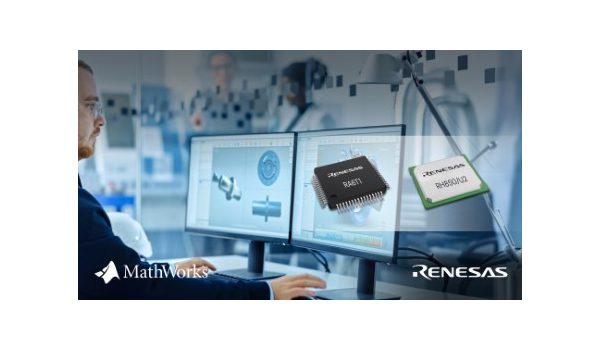
Key Takeaways (TL;DR)
- MathWorks has unveiled new hardware support packages for Renesas’ RH850/U2A automotive and RA6T2 industrial microcontrollers.
- These packages enable direct Simulink deployment of MATLAB and Simulink models to target hardware, significantly streamlining the development process.
- Engineers can now bypass manual toolchain assembly, custom scripting, and initialization code, accelerating the transition from simulation to on-target execution.
- The RH850/U2A package is crucial for electric vehicle (EV) applications like traction motor control and ADAS, reducing time from concept to vehicle-level testing.
- The RA6T2 package targets industrial motion control, offering one-click deployment for servo and variable-speed drives in robotics and factory automation.
- This collaboration aims to enhance development efficiency, foster faster iterations, and reduce integration efforts across critical embedded systems.
Accelerating Embedded Development: A New Era for Automotive and Industrial Control

In a significant development for the embedded systems community, MathWorks has released advanced hardware support packages tailored for Renesas’ critical microcontrollers. These new packages are designed to empower engineers with the capability for direct Simulink deployment of MATLAB and Simulink models onto Renesas’ RH850/U2A automotive and RA6T2 industrial microcontrollers.
This strategic enhancement marks a pivotal step towards dramatically simplifying the development workflow. It eliminates the traditional bottlenecks associated with manual toolchain configuration, the laborious writing of initialization code, and the creation of custom flash scripts, thereby accelerating the entire product lifecycle from concept to validation.
The Core Innovation: Seamless Simulink Deployment

At the heart of this announcement lies the promise of an integrated, automated workflow. Engineers can now develop complex control algorithms within the familiar and powerful Simulink environment. Once the model is refined, a simple trigger initiates an automated build process.
The newly introduced hardware support package takes over, efficiently handling the compilation, flashing, and subsequent on-target execution of the algorithm directly onto the physical Renesas chip. This seamless transition is expected to liberate engineering teams from tedious, error-prone manual tasks, allowing them to focus more on innovation and optimization.
Empowering Automotive Innovation: Focus on RH850/U2A
For the rapidly evolving automotive sector, particularly in the realm of electric vehicle (EV) engineering, the support for Renesas’ RH850/U2A automotive microcontroller is a game-changer. This robust microcontroller is widely employed in Electronic Control Units (ECUs) that manage critical EV functions, including traction motor control, Advanced Driver-Assistance Systems (ADAS), and various body electronics.
The ability for direct Simulink deployment means that sophisticated control strategies, such as field-oriented control for precise motor regulation and regenerative braking algorithms for energy recovery, can move from theoretical simulation to practical hardware implementation with unprecedented speed. This reduction in integration steps between design and validation is vital for meeting aggressive development timelines.
Shortening the time from initial concept development to comprehensive vehicle-level testing is a critical advantage in today’s competitive automotive landscape. Furthermore, the streamlined process is set to expedite calibration across diverse drive cycles, enabling engineers to fine-tune performance and efficiency more rapidly and effectively. This ultimately contributes to faster market entry for new EV technologies and enhancements.
Driving Industrial Automation: Precision with RA6T2 Microcontroller
Beyond automotive applications, the industrial sector stands to gain significantly from the MathWorks-Renesas collaboration. The new package for the RA6T2 industrial microcontroller targets high-precision industrial motion control applications. This includes servo drive and variable-speed drive systems, which are foundational to modern robotics and sophisticated factory automation processes.
With one-click Simulink deployment capabilities, engineers working on industrial systems can now achieve rapid on-bench closed-loop tuning. This dramatically simplifies the iterative process of optimizing motor control, ensuring higher accuracy, better response times, and enhanced overall system performance in demanding industrial environments. The efficiency gains translate directly into quicker deployment of automated solutions and improvements in manufacturing productivity.
Addressing Industry Challenges: The Value Proposition
Embedded systems development has historically been characterized by its complexity, often involving fragmented toolchains and significant manual integration efforts. Engineers frequently spend considerable time on non-core activities like configuring compilers, linking libraries, and debugging low-level communication protocols between software and hardware.
These new hardware support packages directly address these pain points. By providing a unified environment for model-based design and direct Simulink deployment, MathWorks and Renesas are enabling engineers to shift their focus from integration hurdles to core algorithm development and system innovation. This approach inherently reduces the potential for human error, improves code reliability, and accelerates the validation cycle.
The benefit of iterating faster means design flaws can be identified and corrected earlier in the development process, minimizing costly rework and delays downstream. This robust framework for rapid prototyping and validation is indispensable for industries under constant pressure to deliver more advanced and efficient solutions.
Strategic Collaboration: A Unified Vision for Engineering Excellence
The synergy between MathWorks, a leader in mathematical computing software, and Renesas, a prominent provider of microcontroller solutions, underscores a shared commitment to enhancing engineering productivity. This partnership seeks to provide developers with a more integrated and user-friendly experience, thereby fostering greater innovation.
Brad Rex, Senior Director at Renesas, articulated the vision behind this collaboration: “By working with MathWorks, we’ve removed the need to assemble toolchains and device drivers by hand so teams can simulate and validate designs earlier, iterate faster, and reduce integration effort.” This statement highlights the core objective: to streamline workflows and empower engineers to bring their ideas to fruition more efficiently.
Broader Implications for EV Engineering and Smart Manufacturing
The advancements in Simulink deployment capabilities for Renesas microcontrollers will have far-reaching implications. For EV engineering, it means faster development cycles for more efficient power electronics, advanced battery management systems, and sophisticated autonomous driving features. This contributes directly to the overall acceleration of electric mobility adoption and performance improvements.
In the industrial sphere, the enhanced support facilitates the rapid deployment of next-generation robotics, intelligent manufacturing systems, and highly responsive automation solutions. As industries worldwide embrace Industry 4.0 paradigms, tools that bridge the gap between model-based design and real-world hardware implementation become increasingly critical for maintaining a competitive edge.
Conclusion
The release of these hardware support packages by MathWorks for Renesas’ RH850/U2A and RA6T2 microcontrollers represents a significant step forward in embedded systems development. By simplifying the complex process of deploying control algorithms, it empowers engineers in both automotive and industrial sectors to innovate with greater speed and efficiency. This collaboration is poised to accelerate the development of the next generation of electric vehicles and intelligent industrial machinery, driving progress across critical technological frontiers.
Source: MathWorks
Frequently Asked Questions (FAQ)
Q1: What is the primary benefit of these new hardware support packages?
A1: The main benefit is the ability for direct Simulink deployment of MATLAB and Simulink models to Renesas microcontrollers. This eliminates manual tasks like toolchain assembly and custom coding, significantly speeding up the development and validation of control algorithms for automotive and industrial applications.
Q2: Which Renesas microcontrollers are supported by these new packages?
A2: The new hardware support packages specifically provide direct Simulink deployment capabilities for Renesas’ RH850/U2A automotive microcontroller and the RA6T2 industrial microcontroller, catering to distinct yet equally critical application areas.
Q3: How do these packages impact electric vehicle (EV) development?
A3: For EV development, the RH850/U2A package streamlines the deployment of complex algorithms for traction motor control, ADAS, and body electronics. This shortens the time from concept to vehicle-level testing and speeds up calibration, accelerating the innovation cycle in electric mobility.
Q4: What applications in industrial automation benefit from the RA6T2 package?
A4: The RA6T2 package is designed for industrial motion control applications, including servo drives and variable-speed drives used in robotics and factory automation. It offers one-click deployment for efficient on-bench closed-loop tuning, improving precision and performance in automated systems.
Q5: Do these packages require engineers to learn new programming languages or tools?
A5: No, these packages integrate directly with existing MATLAB and Simulink environments. Engineers can continue to design and model control algorithms within Simulink, with the new packages handling the underlying complexities of compilation and deployment to the Renesas hardware.
Q6: How does this collaboration reduce integration effort for development teams?
A6: The collaboration reduces integration effort by automating the process of compiling, flashing, and executing models on hardware. As Renesas Senior Director Brad Rex stated, it removes the need to manually assemble toolchains and device drivers, allowing teams to focus on design and validation.
Q7: Is this solution suitable for rapid prototyping and iterative design?
A7: Absolutely. The streamlined Simulink deployment process facilitates rapid prototyping by enabling quick transitions from simulation to hardware. This allows engineers to iterate on designs faster, test changes efficiently, and validate performance in real-time, accelerating the overall development timeline.