
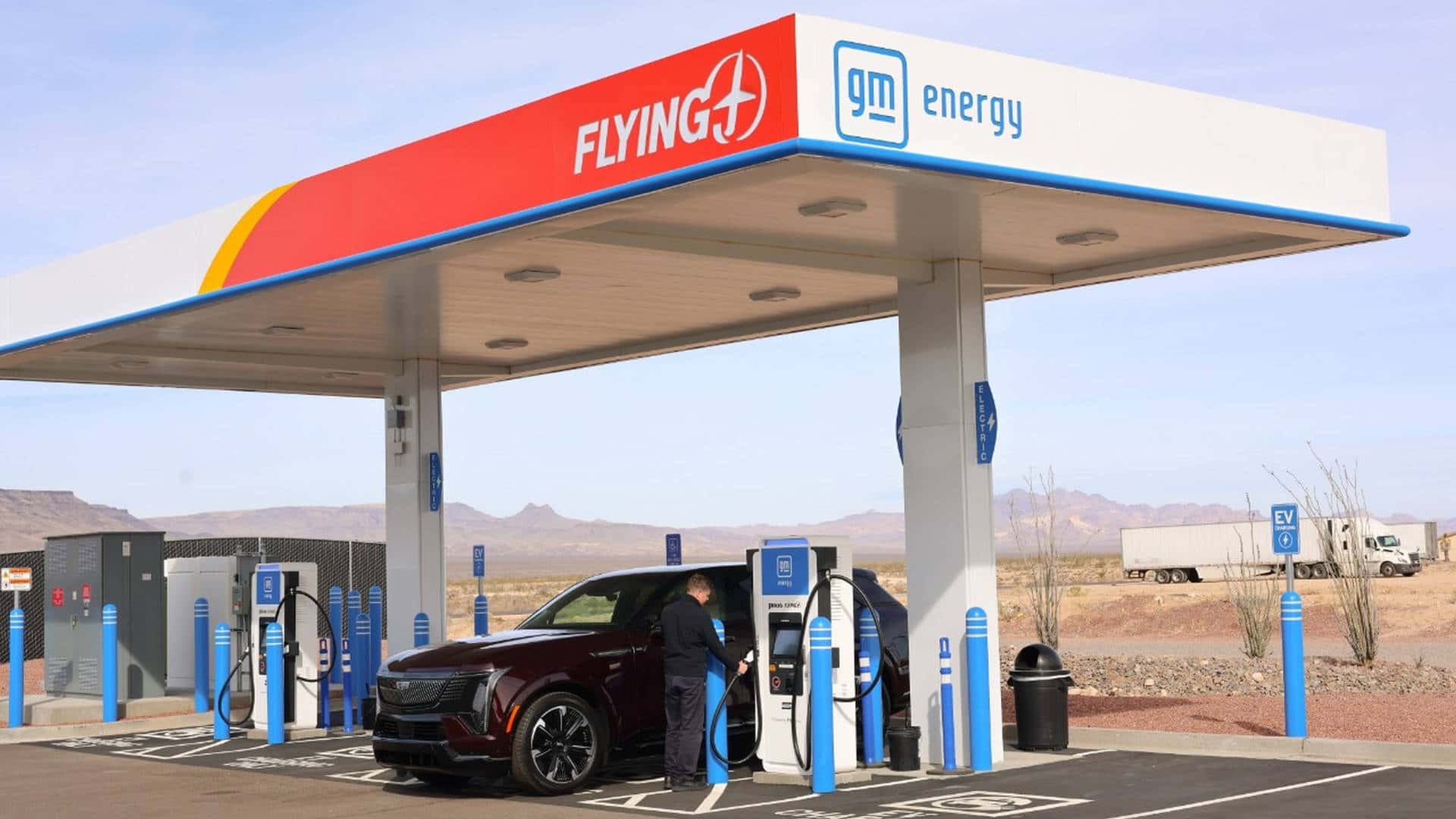
Key Takeaways:
- Pilot Company has expanded its electric vehicle (EV) charging network to over 300 locations across North America, marking a significant milestone in sustainable travel infrastructure.
- This expansion represents an increase of more than 50% in the number of fast-charging stations in less than a year, demonstrating rapid progress in EV charging deployment.
- The network now features close to 1,300 individual 350 kW fast-charging stalls, primarily EVgo dispensers, strategically located along major interstate travel corridors.
- The initiative is part of a 2022 partnership with GM Energy and EVgo, aiming to install up to 2,000 fast chargers at 500 Pilot and Flying J sites across the U.S.
- These travel centers offer comprehensive amenities, including well-lit bays, free Wi-Fi, on-site restaurants, and groceries, enhancing the charging experience for EV drivers on long journeys.
Pilot Company, North America’s largest network of travel centers, has achieved a significant milestone in its commitment to enhancing electric vehicle infrastructure. The company has announced that its comprehensive EV charging network now spans over 300 locations across the United States, providing crucial fast-charging capabilities for electric vehicle drivers.

This rapid expansion underscores a burgeoning effort to support the growing adoption of electric vehicles and alleviate range anxiety for long-distance travelers. The increased availability of high-speed charging options at familiar and convenient roadside locations marks a pivotal step in the national transition towards electrified transportation.
Rapid Expansion Across North America
The acceleration of Pilot’s EV charging network has been notably swift. In a period spanning less than a year, the number of fast-charging stations operated by Pilot has surged by over 50%. This impressive growth highlights the company’s aggressive strategy to meet the evolving demands of the electric mobility landscape.
Milestones Achieved and Future Trajectory
As reported, Pilot added 50 new sites across 25 states during the first half of 2026 alone, bringing the total number of operational stations to 301, according to the company’s official website. This substantial increase builds upon a foundation of just over 200 charging stations available at Pilot’s travel centers last September.

Beyond the station count, the network’s capacity is further detailed by EV charging data platform Paren, which indicates that the total number of individual charging stalls is nearing 1,300. This dense deployment ensures that more EV drivers can access reliable power simultaneously, reducing wait times and improving overall efficiency.
Strategic Locations for Driver Convenience
The strategic placement of these charging stations is a cornerstone of Pilot’s initiative. By integrating high-speed EV chargers into their existing travel center infrastructure, Pilot ensures that electric vehicle owners can charge their vehicles along major interstate travel corridors, mirroring the convenience traditionally offered to internal combustion engine vehicle users.
These locations are designed to cater to the needs of travelers, offering amenities such as well-lit charging bays for safety and visibility, access to free Wi-Fi for productivity or entertainment during charging sessions, and the availability of on-site restaurants and groceries. This holistic approach aims to transform charging stops from mere necessities into comfortable and convenient breaks for EV drivers.
Advanced Charging Technology and User Experience
Central to Pilot’s expanding network is the deployment of cutting-edge charging technology, specifically 350-kilowatt (kW) EVgo dispensers. These high-power chargers are crucial for minimizing charging times, enabling electric vehicles to regain significant range in a relatively short period, which is essential for long-haul travel.
Power and Efficiency: The 350 kW Advantage
Each 350 kW EVgo dispenser is equipped with two charging cables, offering flexibility for drivers. While the maximum output is shared if two vehicles are charging simultaneously, a single vehicle utilizing a dispenser can leverage the full 350 kW power output. This high-capacity charging capability makes Pilot’s network particularly attractive for modern EVs capable of ultra-fast charging, significantly reducing the duration of roadside stops.
Seamless Charging with Plug-and-Charge
Further enhancing the user experience, the charging network supports Plug-and-Charge functionality for compatible electric vehicles. This technology streamlines the charging process, allowing drivers to simply plug in their vehicle to initiate a charging session without needing to interact with a separate payment app or card. Provided a payment method is pre-configured, Plug-and-Charge offers a frictionless and intuitive charging experience, mirroring the simplicity of refueling a gasoline vehicle.
Sean Marrero, President of Retail at Pilot, emphasized the company’s focus on customer-centric investments. “Pilot is focused on investing in areas that matter most to create spaces our guests want to return to and are worth staying for our team members,” Marrero stated. “Whether you’re stopping for a charge, a full tank, or a fresh meal this summer, we are making the most of every mile for every traveler on the open road.” This statement reinforces Pilot’s commitment to providing a comprehensive and enjoyable experience for all travelers, regardless of their vehicle’s propulsion system.
A Collaborative Vision for EV Infrastructure
The extensive build-out of Pilot’s EV charging network is the result of a significant strategic partnership forged in 2022. This collaboration involves Pilot Company, GM Energy, and EVgo, uniting industry leaders to tackle the challenges of EV infrastructure deployment on a grand scale.
The GM Energy and EVgo Partnership
The ambitious partnership was initially conceived to install up to 2,000 fast chargers across as many as 500 Pilot and Flying J locations throughout the United States. This monumental undertaking aims to establish one of the most widespread and accessible fast-charging networks for electric vehicles, fundamentally changing how EV owners approach long-distance travel.
The rollout commenced with the first stations coming online by the end of 2023. The network has seen consistent expansion, with over 130 stations already operational in more than 25 states by March 2025. With the latest announcement, Pilot has officially passed the halfway point towards achieving its ultimate goal of 2,000 chargers, demonstrating robust progress and execution on the partnership’s commitments.
Bridging Gaps on Major Travel Corridors
The strategic alliance targets a crucial need: reliable charging infrastructure along major travel arteries. By focusing on Pilot and Flying J travel centers, the partnership ensures that EV drivers can find charging solutions at predictable intervals, akin to traditional fueling stations. This approach directly addresses concerns about range anxiety, which remains a significant barrier to broader EV adoption.
The modernization efforts alongside new installations are also critical. For instance, the company installed new chargers in key locations such as Chicopee, Massachusetts, and Ponce de Leon, Florida. Simultaneously, it undertook the modernization of 18 existing locations across 13 U.S. states and Canadian provinces. These upgrades ensure that the network remains state-of-the-art and capable of serving the latest generation of electric vehicles.
Driving the Future of Electric Mobility
The expansion of the EV charging network by companies like Pilot is indispensable for the widespread adoption of electric vehicles. A robust and reliable charging infrastructure is not merely a convenience but a fundamental requirement for electric mobility to reach its full potential.
Addressing Range Anxiety and Boosting Adoption
One of the primary concerns for prospective EV buyers is ‘range anxiety’—the fear of running out of power before reaching a charging station. The proliferation of fast chargers at convenient locations directly combats this fear, making long road trips and interstate travel more feasible and less stressful for EV owners. This enhances the practicality and appeal of electric vehicles for a wider demographic, accelerating the shift away from fossil fuel dependency.
Industry-Wide Efforts in Charging Expansion
Pilot is not alone in its commitment to expanding EV charging offerings. The broader industry is witnessing significant investments in this critical area. Walmart, for example, is also aggressively supercharging its efforts, with reports indicating that the retail giant already has over 600 charging ports operational across its locations. Such parallel developments underscore a collective push across various sectors to build a comprehensive national charging grid.
These large-scale deployments by major companies are creating a more interconnected and reliable ecosystem for electric vehicles. As more charging points become available, the overall utility and convenience of owning an EV will only increase, driving further consumer confidence and market growth.
Looking Ahead: The Road to 2,000 Chargers
With more than 300 locations now active and nearing 1,300 individual stalls, Pilot Company has made substantial headway in its goal to install 2,000 fast chargers at 500 travel centers. This ambitious target, set in partnership with GM Energy and EVgo, positions Pilot as a key player in shaping the future of electric vehicle travel in North America.
The continued rollout of 350 kW fast chargers, strategically integrated with essential travel amenities, promises to provide a robust backbone for the evolving electric vehicle landscape. This sustained investment and expansion will not only serve current EV drivers but also encourage more consumers to make the transition to electric, contributing significantly to a more sustainable transportation future.
FAQ Section
How many EV charging locations does Pilot Company currently have?
Pilot Company has expanded its EV charging network to over 300 locations across North America, with 301 stations reported on its website. This represents a significant milestone in providing accessible charging infrastructure for electric vehicle owners.
What type of chargers are installed at Pilot locations?
Pilot locations primarily feature 350-kilowatt (kW) EVgo dispensers. These are fast chargers designed to provide rapid power to electric vehicles, allowing for quick charging sessions, especially beneficial for long-distance travel on interstate corridors.
How many individual charging stalls are available?
According to EV charging data platform Paren, Pilot’s network offers close to 1,300 individual charging stalls. This high number of stalls at various locations helps to reduce wait times and improve accessibility for EV drivers.
When did Pilot begin expanding its EV charging network?
Pilot Company, in partnership with GM Energy and EVgo, initiated its major EV charging expansion in 2022. The first stations became operational by the end of 2023, with rapid growth continuing into the present period.
What amenities are available at Pilot’s EV charging stations?
Pilot’s travel centers offer a range of amenities for EV drivers, including well-lit charging bays, free Wi-Fi, on-site restaurants, and grocery options. These features aim to enhance comfort and convenience during charging stops.
What is the ultimate goal of Pilot’s EV charging partnership?
The partnership between Pilot Company, GM Energy, and EVgo aims to install up to 2,000 fast chargers at up to 500 Pilot and Flying J locations across the U.S. This ambitious goal is designed to build a comprehensive national fast-charging network.