
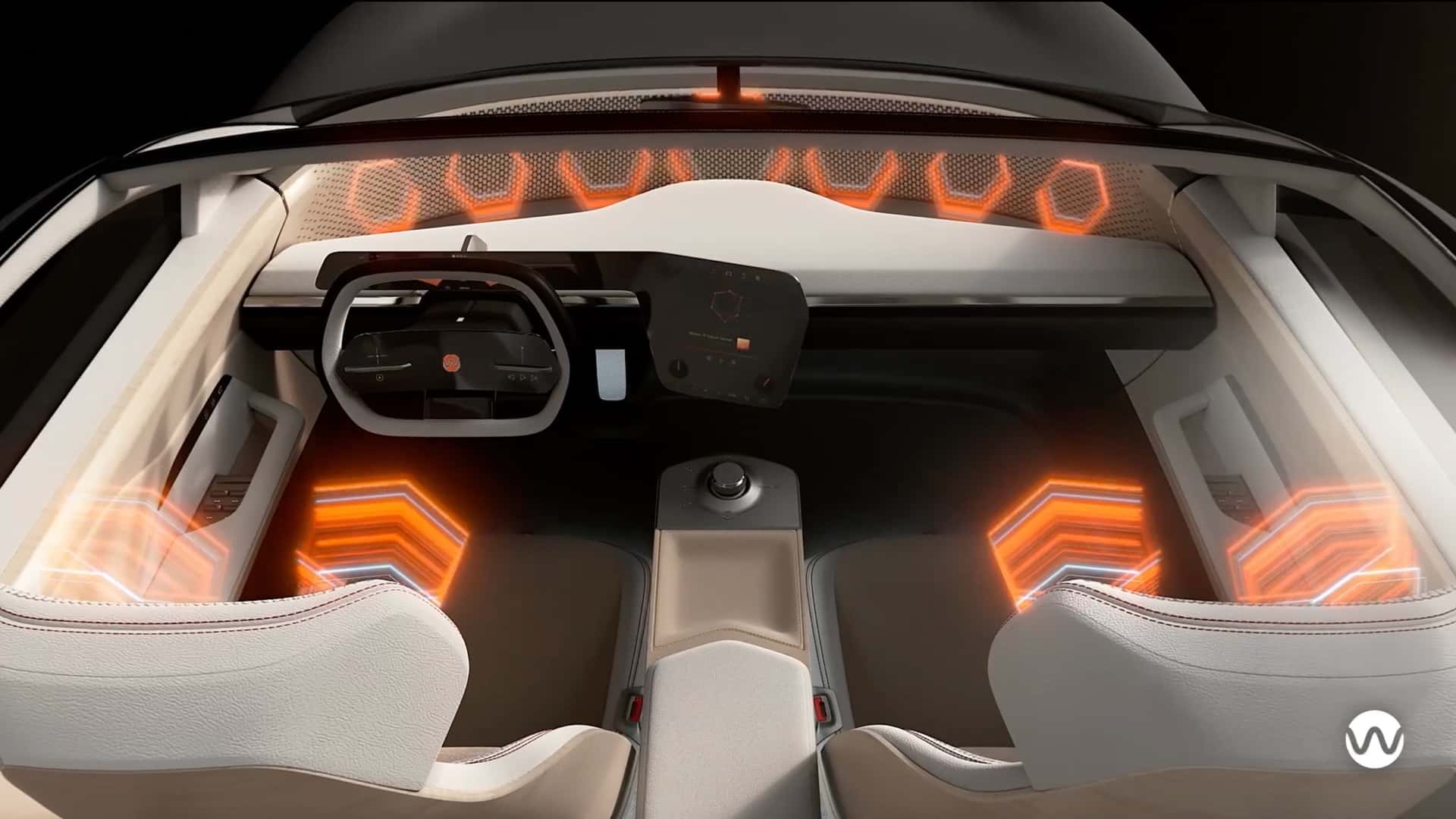
A select few auditory experiences are indelibly etched into memory, capable of evoking a profound sensory response. For some, it’s the raw power of a live concert; for others, the immersive embrace of advanced spatial audio in a cinema. The latest contender for such a memorable encounter now resides within the opulent confines of the Range Rover SV Ultra, where its groundbreaking electrostatic speakers are setting a new benchmark for in-car sound.
Luxury automaker Land Rover has embarked on a significant quest to redefine automotive audio. The marque’s new system, featuring revolutionary electrostatic speakers, eschews much of the conventional speaker hardware in favor of a radically simplified design. This innovative approach has positioned Jaguar Land Rover as the world’s first automaker to integrate electrostatic speakers into a production vehicle.

Following an extensive 20-minute demonstration, the system in the Range Rover SV Ultra delivered an auditory experience described as nothing short of ‘sensory magic.’ It stands as arguably the most impressive car audio system heard to date, promising a concert-hall experience within the vehicle’s cabin.
Key Takeaways (TL;DR)
- Groundbreaking Technology: Range Rover SV Ultra introduces the world’s first production-car electrostatic speakers, developed by Warwick Acoustics.
- Radically Simplified Design: Ditching traditional voice coils, magnets, and cones, these speakers use a 1-millimeter membrane between two charged metal plates.
- Unprecedented Sound Fidelity: Delivers exceptional precision and zero perceptible distortion, reproducing sound 1,000 times faster than conventional units.
- Enhanced Efficiency: Consumes 90% less energy and has 90% less mass, eliminating rare-earth materials, potentially extending EV range by up to 20 miles (WLTP).
- Immersive Experience: Creates a unique sense of space, making music float naturally within the cabin, complemented by bass speakers and haptic feedback seats/floor.
- Luxury Offering: Standard on the SV Ultra trim, available as a $12,570 option on other SV trims, representing a significant leap in premium in-car audio technology.
A Paradigm Shift in Automotive Audio
For decades, advancements in automotive audio primarily refined the foundational principles of the traditional dynamic speaker. These systems, while impressive, fundamentally rely on the same core components: a voice coil, a magnet, and a diaphragm attached to a cone. An electrical signal energises the voice coil within a magnetic field, causing it to move and push the cone, thereby displacing air to generate sound waves.
Over the past century, improvements have largely centred on material science, sophisticated tuning algorithms, more powerful amplification, and advanced software integration. Modern high-end systems—such as the Bowers & Wilkins Diamond Surround Sound in Volvo and BMW models, Burmester 3D spatial audio in Mercedes-Benz, or AKG systems with Dolby Atmos in Cadillacs—have pushed the boundaries of immersion and entertainment. However, they remain rooted in this established dynamic driver paradigm.

Beyond Traditional Drivers: The Electrostatic Advantage
The innovation introduced with the Range Rover electrostatic speakers marks a significant departure from these conventional designs. At its core, the hardware is dramatically simplified. Gone are the cones, voice coils, and magnets that define traditional speakers. Instead, the technology employs a hair-thin, 1-millimeter membrane suspended between two electrically charged metal plates.
This minimalist design fundamentally alters how sound is produced. Unlike a cone that is mechanically pushed, the membrane itself vibrates in direct response to an electrical signal. This direct movement, coupled with an infinitesimally lower moving mass, is key to the system’s superior performance.
Tilesh Karania, the senior electrical innovation engineer at Jaguar Land Rover, elucidated this during the demonstration: “The SV Ultra has 21 of these membranes throughout the cabin. Instead of moving a cone, the membrane itself vibrates in response to an electrical signal to produce sound. That dramatically lower moving mass allows the speakers to reproduce sound with exceptional precision and zero perceptible distortion.”
The Engineering Behind the Innovation
The development of these cutting-edge Range Rover electrostatic speakers is the result of collaboration with U.K.-based Warwick Acoustics, a company at the forefront of this advanced audio technology. Their expertise has enabled Land Rover to deploy a system that not only offers unparalleled sound quality but also boasts notable efficiency and environmental benefits.
Simplified Design, Superior Performance
The inherent simplicity of the electrostatic speaker design translates directly into performance advantages. With fewer moving parts and the elimination of heavier components like magnets and voice coils, the system is capable of responding to audio signals with astonishing speed and accuracy. This allows for a pristine reproduction of sound, capturing nuances often lost in conventional setups.
The 21 electrostatic membranes distributed across the Range Rover SV Ultra’s cabin work in concert to create a cohesive sound field. The absence of traditional speaker components significantly reduces internal resonance and mechanical distortion, factors that often colour the sound produced by dynamic drivers. The outcome is an audio output that is incredibly clean, transparent, and true to the original recording.
Efficiency and Environmental Benefits
Beyond acoustic fidelity, the Range Rover electrostatic speakers deliver substantial practical advantages. The system responds an impressive 1,000 times faster than conventional units, yet it achieves this with remarkable energy efficiency, consuming 90% less power. This reduction in power consumption is a critical factor, particularly in the context of modern vehicle design.
Furthermore, the technology contains 90% less mass compared to traditional premium audio setups, contributing to overall vehicle weight reduction. This mass reduction, combined with the elimination of magnets and rare-earth materials, underscores a commitment to sustainable engineering. Warwick Acoustics estimates that on an electric vehicle (EV) equipped with a 100-kilowatt-hour battery, its electrostatic system could extend the WLTP range by up to 20 miles. This potential for improved EV efficiency presents a compelling argument for wider adoption of the technology.
Holistic Immersion: Beyond the Speakers
While the electrostatic membranes form the core of the system, Land Rover has ensured a comprehensive audio experience that engages more than just the ears. To deliver a full-spectrum sound that includes robust low frequencies, the system integrates five additional bass speakers. These work in conjunction with what the company terms “Body and Soul” seats and a “Haptic Floor.”
Tactile Feedback and Customisation
The “Haptic Floor” utilizes transducers to create a bass-like vibrational effect, adding a tactile dimension to the listening experience. Similarly, four transducers are strategically installed in each seat, allowing occupants to physically feel the music. While this haptic feedback enhances immersion, Land Rover provides occupants with the flexibility to adjust or completely deactivate the intensity of these transducers. This customisation ensures that the tactile effect complements, rather than overwhelms, the exceptional clarity of the Range Rover electrostatic speakers.
For some, the sheer precision and clarity of the electrostatic speakers themselves are sufficient, rendering additional haptic effects as potentially superfluous. The ability to tailor this element allows for a personalised audio environment, catering to individual preferences without compromising the core acoustic performance.
The Unrivaled Listening Experience
To truly appreciate the transformative nature of these Range Rover electrostatic speakers, one must experience them firsthand. The demonstration commenced with Susanne Vega and DNA’s “Tom’s Diner,” a track renowned for its minimalist production and vocal intimacy. The senior electrical innovation engineer noted, “You can hear her breathe,” a statement that proved to be an accurate description of the astounding detail. “Every inhale before each sentence came through with a jaw-dropping level of clarity,” showcasing the system’s ability to render even the most subtle vocal nuances.
Clarity, Detail, and Spatial Presentation
The subsequent playback of “Hotel California” further exemplified the system’s prowess. The acoustic and electric guitars, bass lines, drums, and percussion were presented with remarkable clarity, each instrument distinctly rendered without any sense of muddiness, compression, or distortion. It was an experience akin to being in a professional recording studio, where every single note comes to life with crystalline purity.
Beyond the detailed fidelity, the most striking attribute was the profound “sense of space” created within the cabin. This was not the artificial separation often associated with 3D spatial audio, where sounds are distinctly placed from various directions. Instead, the music seemed to transcend the physical boundaries of the vehicle, as if originating from beyond the car’s interior walls. The sound diffused evenly and naturally, floating around the interior with a beautiful cohesiveness that defied easy localisation from specific speakers.
This unique spatial presentation had a calming effect, making sustained listening, even at higher volumes, unusually comfortable and less fatiguing. The impressive dynamic range of these speakers was evident, handling diverse genres from the intricate layers of “Hotel California” to the pop sensibilities of Taylor Swift’s “Lavender Haze” with consistent, unwavering clarity.
Market Positioning and Future Implications
The introduction of the Range Rover electrostatic speakers marks a significant milestone in automotive audio. While existing premium audio systems are undoubtedly impressive, this new technology raises the bar to an unprecedented level. The implications for the luxury automotive segment are substantial, potentially prompting other high-end manufacturers to explore similar partnerships with Warwick Acoustics.
Exclusivity and Pricing
Currently, the electrostatic speaker system is offered as standard equipment on the Range Rover SV Ultra trim, the pinnacle of the Range Rover lineup. For clients opting for other non-ultra SV trims, this extraordinary audio system is available as an option at a considerable sum of $12,570. While this represents a significant investment, it is positioned within the context of a quarter-million-dollar vehicle, where such an enhancement aligns with the expectations of ultra-luxury buyers seeking unparalleled experiences.
The Road Ahead for Premium Audio
The broader hope within the industry is that this advanced audio technology will not remain exclusively within the domain of ultra-luxury vehicles. Should these sophisticated Range Rover electrostatic speakers eventually become more accessible and trickle down into a wider range of vehicles, they could represent one of the most substantial advancements in automotive audio in many decades, fundamentally changing how occupants experience music on the move.
This innovation underlines a growing trend towards elevating the in-car experience, making the journey as refined and enjoyable as the destination. The electrostatic speakers in the Range Rover SV Ultra are a testament to what is possible when pioneering technology meets automotive luxury, offering a glimpse into the future of premium sound on wheels.
Frequently Asked Questions (FAQ)
What are electrostatic speakers?
Electrostatic speakers are a type of audio transducer that produces sound using a thin, electrically charged membrane suspended between two perforated metal plates. Unlike conventional speakers that use magnets and voice coils to move a cone, electrostatic speakers vibrate the membrane directly in response to an electrical signal, resulting in incredibly precise and distortion-free sound reproduction.
How do Range Rover electrostatic speakers differ from traditional car audio systems?
Traditional car audio systems rely on dynamic drivers with cones, magnets, and voice coils. Range Rover’s electrostatic speakers, developed by Warwick Acoustics, forgo these components. They use a simplified design with a thin membrane and charged plates, offering significantly faster response times, reduced mass, and lower energy consumption, leading to superior clarity and a unique spatial sound.
What are the key benefits of this new audio technology?
The primary benefits include exceptional sound precision with zero perceptible distortion, 1,000 times faster response compared to conventional speakers, and a remarkable 90% reduction in energy consumption and mass. Additionally, they eliminate the need for rare-earth materials and can potentially enhance an electric vehicle’s range due to their efficiency.
Is the Range Rover electrostatic speaker system available on all models?
No, the electrostatic speaker system is currently offered as standard equipment on the Range Rover SV Ultra trim. For other non-ultra SV trims, it is available as an optional upgrade, carrying a significant additional cost of $12,570, reflecting its premium and pioneering nature within the luxury segment.
How does the system create an immersive experience beyond just sound?
Beyond the 21 electrostatic membranes, the system integrates five additional bass speakers, “Body and Soul” seats, and a “Haptic Floor.” The seats and floor incorporate transducers that vibrate in sync with the audio, adding a tactile dimension to the bass frequencies. This haptic feedback can be adjusted or turned off based on user preference, offering a customisable, multi-sensory experience.