
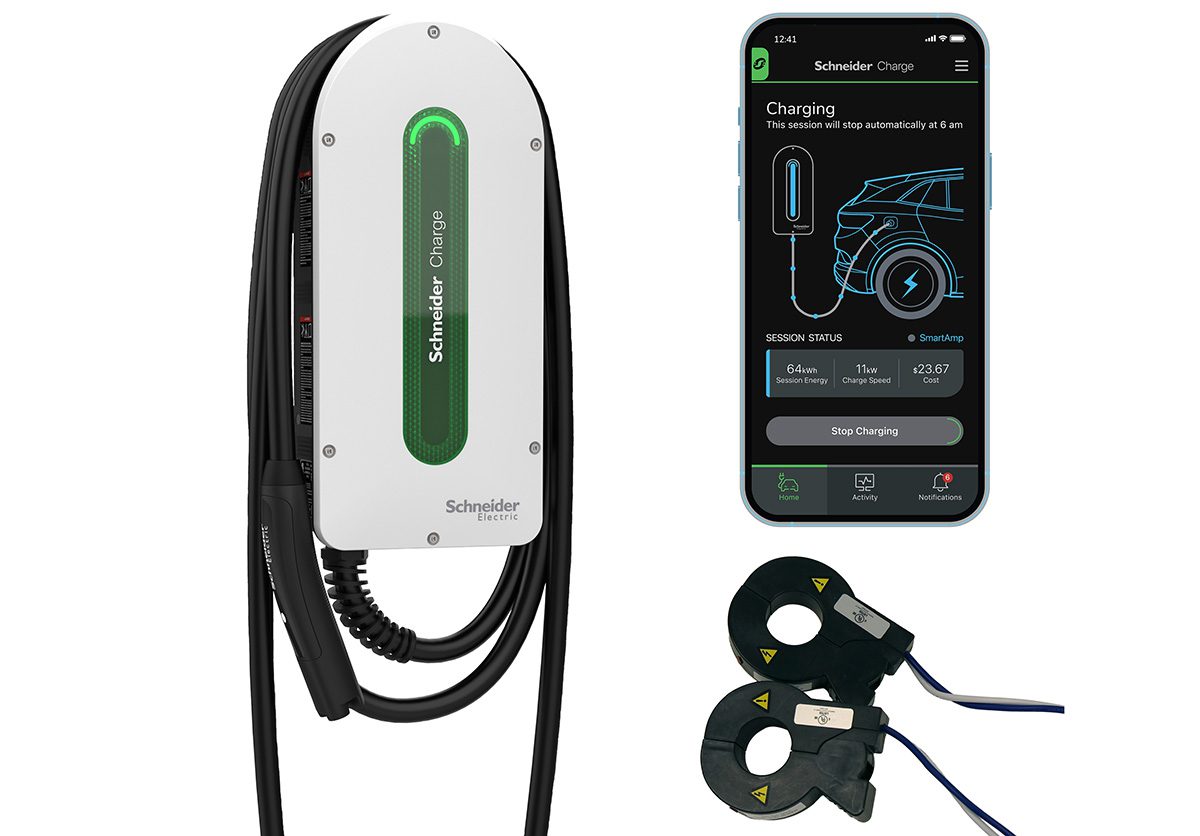
Schneider Electric, a global leader in energy management and automation, has announced the launch of its new smart Level 2 residential EV charger, the Schneider Charge. Now available across the United States and Canada, this innovative solution is engineered to simplify the integration of high-power electric vehicle (EV) charging within a home’s existing electrical infrastructure, addressing a critical challenge for many homeowners.
The introduction of the Schneider Charge marks a significant step forward in making residential EV charging more accessible and less disruptive. It is particularly relevant for homes, especially older constructions, that often lack the sufficient electrical capacity required to support demanding applications like Level 2 EV charging without necessitating costly and complex service or electrical panel upgrades.

Key Takeaways
- Schneider Electric has launched the Schneider Charge, a new Level 2 residential EV charger.
- It features SmartAmp, a dynamic load-management technology, to optimize charging speed.
- This technology allows installation within existing home electrical capacity, avoiding costly upgrades.
- The charger delivers 11.5 kW/48 A output and is compliant with industry standards like OCPP 1.6 and UL 3141.
- Available with NACS (J3400) or J1772 connectors, it offers flexible compatibility for various EVs.
- The hardwired design provides a permanent, reliable charging solution for modern homes.
Addressing the Home Electrical Capacity Challenge
The rapid growth in electric vehicle adoption has brought with it new considerations for homeowners, particularly regarding their home’s electrical capacity. While Level 1 charging, typically using a standard 120V outlet, offers convenience, it is often too slow for daily charging needs, especially for drivers with longer commutes. Level 2 EV charging, which uses a 240V circuit, provides significantly faster charging speeds, making it a preferred option for most EV owners.
However, the installation of a Level 2 residential EV charger can often pose a significant hurdle. Many homes, particularly those constructed decades ago, were not designed to accommodate the substantial power demands of a dedicated Level 2 EV charger running at full capacity alongside other high-energy appliances such as air conditioners, electric ovens, or water heaters. This can lead to situations where the home’s main electrical panel is insufficient, requiring expensive and time-consuming upgrades to the service entrance or the panel itself.
These upgrades can involve permits, professional electricians, and considerable financial outlay, creating a barrier to entry for many potential EV owners or those looking to enhance their home charging experience. The need for a solution that circumvents these extensive modifications has become increasingly apparent as the electrification trend accelerates.

Introducing SmartAmp: Dynamic Load Management for Efficient Charging
At the core of the new Schneider Charge is its proprietary SmartAmp technology, Schneider Electric’s advanced dynamic load-management system. This innovative feature is designed to alleviate the electrical capacity constraints faced by homeowners. SmartAmp continuously monitors the household’s total electrical consumption in real time.
When other high-power appliances demand electricity, SmartAmp intelligently and automatically adjusts the EV charging speed downwards to ensure the home’s overall electrical draw remains within safe limits and avoids overloading the system. Conversely, when household electrical use decreases, the system automatically ramps up the charging speed, maximizing the power delivered to the EV without the need for manual intervention.
This integrated approach means that homeowners can benefit from optimal charging output without the need for separate monitoring devices or additional system components. The built-in intelligence of SmartAmp streamlines the charging process, making it more efficient and safer, all while working within the existing electrical framework of the home.
Maximizing Charging Output and Minimising Disruption
The Schneider Charge delivers a robust 11.5 kW/48 A of charging output, ensuring rapid and efficient charging for compatible electric vehicles. This substantial power delivery significantly reduces charging times compared to Level 1 options, allowing drivers to fully charge their vehicles overnight or top up quickly during the day.
Beyond its power capabilities, the charger’s design emphasizes compliance and safety. It adheres to OCPP 1.6, an open charge point protocol that ensures interoperability with various backend systems and smart grid applications. Furthermore, it supports managed-load installations in accordance with UL 3141, a critical safety standard for EV charging systems with load management capabilities. This adherence to industry standards underlines its reliability and future-proofing for evolving energy ecosystems.
Shawn Bonacorsi, Head of Electrification Solutions, Schneider Electric North America, highlighted the product’s foundational benefit: As homeowners buy EVs and add high-power electric technologies, many are realizing their existing electrical systems were not built for that level of demand. Schneider Charge helps remove that installation hurdle by enabling Level 2 charging within a home’s existing electrical capacity. By building load management into the charger, we’re making home EV charging easier to install with less complexity and disruption for homeowners.
His statement underscores the product’s value proposition in simplifying the transition to electric mobility for a broad base of consumers.
Flexible Connectivity and Installation Options
Versatility in connectivity is a key aspect of the Schneider Charge. It is available with both the North American Charging Standard (NACS), also known as J3400, and the widely adopted J1772 connectors. This dual-connector availability ensures compatibility with the vast majority of electric vehicles currently on the road and those anticipated in the future, providing peace of mind for EV owners regarding their charging infrastructure investment.
The initial release of the Schneider Charge features a hardwired design, ensuring a permanent and secure installation. This robust setup is ideal for homeowners seeking a dedicated and reliable charging station. Looking ahead, a plug-in version is anticipated to be introduced in early 2027, offering even greater flexibility for installation in various residential settings. Each unit comes equipped with a generous 25-foot charging cable, providing ample reach for convenient vehicle placement.
To further support homeowners and installers, Schneider Electric has partnered with Qmerit, a leading network for EV charger installations. This collaboration ensures professional and streamlined installation support, helping to simplify the process from purchase to activation and ensuring the charger is set up safely and efficiently within the home’s electrical system.
The Future of Residential EV Charging
The launch of the Schneider Charge with its integrated dynamic load management capabilities signifies a crucial evolution in the residential EV charging market. By addressing the common issue of insufficient home electrical capacity, Schneider Electric is paving the way for more widespread adoption of Level 2 charging, making it a more practical and cost-effective option for a broader segment of homeowners.
This solution not only benefits individual EV owners by making charging more convenient and affordable but also contributes to the broader goal of grid stability. By intelligently managing peak loads, smart chargers like the Schneider Charge can help prevent strain on the electrical grid, supporting the transition to a more sustainable and electrified future. As electric vehicle sales continue to surge, such innovative technologies will be instrumental in building robust and resilient charging infrastructure that can keep pace with demand.
FAQ Section
What is the primary benefit of the Schneider Charge’s built-in load management?
The main benefit is the ability to install a Level 2 EV charger without costly electrical panel upgrades. Its SmartAmp technology dynamically adjusts charging speed based on real-time household electrical use, preventing overloads and maximizing charging efficiency within existing capacity.
How does SmartAmp technology work?
SmartAmp continuously monitors the total electrical consumption of the home. When other high-power appliances are active, it temporarily reduces the EV charging speed. Once demand from other appliances decreases, it automatically increases the charging speed, optimizing power delivery to the EV.
What charging output does the Schneider Charge provide?
The Schneider Charge delivers a robust 11.5 kW/48 A of charging output. This Level 2 charging capability ensures significantly faster charging times compared to standard Level 1 (120V) chargers, allowing for more efficient daily charging.
What connector types are available for the Schneider Charge?
The charger is available with two common connector types: the North American Charging Standard (NACS), also known as J3400, and the J1772 connector. This ensures broad compatibility with a wide range of electric vehicles currently on the market.
Is the Schneider Charge compliant with industry standards?
Yes, the Schneider Charge is compliant with OCPP 1.6, an open standard for communication between EV chargers and central management systems. It also supports managed-load installations in accordance with UL 3141, a key safety standard for such EV charging systems.
When will a plug-in version of the Schneider Charge be available?
While the initial release features a hardwired design for permanent installation, Schneider Electric has indicated that a plug-in version of the Schneider Charge is planned for introduction in early 2027, offering more installation flexibility for consumers.
Who provides installation support for the Schneider Charge?
Schneider Electric has partnered with Qmerit to provide professional installation support for the Schneider Charge. This collaboration aims to ensure a smooth, safe, and efficient installation process for homeowners.