
Key Takeaways:
- Tesla’s dedicated autonomous ride-sharing vehicle, the Cybercab, is scheduled for its official launch on September 3 in Austin, Texas.
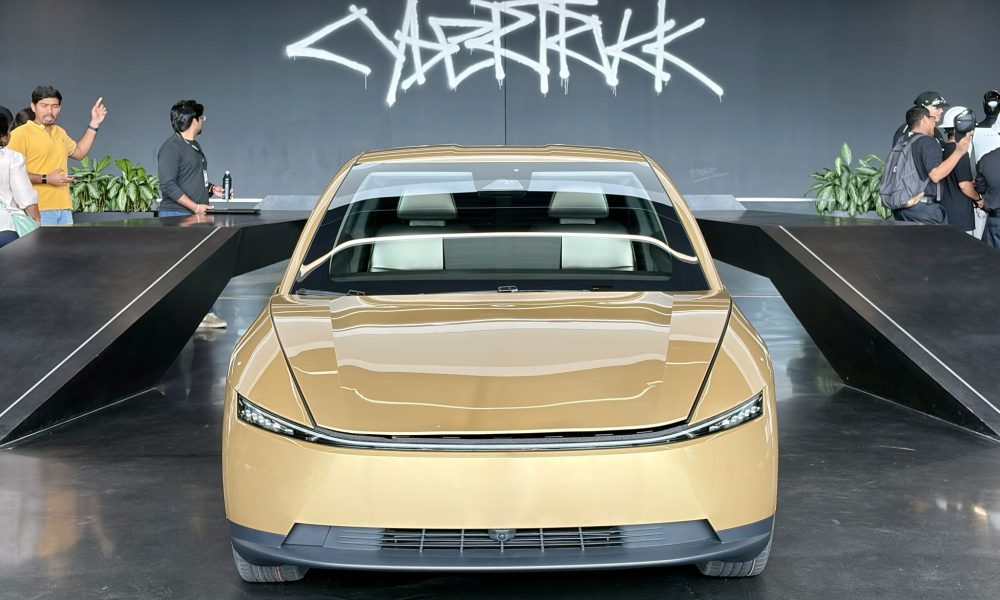
- The Cybercab is designed with two seats and notably lacks a steering wheel or pedals, signalling its intent for fully autonomous operation.
- It will join the existing Tesla Model Y fleet, which has already been conducting driverless rides for over a year as part of the company’s Robotaxi initiative.
- The launch represents a significant milestone in Tesla’s multi-year development of its Full Self-Driving (Supervised) platform and advanced AI hardware.
- Previous demonstrations include the ‘We, Robot’ event in 2024 and internal employee rides, building anticipation for public road deployment.
Tesla’s Cybercab Poised for Imminent Launch in Austin
Austin, Texas, the global headquarters of Tesla, is gearing up for a landmark event as the electric vehicle giant officially confirms the launch of its much-anticipated Cybercab on September 3. Invitations for a dedicated unveiling ceremony have begun circulating, pointing to a pivotal moment in the evolution of autonomous transport and urban mobility solutions.

This launch is not merely the introduction of a new vehicle; it represents a significant leap forward in Tesla’s ambitious vision for fully autonomous ride-sharing. The Cybercab, a purpose-built two-seater, distinguishes itself by completely foregoing traditional controls such as a steering wheel and pedals, designed from the ground up for driverless operation.
The vehicle is slated to integrate seamlessly into Tesla’s burgeoning Robotaxi fleet, operating alongside the Tesla Model Y. For over a year, the Model Y has been providing driverless rides to real-world passengers, establishing a crucial foundation for the expansion of autonomous services within the company’s ecosystem.
The move underscores Tesla’s commitment to advancing its self-driving capabilities and bringing its long-promised autonomous future closer to reality. The September 3 event is expected to showcase the Cybercab’s capabilities, potentially demonstrating its ability to transport passengers on public roads within the city of Austin.

The Cybercab Revealed: A Glimpse into Driverless Mobility
The Cybercab’s design is a testament to its singular purpose: fully autonomous passenger transport. By eliminating manual controls, Tesla is ushering in a new paradigm for urban mobility, where human intervention is no longer a prerequisite for ride-sharing services. This minimalist, control-free approach is central to its functionality as a dedicated robotaxi.
Its two-seat configuration targets the efficiency and demand often seen in individual or duo ride-sharing scenarios, aiming to optimize fleet utilization and passenger experience. This strategic design decision reinforces Tesla’s focus on scalable, high-volume autonomous operations that could redefine city transit.
The introduction of such a radical vehicle highlights Tesla’s confidence in its Full Self-Driving technology. The company has invested heavily in artificial intelligence and sensor development to achieve a level of autonomy that allows for the complete removal of human operational interfaces.
If the event includes public road demonstrations, allowing the Cybercab to autonomously pick up and drop off passengers at various destinations within Austin, it would undeniably mark a substantial advancement in Tesla’s ongoing self-driving narrative. Such a deployment would move beyond controlled environments and into real-world, dynamic urban settings.
Thank you so much @Tesla for inviting us to the Cybercab launch in Austin! 🤠 pic.twitter.com/F1rAR8zd5O
— TESLARATI (@Teslarati) August 22, 2026
The Evolution of Tesla’s Autonomy Vision
From FSD (Supervised) to Dedicated Hardware
The journey towards the Cybercab has been a multi-year endeavour, intrinsically linked to the continuous development of Tesla’s autonomous driving technology. At its core is the Full Self-Driving (Supervised) platform, a sophisticated software suite that has been progressively refined and deployed across a wide range of Tesla vehicles equipped with the necessary hardware.
While FSD (Supervised) offers advanced driver-assistance features, the Cybercab represents a shift towards an even higher level of autonomy, necessitating dedicated hardware for full driverless functionality. Tesla’s current advanced hardware version, known as AI4, is touted by the company as capable of delivering complete autonomy in specific contexts.
Looking ahead, Tesla has articulated plans for even more robust hardware packages. The company is actively developing AI4.5 and AI5, which are expected to unlock greater capabilities and enhance the reliability and safety of its autonomous vehicles, paving the way for wider adoption of the Robotaxi concept.
These hardware iterations are crucial for processing vast amounts of sensor data and making real-time driving decisions without human oversight. The progression from software-centric updates to integrated hardware solutions underscores Tesla’s long-term strategy for autonomous driving dominance.
Milestones on the Path to Full Autonomy
The upcoming Cybercab launch is the culmination of several significant precursor events and internal developments. Earlier reports from ‘The Information’ had already hinted at Tesla’s imminent plans for the Cybercab, suggesting a launch as early as the end of August 2026. Tesla’s official September 3 date closely follows these predictions.
Public exposure to Tesla’s autonomous ride experience dates back to October 2024, during the ‘We, Robot’ event. Held at Warner Bros. Studios in Burbank, this event offered participants the opportunity to experience fully autonomous rides within a closed circuit, providing an early glimpse into the future of driverless transport.
🚨 Ride in a Tesla Cybercab with us pic.twitter.com/kGqIqgJPRn
— TESLARATI (@Teslarati) May 11, 2025
More recently, in July of the current year (2026), Tesla expanded these experiences to its employees, offering them rides in the Cybercab. These internal trials served as critical testing phases, allowing the company to gather invaluable data and refine the system in real-world, albeit controlled, scenarios before a public unveiling.
Each of these steps, from early demonstrations to employee testing, has been instrumental in validating the technology and building confidence in the Cybercab’s readiness for wider deployment. They form a clear timeline illustrating Tesla’s methodical approach to achieving full autonomy.
Significance for Austin and Beyond
The decision to launch the Cybercab in Austin, where Tesla maintains its headquarters, holds symbolic and practical significance. The city could serve as a vital proving ground for Tesla’s dedicated ride-sharing vehicle, providing a dynamic urban environment for real-world testing and operation.
Should the Cybercab successfully navigate public roads and facilitate passenger transport within Austin, it would not only validate years of technological development but also potentially reshape local urban transport dynamics. It could set a precedent for other cities considering the integration of fully autonomous ride-sharing services.
The successful deployment of a vehicle without traditional controls represents a substantial step towards a future where autonomous fleets operate seamlessly as part of public infrastructure. It moves the conversation from advanced driver assistance to genuinely self-operating vehicles.
The implications extend beyond mere convenience, potentially influencing traffic congestion, parking needs, and the overall efficiency of urban movement. Austin’s experience with the Cybercab could become a blueprint for future autonomous deployments globally.
A New Era for Ride-Sharing
The Cybercab is poised to usher in a new era for the ride-sharing industry. Its fully autonomous nature promises enhanced operational efficiency, reduced human error, and potentially lower operating costs, which could translate into more affordable and accessible transportation for consumers.
By eliminating the need for a human driver, Tesla’s Robotaxi fleet, spearheaded by the Cybercab, could operate 24/7, providing consistent service without traditional labor constraints. This ‘always-on’ capability is a significant competitive advantage in the mobility-as-a-service sector.
The two-seater design, coupled with its autonomous capabilities, makes it an ideal solution for short-to-medium distance urban commutes, minimizing vehicle footprint and maximizing passenger throughput. This targeted approach could optimize resource allocation within a dense urban landscape.
The broader impact on urban planning, public transportation, and personal car ownership could be profound, suggesting a future where private vehicle ownership might become less essential for daily commutes, particularly in cities equipped with robust autonomous fleets.
Elon Musk’s Long-Standing Promise
The launch of the Tesla Cybercab also represents a tangible fulfillment of a long-standing promise by CEO Elon Musk. For many years, Musk has consistently articulated his vision for a fully autonomous vehicle and an accompanying platform that would allow drivers to completely relinquish responsibility behind the wheel.
This vision, once considered futuristic and ambitious, is now on the cusp of becoming a commercial reality. The Cybercab, with its design devoid of manual controls, embodies the ultimate expression of this promise, where the vehicle itself is the driver.
Musk’s steadfast pursuit of full autonomy has been a defining characteristic of Tesla’s innovation strategy, often pushing the boundaries of what is technologically feasible. The Cybercab stands as a testament to this persistent drive to revolutionize personal and public transportation.
The successful execution of this launch will undoubtedly reinforce the credibility of Tesla’s autonomous development efforts and underscore Musk’s influence on the future trajectory of the automotive industry and beyond.
Conclusion
The impending launch of the Tesla Cybercab on September 3 in Austin, Texas, marks a monumental step in the company’s relentless pursuit of autonomous driving. With its innovative two-seat, control-free design, the Cybercab is set to redefine urban ride-sharing and accelerate the adoption of driverless technology.
Building on years of advancements in its Full Self-Driving (Supervised) platform and iterative hardware development, Tesla is poised to demonstrate a level of autonomy that promises to transform how people move within cities. The event in Austin will be closely watched as a potential precursor to a new era of mobility, fulfilling a long-held vision of a truly autonomous future.
Frequently Asked Questions
What is the Tesla Cybercab?
The Tesla Cybercab is a dedicated two-seat, fully autonomous ride-sharing vehicle designed by Tesla. It is unique for lacking traditional controls like a steering wheel or pedals, intended to operate exclusively as part of Tesla’s Robotaxi fleet for driverless passenger transport.
When and where will the Cybercab be launched?
The Tesla Cybercab is officially scheduled to launch on September 3 in Austin, Texas. Invitations have been sent out for a dedicated event to unveil the vehicle and its capabilities in the city where Tesla’s headquarters are located.
How does the Cybercab fit into Tesla’s autonomous driving strategy?
The Cybercab is the ‘next chapter’ in Tesla’s autonomy story, representing the culmination of years of development on its Full Self-Driving (Supervised) platform. It will operate alongside the Tesla Model Y in the Robotaxi fleet, utilizing advanced AI hardware for complete driverless operation.
Has the Cybercab been demonstrated before?
Yes, people previously experienced rides in the Cybercab during Tesla’s ‘We, Robot’ event in October 2024, held on a closed circuit at Warner Bros. Studios. Additionally, Tesla launched employee rides in the Cybercab in July of the current year (2026) as part of its internal testing.
What are the key features of the Cybercab?
Key features of the Tesla Cybercab include its two-seat configuration, the complete absence of a steering wheel or pedals, and its design for fully autonomous, driverless operation. It is explicitly aimed at ride-sharing services within urban environments.
What is the significance of this launch for Tesla?
The launch is a drastic advancement in Tesla’s self-driving journey, potentially demonstrating vehicles taking passengers on public roads without human intervention. It signifies Tesla’s move towards fulfilling CEO Elon Musk’s long-standing promise of a fully autonomous vehicle and platform.