
Key Takeaways (TL;DR)
- Belgian startup SOLiTHOR has announced a significant breakthrough in its solid-state battery technology, achieving an energy density of 465 Wh/kg and 1,400 Wh/L at stack level.
- The innovation relies on a proprietary sol-gel Solid Composite Electrolyte, which entirely eliminates the need for liquid electrolyte, distinguishing it from hybrid battery designs.
- Safety is paramount, with the technology successfully passing critical overcharge and nail penetration tests at 100% charge without any thermal runaway, fire, smoke, or leakage.
- Demonstrating robust performance, the multilayer pouch cells offer continuous discharge at up to 5C, pulse discharge at 10C, and a cycle life exceeding 500 cycles with 80% capacity retention.
- The manufacturing process is designed for scalability and cost efficiency, being roll-to-roll compatible and reducing key production steps and associated costs by up to 25%.
- Potential applications span high-demand sectors including aerospace, dual-use defense, and advanced mobility, underscored by early defense funding for deep-sea autonomy.
In a significant development for the future of energy storage, Belgian battery innovator SOLiTHOR has unveiled a comprehensive technical update on its groundbreaking solid-state battery technology. The startup has demonstrated its proprietary sol-gel Solid Composite Electrolyte achieving an impressive energy density of 465 Wh/kg and 1,400 Wh/L at the stack level within a multilayer pouch design. This milestone not only highlights a substantial leap in battery performance but also underscores a commitment to enhanced safety and manufacturing efficiency.

The core of SOLiTHOR’s innovation lies in its unique electrolyte system, which is entirely solid. Unlike many competing solutions that integrate semi-solid or hybrid approaches, SOLiTHOR’s design requires no liquid electrolyte. This fundamental distinction positions their solid-state battery technology as a true next-generation solution, addressing long-standing challenges associated with conventional lithium-ion batteries.
Breakthrough in Energy Density and Performance
The reported energy density figures represent a major advancement for solid-state battery technology. Achieving 465 Wh/kg and 1,400 Wh/L at the stack level in a multilayer pouch design signifies a substantial increase in power capabilities for a given weight and volume. This critical performance metric was realized by impregnating the solid composite electrolyte into a high-loading cathode, boasting an areal capacity of 8 mAh/cm².
Such high energy density is crucial for applications demanding extended range and lighter power sources, particularly in the burgeoning electric vehicle (EV) sector, where every kilogram and litre saved translates directly into improved vehicle performance and efficiency. For portable electronics and other high-demand applications, these metrics promise longer operating times and more compact designs.

Dynamic Power Capabilities and Sustained Cycle Life
Beyond static energy density, the operational performance of SOLiTHOR’s solid-state battery technology has also demonstrated remarkable capabilities. In multilayer pouch cells rigorously tested at 25 °C, the technology exhibited continuous discharge at up to 5C. This means the battery can deliver five times its total capacity in one hour, showcasing its robust power delivery for demanding applications without significant capacity degradation.
Furthermore, the cells were capable of pulse discharge at 10C for 30 seconds at a 50% state of charge. This high-rate pulse capability is vital for scenarios requiring rapid bursts of power, such as acceleration in electric vehicles or instantaneous power demands in defense systems. Equally important for long-term viability, a 1 Ah multilayer pouch cell demonstrated a cycle life exceeding 500 discharge cycles, maintaining more than 80% of its initial capacity retention. This longevity is a key indicator of reliability and cost-effectiveness over the lifespan of the battery.
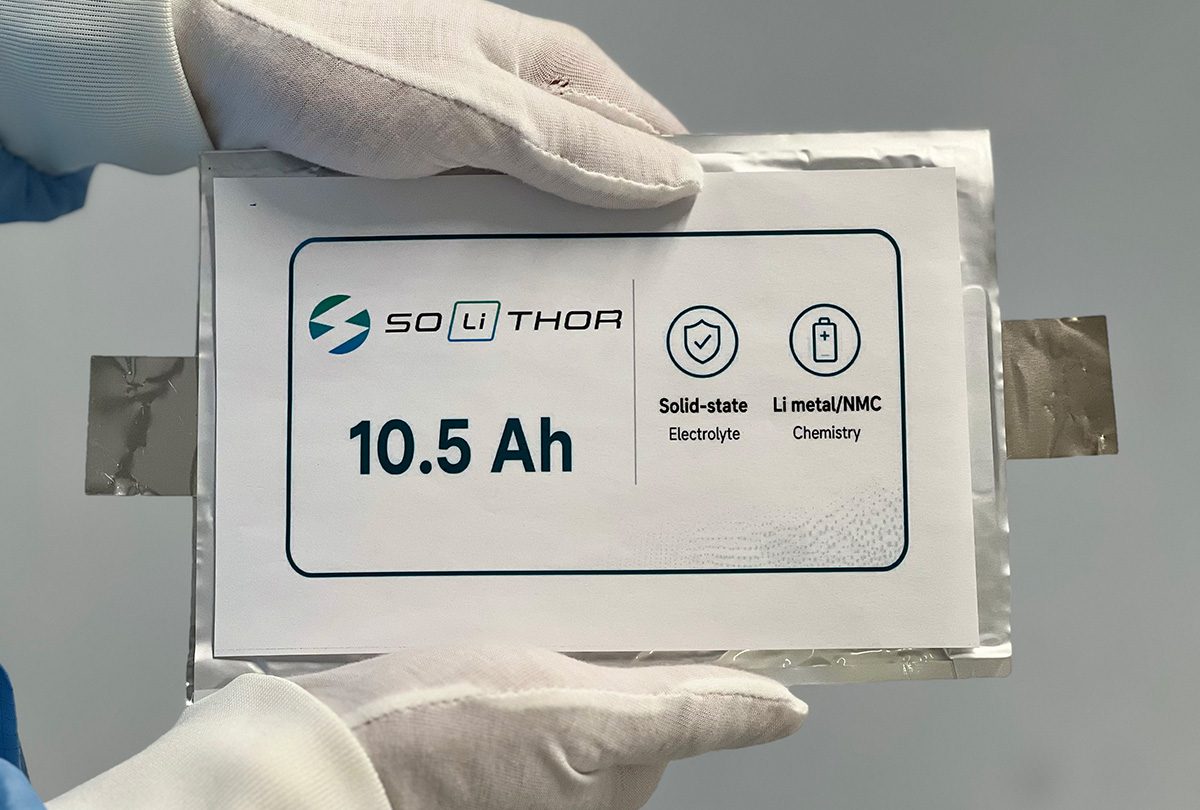
To further validate its scalability, SOLiTHOR has successfully produced its inaugural 10 Ah demonstration cell. This achievement serves as a crucial checkpoint in transitioning from laboratory-scale prototypes to commercially viable, larger-format battery solutions, signaling the company’s progress towards mass production readiness for its solid-state battery technology.
Unprecedented Safety Credentials
Perhaps one of the most compelling aspects of SOLiTHOR’s announcement is the battery’s robust safety profile. The 10 Ah demonstration cell underwent and successfully passed stringent industry-standard safety evaluations, including overcharge and nail penetration tests, even at 100% state of charge. These tests are notoriously challenging for traditional lithium-ion batteries, which often present risks of thermal runaway, fire, or explosions under such extreme conditions.
Remarkably, the SOLiTHOR cell exhibited no smoke, leakage, thermal runaway, or fire during these rigorous assessments. This exceptional safety performance is a direct benefit of the solid-state electrolyte, which inherently mitigates many of the flammability risks associated with liquid electrolytes in conventional batteries. This breakthrough in solid-state battery technology addresses a primary concern for consumers and regulators alike, potentially paving the way for safer electric vehicles, portable devices, and energy storage systems.
Revolutionizing Battery Manufacturing and Cost Efficiency
The advancements extend beyond performance and safety to the very heart of battery production. SOLiTHOR’s manufacturing process is designed to be fully roll-to-roll compatible, a standard widely adopted in current high-volume battery manufacturing. This compatibility means that existing lithium-ion production lines can be upgraded to accommodate SOLiTHOR’s solid-state process without necessitating entirely new and expensive equipment investments, thereby accelerating adoption and reducing capital expenditure.
Moreover, the process eliminates the electrolyte-filling step entirely, a complex and time-consuming stage in traditional battery manufacturing. Concurrently, it reduces the critical formation and aging time by two-thirds. These two steps alone can account for up to 25% of current lithium-ion processing costs. By streamlining these stages, SOLiTHOR’s solid-state battery technology promises significant reductions in manufacturing expenses and production turnaround times, making high-performance batteries more accessible and economically viable.
Diverse Applications and Strategic Funding
The high energy density, power performance, cycle life, and inherent safety characteristics of SOLiTHOR’s solid-state battery technology open doors to a wide array of applications across demanding sectors. These include the aerospace industry, where lightweight, high-energy-density batteries are critical for aircraft electrification and drone technology; dual-use defense applications, requiring rugged and reliable power sources for military equipment and unmanned systems; and broader mobility solutions, encompassing electric vehicles, public transport, and advanced personal mobility devices.
The company has already secured its first defense funding through the DEEP-TECH project, an initiative under the prestigious European Defence Fund. This funding specifically targets deep-sea autonomy applications, highlighting the technology’s potential for robust performance in extreme and challenging environments where reliability and safety are paramount.
Expert Endorsement and Future Outlook
Dr. Fanny Bardé, co-founder and CTO at SOLiTHOR, emphasized the significance of these achievements. “These technical achievements not only prove that the chemistry works, but that it delivers the combination of energy density, power performance and cycle life required for practical applications,” she stated. Dr. Bardé further noted, “The achievements also highlight our ability to accelerate development, with faster iterations and more effective impact on performance.” This expert perspective reinforces the credibility and practical applicability of SOLiTHOR’s innovations in solid-state battery technology.
As the global demand for sustainable and high-performance energy solutions continues to soar, advancements in solid-state battery technology are critical. SOLiTHOR’s recent breakthroughs underscore a promising future for battery development, offering a potent combination of superior energy density, dynamic performance, and unparalleled safety, all while simplifying the manufacturing process. These developments are poised to drive transformative changes across various industries, from consumer electronics and electric vehicles to aerospace and defense, marking a pivotal moment in the evolution of energy storage.
Source: SOLiTHOR
Frequently Asked Questions About SOLiTHOR’s Solid-State Battery Technology
What is SOLiTHOR’s main technological breakthrough?
SOLiTHOR has developed a sol-gel Solid Composite Electrolyte that allows for the creation of solid-state batteries with a high energy density of 465 Wh/kg and 1,400 Wh/L at stack level. A key distinction is the complete elimination of liquid electrolyte, differentiating it from hybrid or semi-solid battery designs.
How safe are SOLiTHOR’s new batteries?
The batteries demonstrate exceptional safety. A 10 Ah demonstration cell successfully passed stringent overcharge and nail penetration tests at 100% charge. Crucially, these tests resulted in no smoke, leakage, thermal runaway, or fire, addressing major safety concerns often associated with conventional lithium-ion batteries.
What performance metrics have been achieved?
The multilayer pouch cells exhibited continuous discharge at up to 5C and pulse discharge at 10C for 30 seconds at 50% state of charge. Furthermore, they demonstrated a cycle life exceeding 500 discharge cycles with over 80% initial capacity retention in 1 Ah cells, indicating robust and durable performance.
How does this technology impact battery manufacturing?
SOLiTHOR’s process is roll-to-roll compatible, meaning it can be integrated into existing lithium-ion production lines with minimal upgrades. It eliminates the electrolyte-filling step and reduces formation and aging time by two-thirds, potentially cutting up to 25% of current Li-ion processing costs and increasing manufacturing efficiency.
What are the potential applications for these batteries?
Given their high energy density, superior safety, and robust performance, SOLiTHOR’s solid-state battery technology is ideal for demanding applications. These include aerospace (for lighter, longer-range aircraft), dual-use defense (for reliable military power sources), and various mobility solutions like electric vehicles and autonomous systems.
Has SOLiTHOR received any external funding?
Yes, SOLiTHOR has secured its first defense funding through the DEEP-TECH project, which falls under the prestigious European Defence Fund. This funding is specifically earmarked for applications in deep-sea autonomy, showcasing the technology’s versatility and reliability in extreme environments.