
Key Takeaways:
- Belgian startup SOLiTHOR has unveiled significant advancements in its solid-state battery technology, reporting an energy density of 465 Wh/kg and 1,400 Wh/L at the stack level.
- The innovation centers on a sol-gel Solid Composite Electrolyte, integrated into a high-loading cathode within a multilayer pouch design, notably requiring no liquid electrolyte.
- Safety benchmarks were met with the technology successfully passing rigorous overcharge and nail penetration tests at 100% charge, demonstrating no smoke, leakage, thermal runaway, or fire.
- The manufacturing process is designed for roll-to-roll compatibility, eliminating the electrolyte-filling step and significantly reducing formation and aging times, which could cut up to 25% of current Li-ion processing costs.
- With robust performance and enhanced safety, SOLiTHOR’s solid-state battery technology is being eyed for high-stakes applications including aerospace, dual-use defense, and advanced mobility solutions.
BRUSSELS, Belgium – Belgian battery innovator SOLiTHOR has announced a groundbreaking technical update for its solid-state battery technology, showcasing an impressive energy density and unparalleled safety features. The company’s proprietary sol-gel Solid Composite Electrolyte has achieved a remarkable 465 Wh/kg and 1,400 Wh/L at the stack level in a multilayer pouch design. This significant milestone was accomplished by effectively impregnating the electrolyte into a high-loading cathode, boasting an areal capacity of 8 mAh/cm².

A central distinction of this advancement, as highlighted by SOLiTHOR, is the complete absence of liquid electrolyte. This characteristic fundamentally differentiates their approach from many competing semi-solid and hybrid battery designs currently under development, positioning SOLiTHOR’s solid-state battery technology as a pure solid-state solution with inherent advantages in safety and performance.
Breakthroughs in Energy Density and Power Performance
The pursuit of higher energy density in batteries is a critical factor for extending the range of electric vehicles (EVs), enhancing drone capabilities, and powering advanced aerospace applications. SOLiTHOR’s reported 465 Wh/kg and 1,400 Wh/L at the stack level represent a substantial leap forward, indicating the potential for lighter and more compact battery packs without compromising power output.
Further performance metrics underscore the robustness of this new solid-state battery technology. In multilayer pouch cells rigorously tested at a temperature of 25 °C, the technology demonstrated its ability to sustain continuous discharge at rates up to 5C, exhibiting minimal capacity loss. This capability is vital for applications requiring consistent, high-power delivery over extended periods.

Beyond continuous operation, the cells also proved their mettle in rapid power demands, successfully performing pulse discharges at 10C for 30 seconds, even when at 50% state of charge. Such high-rate discharge capabilities are crucial for scenarios demanding sudden bursts of power, like acceleration in electric vehicles or rapid maneuvers in drones, showcasing the dynamic power performance of the solid-state electrolyte.
Enhanced Cycle Life and Scalability Milestones
Durability and longevity are paramount for any battery technology aiming for widespread adoption. SOLiTHOR’s solid-state battery technology has shown promising results in this area, with a 1 Ah multilayer pouch cell exceeding 500 discharge cycles while retaining more than 80% of its initial capacity. This extended cycle life is indicative of a robust and stable chemistry, translating into longer operational lifespans for devices powered by these batteries and reduced frequency of battery replacements.
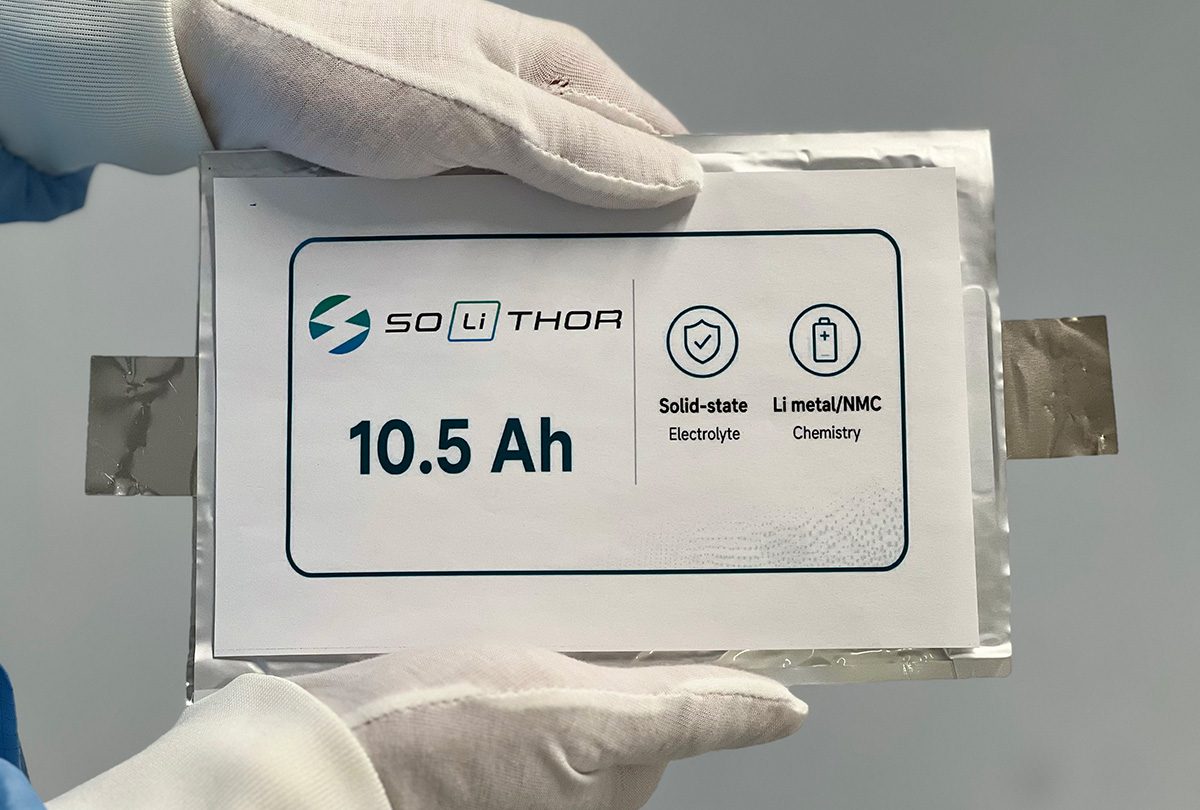
To validate the scalability of its innovative solid-state battery technology, SOLiTHOR has successfully produced its first 10 Ah demonstration cell. This achievement marks a crucial checkpoint in the company’s development roadmap, signaling its capability to transition from laboratory-scale prototypes to larger-format cells suitable for commercial applications. The ability to scale production efficiently is key to meeting the burgeoning global demand for advanced battery solutions.
Unprecedented Safety Credentials: Nail Penetration Test Passed
One of the most critical challenges in battery development, particularly for high-energy density chemistries, is ensuring safety. Incidents of thermal runaway and fires in conventional lithium-ion batteries have spurred intensive research into safer alternatives. SOLiTHOR’s solid-state battery technology has made significant strides in addressing these concerns.
The company announced that its cells successfully passed stringent overcharge and nail penetration tests while at 100% charge. These tests are considered industry benchmarks for battery safety, simulating extreme abuse conditions. Crucially, the tests revealed no smoke, no leakage, no thermal runaway, and no fire. The absence of these adverse reactions is a monumental achievement, reinforcing the inherent safety advantages of a solid-state electrolyte over flammable liquid electrolytes.
Passing the nail penetration test is particularly noteworthy. It involves forcibly driving a metal nail through the battery cell, creating an internal short circuit designed to trigger thermal runaway. The fact that SOLiTHOR’s solid-state battery technology withstood this challenge without any catastrophic failure underscores its potential to significantly enhance safety in a wide array of applications, from consumer electronics to large-scale EV battery packs.
Streamlined Manufacturing for Cost Efficiency
Beyond performance and safety, the economic viability of new battery technologies hinges on efficient and cost-effective manufacturing processes. SOLiTHOR’s solid-state battery technology offers substantial advantages in this domain, designed with industrial scalability in mind. The company’s process is inherently roll-to-roll compatible, a standard manufacturing technique in many industries that allows for continuous, high-volume production.
A key innovation in the manufacturing workflow is the complete elimination of the electrolyte-filling step. This step, typically complex and time-consuming in traditional liquid electrolyte battery production, is a significant bottleneck. Its removal not only simplifies the manufacturing process but also reduces the potential for defects and contamination.
Furthermore, SOLiTHOR’s method significantly reduces the formation and aging time by two thirds. These two phases in conventional lithium-ion battery manufacturing can collectively account for up to 25% of the total processing costs. By streamlining these stages, the company anticipates substantial cost reductions, making its solid-state battery technology more competitive in the market.
An additional benefit for manufacturers is the claim that existing lithium-ion production lines can be upgraded to accommodate SOLiTHOR’s solid-state process without requiring entirely new equipment. This compatibility lowers the barrier to entry for manufacturers looking to transition to solid-state technology, facilitating quicker adoption and broader market penetration.
Diverse Applications and Strategic Funding
The superior performance and enhanced safety profile of SOLiTHOR’s solid-state battery technology position it for deployment across a spectrum of demanding applications. The company is actively targeting sectors such as aerospace, dual-use defense, and advanced mobility, where robust and reliable power sources are critical. In aerospace, the high energy density can translate to longer flight durations for electric aircraft and drones, while in defense, the intrinsic safety is invaluable for critical missions.
Underscoring the strategic importance of this technology, SOLiTHOR has already secured its initial defense funding. This support comes through the DEEP-TECH project, an initiative under the prestigious European Defence Fund, specifically targeting deep-sea autonomy applications. This early backing from the defense sector highlights the trust and recognition of the technology’s potential for high-stakes, specialized environments.
Expert Perspective on Accelerated Development
Dr. Fanny Bardé, co-founder and CTO at SOLiTHOR, expressed confidence in these recent achievements, emphasizing their practical implications. “These technical achievements not only prove that the chemistry works, but that it delivers the combination of energy density, power performance and cycle life required for practical applications,” stated Dr. Bardé. Her comments underscore the transition of the technology from theoretical promise to tangible, real-world utility.
Dr. Bardé further elaborated on the company’s agile development approach: “The achievements also highlight our ability to accelerate development, with faster iterations and more effective impact on performance.” This commitment to rapid iteration and continuous improvement is crucial for maintaining a competitive edge in the fast-evolving battery technology landscape.
The advancements by SOLiTHOR mark a significant step forward in the quest for next-generation energy storage solutions. With an emphasis on high energy density, superior safety, and manufacturing efficiency, this solid-state battery technology holds considerable promise for reshaping the future of electric vehicles, aerial mobility, and defense applications. As the world increasingly shifts towards electrification, innovations like these are vital in paving the way for a more sustainable and secure energy future. (Source: SOLiTHOR)
Frequently Asked Questions (FAQ)
What makes SOLiTHOR’s solid-state battery technology unique?
SOLiTHOR’s technology stands out by utilizing a sol-gel Solid Composite Electrolyte that entirely eliminates the need for liquid electrolyte. This core distinction from semi-solid or hybrid approaches provides enhanced safety and performance, making it a truly solid-state solution for energy storage in various applications.
What energy density has SOLiTHOR achieved with its solid-state electrolyte?
SOLiTHOR has successfully achieved an impressive energy density of 465 Wh/kg and 1,400 Wh/L at the stack level. These figures signify a substantial improvement over conventional batteries, promising lighter and more compact power sources for high-demand applications like electric vehicles and aerospace.
How safe is SOLiTHOR’s new battery technology?
The battery technology has demonstrated exceptional safety by passing rigorous overcharge and nail penetration tests at 100% charge without any incidence of smoke, leakage, thermal runaway, or fire. This robust safety profile is a key advantage, addressing critical concerns associated with traditional lithium-ion batteries.
What are the manufacturing benefits of SOLiTHOR’s process?
The manufacturing process for SOLiTHOR’s solid-state battery technology is designed for efficiency and cost-effectiveness. It is roll-to-roll compatible, eliminates the electrolyte-filling step, and reduces formation and aging times by two-thirds, potentially cutting up to 25% of current Li-ion processing costs. It also allows upgrades to existing Li-ion production lines.
Which industries are targeted for this solid-state battery technology?
SOLiTHOR’s solid-state battery technology is strategically aimed at demanding sectors including aerospace, dual-use defense, and advanced mobility. Its high energy density, power performance, and superior safety make it ideal for applications requiring reliable and robust power solutions, such as deep-sea autonomy, for which it has already received defense funding.