
Key Takeaways
- Target is significantly expanding its electric vehicle charging network, aiming to add dozens more public EV charging facilities across its stores nationwide.
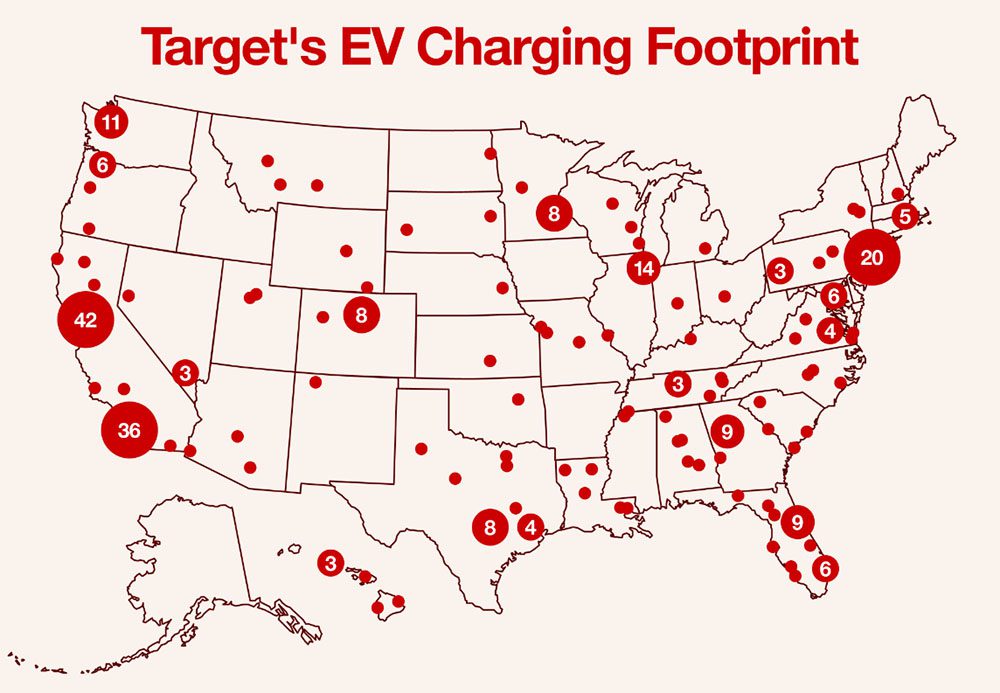
- The retail giant currently operates over 3,000 charging stalls at 300 sites in 42 US states, following its first fast-charging installation in 2017.
- An additional 35 EV charging sites are presently under construction, with plans for over 100 more in various stages of development.
- Target’s expansion strategy leverages strategic partnerships and detailed analysis of local EV penetration, market dynamics, and utility availability to optimize site selection.
- This move aligns with a growing trend among big-box retailers and other businesses like Walmart, Wawa, and Bojangles, to enhance customer convenience and promote sustainable transportation through accessible charging infrastructure.
In a significant boost for electric vehicle (EV) drivers across the United States, retail giant Target has announced an ambitious expansion of its public EV charging facilities. The company, which initiated its foray into EV infrastructure in 2017, is set to add dozens more charging sites, further cementing its role in supporting the nation’s transition to electric mobility. This strategic push comes as major retailers increasingly recognize the dual benefits of sustainability and enhanced customer experience through on-site charging solutions.
Big-box retailers have long been identified as prime locations for the deployment of public EV charging facilities. Their strategic positioning near major highways and bustling urban centers makes them highly accessible for a broad spectrum of EV users, including daily commuters and long-distance travelers. Crucially, the average shopping duration at these stores aligns perfectly with the time required for a fast charge, offering a convenient, integrated solution for EV drivers to power up while running errands.
The Evolving Landscape of Retail EV Charging
Despite the evident advantages, the integration of EV charging infrastructure within big-name retail environments experienced a relatively slow start. Reports from as recently as 2024 indicated that many major retailers’ charging installations lagged behind their stated environmental commitments. This initial hesitancy was often attributed to the significant upfront investment, the complexity of grid integration, and the nascent stage of widespread EV adoption.
However, the tide has demonstrably turned. Over the past couple of years, there has been a noticeable acceleration in the deployment of public EV charging facilities across various retail segments. Leading US retail chains, convenience stores, and fast-food establishments are now rolling out new charging initiatives at an impressive pace. Companies like Walmart, Wawa, and Bojangles are among the latest to actively promote and expand their EV charging networks, signaling a collective industry shift towards embracing electric vehicle support as a core amenity.
Target’s Expanding EV Charging Footprint
Target’s journey into the EV charging space began with the commissioning of its first fast-charging site in 2017, located at a store in San Mateo, California. From that single pioneering site, the company has steadily grown its network. Today, Target proudly hosts public EV charging facilities at 300 locations, encompassing an impressive total of over 3,000 individual charging stalls. These facilities are strategically spread across 42 states, providing a wide geographical reach for EV drivers.
The company emphasizes that the provision of EV charging at its stores is not merely a corporate sustainability endeavor but a direct response to customer demand. Feedback consistently indicates that customers view on-site EV charging as a significant added convenience that substantially enhances their overall shopping experience. This positive reinforcement from consumers underpins Target’s continued investment in expanding its charging infrastructure.
Future Growth: Sites Under Construction and Development
Building on its established network, Target has announced ambitious plans for further expansion. The company currently has 35 new public EV charging facilities under construction. This immediate phase of expansion will soon add a significant number of new charging points to its existing network, increasing accessibility for a growing EV user base.
Beyond the immediate construction projects, Target has a robust pipeline of future developments. More than 100 additional EV charging sites are in various stages of development, indicating a sustained, long-term commitment to bolstering its charging infrastructure. This multi-phase expansion strategy underscores Target’s confidence in the continued growth of the EV market and its dedication to providing essential services to electric vehicle owners.
Strategic Site Selection and Partnerships
The strategic deployment of public EV charging facilities is a complex undertaking, requiring careful consideration of numerous factors to ensure optimal utility and return on investment. Target approaches this by working in close collaboration with specialized partners. This collaborative model allows the company to leverage expert insights and technical capabilities in the planning and execution phases.
The process of determining suitable Target stores for new charging sites involves a rigorous evaluation. Key criteria include an assessment of local market dynamics, which encompasses factors such as population density, commuter routes, and existing EV charging deserts. Crucially, the level of local EV penetration is a significant consideration; areas with a higher concentration of electric vehicles naturally present a greater demand for charging services.
Furthermore, Target meticulously evaluates utility availability and infrastructure capacity at potential sites. This ensures that new installations can be seamlessly integrated into the existing power grid without compromising efficiency or reliability. This data-driven approach to site selection is pivotal in creating an effective and user-friendly public EV charging network that truly meets the needs of the community.
Enhancing the Customer Experience and Sustainability Goals
The expansion of Target’s public EV charging facilities aligns perfectly with broader corporate sustainability goals while simultaneously addressing direct consumer needs. By providing convenient and accessible charging options, Target not only contributes to reducing carbon emissions associated with transportation but also enhances its value proposition to a growing segment of environmentally conscious consumers.
This initiative transforms Target stores into more than just retail destinations; they become essential hubs within the electric mobility ecosystem. For EV drivers, the ability to charge their vehicle while completing routine shopping tasks translates into significant time savings and increased convenience, making the transition to electric vehicles even more appealing. The integration of such services is increasingly becoming a competitive differentiator in the retail sector.
Looking Ahead: The Future of Retail-Integrated EV Charging
Target’s accelerated expansion of its public EV charging facilities reflects a broader industry trend where businesses are increasingly recognizing their role in enabling sustainable transportation. As EV adoption continues its upward trajectory, the demand for reliable and accessible charging infrastructure will only intensify. Retailers, with their vast networks of easily accessible locations, are uniquely positioned to meet a significant portion of this demand.
The commitment shown by companies like Target, Walmart, Wawa, and Bojangles signifies a crucial step forward in building a robust national EV charging network. Their investments not only benefit individual EV owners but also contribute to the overall resilience and widespread acceptance of electric vehicles. As these networks mature, they will play a vital role in making electric mobility a practical and attractive option for even more consumers across the country.
FAQ
How many EV charging sites does Target currently operate?
Target currently hosts EV charging facilities at 300 sites across 42 states, providing over 3,000 charging stalls for electric vehicle owners.
When did Target install its first fast-charging site?
Target commissioned its very first fast-charging site at a store located in San Mateo, California, in the year 2017.
How many new EV charging sites are under construction or in development?
Target has 35 more EV charging sites currently under construction and an additional 100-plus sites that are in various stages of development.
Why are big-box retailers considered ideal locations for EV charging?
Big-box retailers are ideal due to their proximity to highways and urban centers, making them easily accessible, and customers typically spend enough time on-site for a fast charge.
What factors does Target consider when selecting new charging sites?
Target works with partners to evaluate market dynamics, local EV penetration rates, and the availability of utility infrastructure to determine the best locations for new charging facilities.
Are other major retailers also expanding their EV charging networks?
Yes, several other prominent retailers and establishments, including Walmart, Wawa, and Bojangles, are also actively expanding their public EV charging initiatives.
How do customers perceive EV charging at Target stores?
Target’s customers frequently cite EV charging as an added convenience that significantly enhances their overall shopping experience at the stores.