
Key Takeaways:
- Tesla has provided more clarity on its ambitious robotaxi strategy, revealing a hybrid model combining company-owned autonomous vehicles with owner-operated units.
- CEO Elon Musk described the service as a “combination of Airbnb and Uber,” allowing Tesla owners to integrate their vehicles into the ride-hailing network.
- The company’s Q1 earnings report confirmed significant investment in hardware and software for vehicle autonomy, emphasizing a “vision-only architecture.”
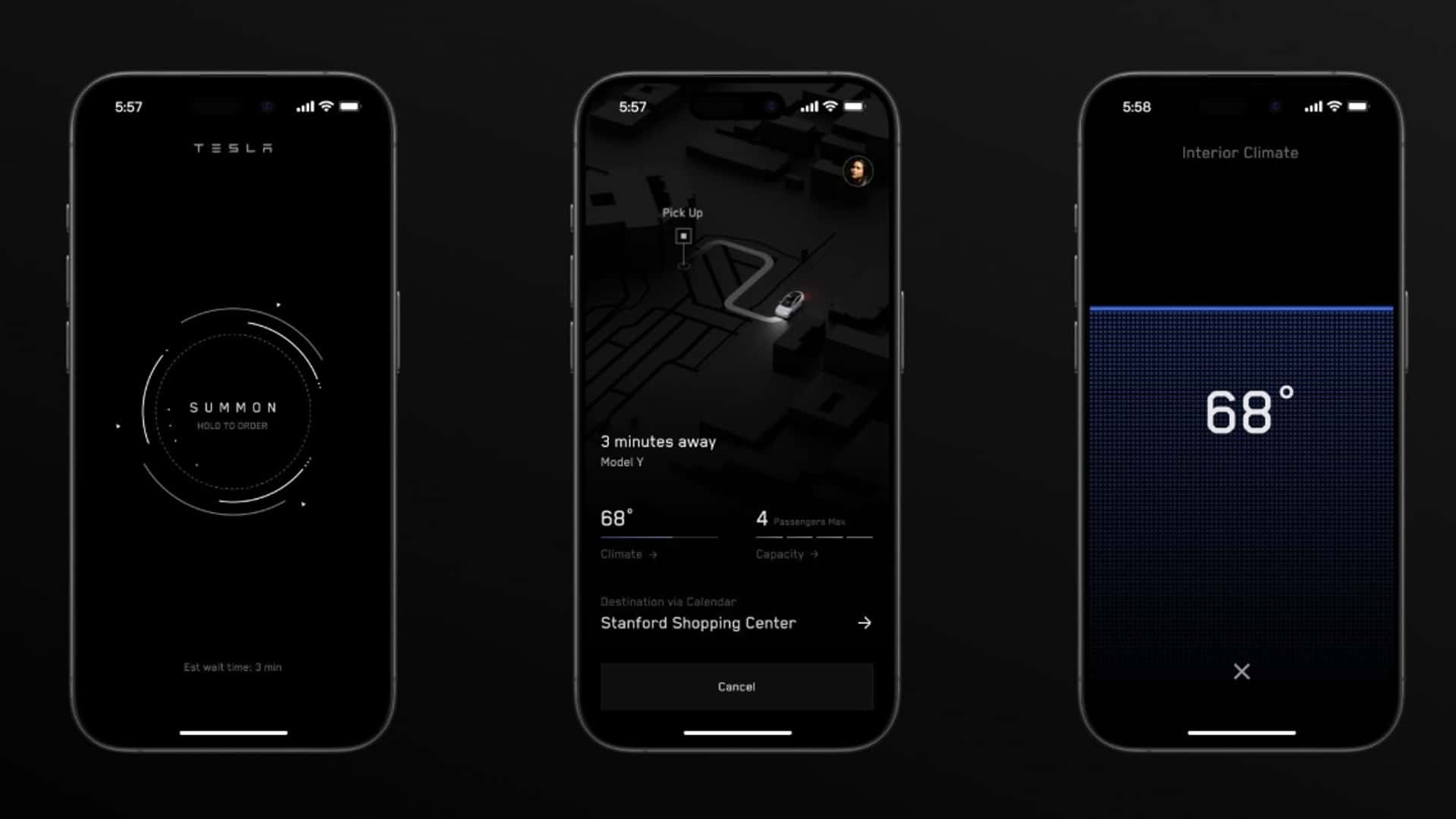
- Renderings from the Tesla app preview potential features like a ‘Summon’ button and climate control pre-settings for future robotaxi users.
- Despite past ambitious timelines and ongoing challenges with its Full Self-Driving (FSD) feature, Tesla maintains that a scalable and profitable autonomy business is achievable.
Tesla Outlines Hybrid Model for Autonomous Ride-Hailing Service
During its first-quarter earnings call on April 23, 2024, electric vehicle giant Tesla offered new insights into its long-anticipated robotaxi project and associated ride-hailing service. Addressing persistent questions from analysts, investors, and the public, CEO Elon Musk detailed a unique operational model designed to blend elements of existing sharing economy platforms.
Musk articulated a vision where the forthcoming Tesla Robotaxi Fleet would operate as a hybrid system. While Tesla itself intends to manage a significant portion of the autonomous vehicle fleet, individual Tesla owners will also have the option to participate in the network, allowing them to monetize their vehicles when not in personal use.
The ‘Airbnb and Uber’ Analogy: A Dual Approach to Mobility
Elaborating on the participation model, Musk stated that Tesla owners would be able to “add or subtract their cars from the fleet whenever they want.” This flexibility extends to user preferences, with owners having control over who can utilize their vehicle within the service.
“They can decide if they want to only let the car be used by friends and family, or only by five-star users or by anyone,” Musk clarified. This tiered access mechanism aims to provide owners with a sense of security and control, distinguishing it from conventional ride-hailing paradigms.
The CEO succinctly encapsulated this multifaceted approach, urging stakeholders to “think of it like a combination of Airbnb and Uber.” This analogy suggests a platform where Tesla would provide the autonomous technology and infrastructure, while owners contribute vehicle supply, akin to how Airbnb hosts offer properties or Uber drivers provide transportation.
Strategic Investments and Technological Foundation
Further details regarding Tesla’s commitment to this futuristic mobility solution were embedded within its first-quarter earnings report. The report explicitly noted that the company is “currently working on ride-hailing functionality that will be available in the future,” underscoring the ongoing development efforts.
The document also highlighted substantial investments directed towards achieving full vehicle autonomy. “We have been investing in the hardware and software ecosystems necessary to achieve vehicle autonomy and a ride-hailing service,” Tesla affirmed, signaling a comprehensive strategy rather than a singular focus on vehicle production.
Vision-Only Architecture: Core to Tesla’s Autonomy Strategy
A crucial aspect of Tesla’s technological approach for its Tesla Robotaxi Fleet is its adherence to a “vision-only architecture.” The earnings report reiterated this commitment, stating, “We believe a scalable and profitable autonomy business can be realized through a vision-only architecture with end-to-end neural networks, trained on billions of miles of real-world data.”
This strategy relies primarily on camera inputs and advanced artificial intelligence, eschewing other sensor modalities like LiDAR, which are often favored by competitors in the autonomous driving space. The extensive training on vast datasets of real-world driving scenarios is deemed critical for refining the neural networks that power the self-driving capabilities.
Previewing the User Experience: An App-Integrated Service
To provide a tangible glimpse into the future of the Tesla Robotaxi Fleet, the company also released preliminary renderings of what the ride-hailing functionality might look like within the existing Tesla mobile application. These visual aids offer early insights into potential user interactions.
The renderings prominently feature a “Summon” button, which is expected to be the primary interface for requesting an autonomous taxi. One screen displayed within the preview also showed a temperature setting of 68 degrees, hinting at customizable climate controls for passengers before they even enter the vehicle.
While specific functionalities remain largely conceptual at this stage, these details suggest a focus on user convenience and personalization, aiming to enhance the passenger experience within the autonomous environment.
Addressing Market Speculation and Future Product Timelines
The recent announcements arrive amid a period of heightened scrutiny and speculation surrounding Tesla’s strategic direction. Earlier reports from Reuters suggested that Tesla had potentially abandoned plans for a more affordable consumer vehicle, opting instead to prioritize the robotaxi initiative.
However, during the earnings call, Tesla moved to clarify its broader product roadmap. The company explicitly stated its intention to accelerate “the launch timing of ‘new vehicles, including more affordable models,’” indicating that the development of more accessible electric vehicles remains a key objective.
This clarification implies that the Tesla Robotaxi Fleet and the introduction of new, more affordable models are not mutually exclusive but rather parallel or sequentially planned ventures within Tesla’s long-term product strategy. The robotaxi service is positioned as a future offering, potentially leveraging these new vehicle platforms.
The Road Ahead: Challenges and Historical Context
While the vision for a comprehensive robotaxi service is compelling, its realization hinges critically on Tesla’s ability to perfect its autonomous driving technology. The company’s Full Self-Driving (FSD) feature, currently available to consumers, still requires constant driver supervision and has, on occasions, demonstrated limitations and errors.
This historical context often leads to investor and public skepticism, particularly given CEO Elon Musk’s past ambitious forecasts. Notably, Musk had famously predicted that Tesla would deploy one million robotaxis on the road by 2020, a target that was not met.
The gap between past proclamations and current technological realities underscores the significant engineering and regulatory hurdles inherent in achieving truly autonomous mobility on a mass scale. While the concept of a Tesla taxi business holds considerable interest, market observers are urged to temper expectations and evaluate progress with a pragmatic perspective.
The recent earnings call served to solidify Tesla’s intent regarding the robotaxi future, providing a framework for how the service might operate. Yet, the definitive success of the Tesla Robotaxi Fleet will ultimately depend on overcoming the complex technical and operational challenges that lie ahead in the autonomous vehicle industry.
FAQ Section
What is Tesla’s robotaxi fleet strategy?
Tesla plans a hybrid robotaxi service combining company-owned autonomous vehicles with privately owned Teslas. Owners can opt to add their cars to the ride-hailing network, setting preferences for who can use their vehicle, offering flexibility and potential income opportunities.
How will Tesla owners participate in the robotaxi fleet?
Tesla owners will have the ability to “add or subtract their cars from the fleet whenever they want.” They can also specify usage parameters, such as allowing only friends and family, five-star users, or anyone to utilize their vehicle for ride-hailing.
What technology underpins Tesla’s autonomous driving?
Tesla’s autonomy strategy is based on a “vision-only architecture” utilizing end-to-end neural networks. These systems are trained on billions of miles of real-world driving data, relying primarily on camera inputs to perceive and navigate the environment without additional sensors like LiDAR.
When will Tesla’s robotaxi service be available?
Tesla stated it is “currently working on ride-hailing functionality that will be available in the future.” While specific timelines remain undisclosed, the company indicated that the robotaxi service would arrive later, following the acceleration of new, potentially more affordable vehicle models.
Did Tesla abandon plans for a cheaper consumer vehicle to focus on robotaxis?
Contrary to earlier reports, Tesla clarified that it is accelerating the launch of “new vehicles, including more affordable models.” This suggests that the robotaxi project and more affordable consumer vehicles are both part of Tesla’s future strategy, rather than one superseding the other.
What challenges does Tesla face with its robotaxi ambitions?
The primary challenge is perfecting its Full Self-Driving (FSD) technology, which still requires driver supervision and has shown limitations. Overcoming significant technical, regulatory, and public trust hurdles will be essential for widespread deployment of a truly autonomous Tesla Robotaxi Fleet.