
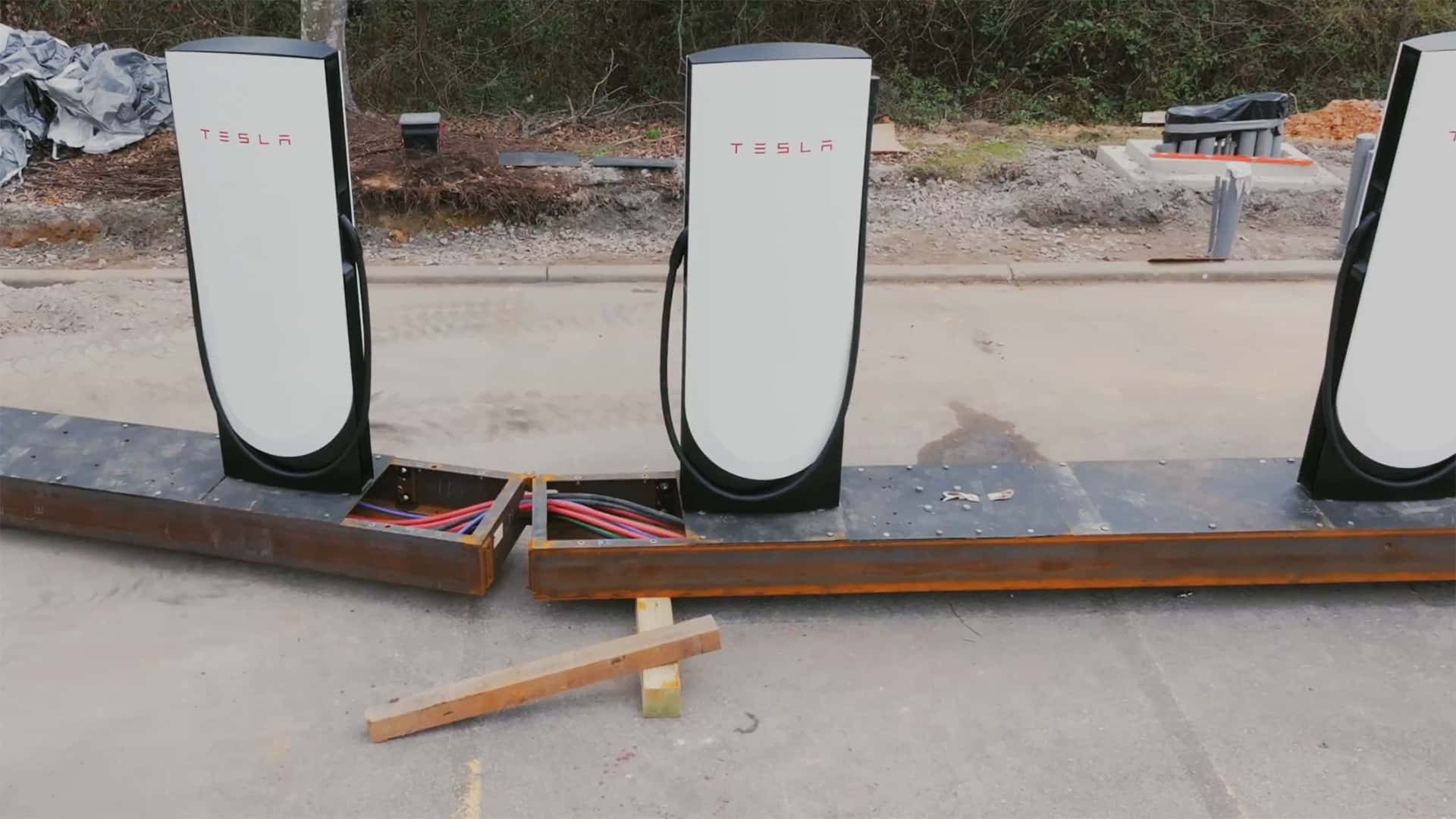
In a significant stride towards accelerating electric vehicle (EV) charging infrastructure, Tesla has unveiled a new generation of prefabricated Supercharger units that promise to halve installation times and substantially reduce deployment costs. This innovative approach, featuring a hinged base design, is set to bolster the company’s already extensive global charging network, making EV ownership even more convenient for a growing number of drivers.
The company’s latest engineering feat involves fitting eight charging stalls and a corresponding V4 power cabinet onto a single, hinged steel base. This advancement marks a departure from previous designs, allowing for a more efficient and rapid expansion of the critical charging infrastructure that underpins the transition to sustainable transportation.

Advancing the Tesla Supercharger Network
The Tesla Supercharger network has long been regarded as the benchmark for EV fast charging in the United States, lauded for its sheer size and consistent reliability. Its widespread availability and, more recently, its accessibility to almost all non-Tesla EVs, have played a pivotal role in alleviating ‘range anxiety’ for American electric vehicle owners.
However, the rapid evolution of EV battery technology necessitates continuous upgrades. While the majority of Superchargers across the US are still of the V3 variety, capable of delivering up to 250 kilowatts (kW), a new wave of electric vehicles like the Lucid Gravity, Porsche Cayenne, and BMW iX3 are engineered to accept significantly higher charging rates.
Recognising this evolving demand, Tesla is proactively enhancing its network. The latest Tesla Supercharger V4 units, equipped with advanced power cabinets, are designed to deliver up to 500 kW per stall. This substantial increase in power output is crucial for future-proofing the network and ensuring that newer, high-capacity EVs can recharge as quickly as possible.

The Ingenuity of Folding Unit (FU) Superchargers
The core of Tesla’s latest deployment strategy lies in what the company has colloquially termed the “Folding Unit (FU) Superchargers.” These pre-assembled units represent a significant leap in modular construction and logistical efficiency. Each unit integrates eight charging posts and a V4 power cabinet onto a robust metal base, cleverly engineered with a hinge in the middle.
This unique hinged design allows two complete folding Supercharger units to be compactly loaded onto a single truck trailer. This optimised transportation method dramatically cuts down on logistical complexities and costs associated with shipping components to installation sites. Upon arrival, the pre-fabricated bases are simply laid onto the ground using a crane, streamlining the entire setup process.
Furthermore, the hinged base offers practical advantages for site deployment. It enables the stations to be easily reconfigured on the spot, adapting to the specific spatial constraints or layout requirements of diverse locations. This flexibility is critical for optimising charger placement in varied urban and highway environments.
Key Advantages: Cost Reduction and Speed
Tesla claims that this innovative approach brings multiple tangible benefits. The company estimates a 33% increase in the number of stalls that can be transported per truck, directly contributing to more efficient logistics. Critically, these enhancements are projected to lower overall installation costs by 20% and, perhaps most notably, halve the typical installation time.
The acceleration of deployment is a game-changer for infrastructure growth. Traditional Supercharger installations often involve extensive on-site civil works, including trenching for cables, pouring concrete foundations, and meticulous electrical wiring. By routing all necessary cables directly from the factory and providing a ready-to-deploy hinged base, Tesla dramatically reduces the labour and time required at the site.
Prior to this innovation, Tesla’s Prefabricated Supercharger Units (PSUs) typically featured up to four stalls and a power cabinet mounted on a rigid concrete base. While efficient for their time, these older PSUs allowed for a maximum of three units, or twelve stalls, to be transported on a single truck trailer. The new folding units, by accommodating eight stalls per unit and allowing two units per truck, significantly boosts the density of chargers that can be deployed at once.
Power Capabilities and Future Iterations
The new hardware’s power cabinet is engineered to deliver a maximum of 1.2 megawatts (MW) of power, while each individual cabinet within the system is capable of outputting up to 500 kW. This high power output ensures that even the most demanding next-generation EVs can achieve optimal charging speeds.
According to Max de Zegher, Tesla’s Senior Director of Charging, the current iteration of these foldable pre-assembled Superchargers represents just the beginning of this technological evolution. De Zegher indicated that the company is moving rapidly, with plans for the technology to reach its third iteration by the next quarter. This aggressive development timeline underscores Tesla’s commitment to continuous innovation in its charging infrastructure.
This rapid iteration cycle suggests ongoing refinements to the design, manufacturing process, and overall efficiency of the Supercharger deployment. Such continuous improvement is vital for keeping pace with the global demand for EV charging, particularly as more manufacturers adopt Tesla’s North American Charging Standard (NACS) and as the worldwide EV fleet continues to expand at an unprecedented rate.
Strengthening EV Adoption Globally
The introduction of these new folding Supercharger units is not merely a technical upgrade; it is a strategic move designed to strengthen the entire EV ecosystem. By reducing the time and cost associated with building new charging stations, Tesla is making it easier and faster to expand its network into new regions and denser urban areas, further bolstering the confidence of prospective EV buyers.
As the global automotive industry increasingly pivots towards electrification, the availability of reliable, fast, and accessible charging infrastructure remains a critical factor for mainstream EV adoption. Tesla’s consistent innovation in this domain, exemplified by the new folding Supercharger technology, plays a crucial role in paving the way for a more sustainable transportation future, offering robust solutions for the evolving demands of electric vehicle owners worldwide.