
Key Takeaways:
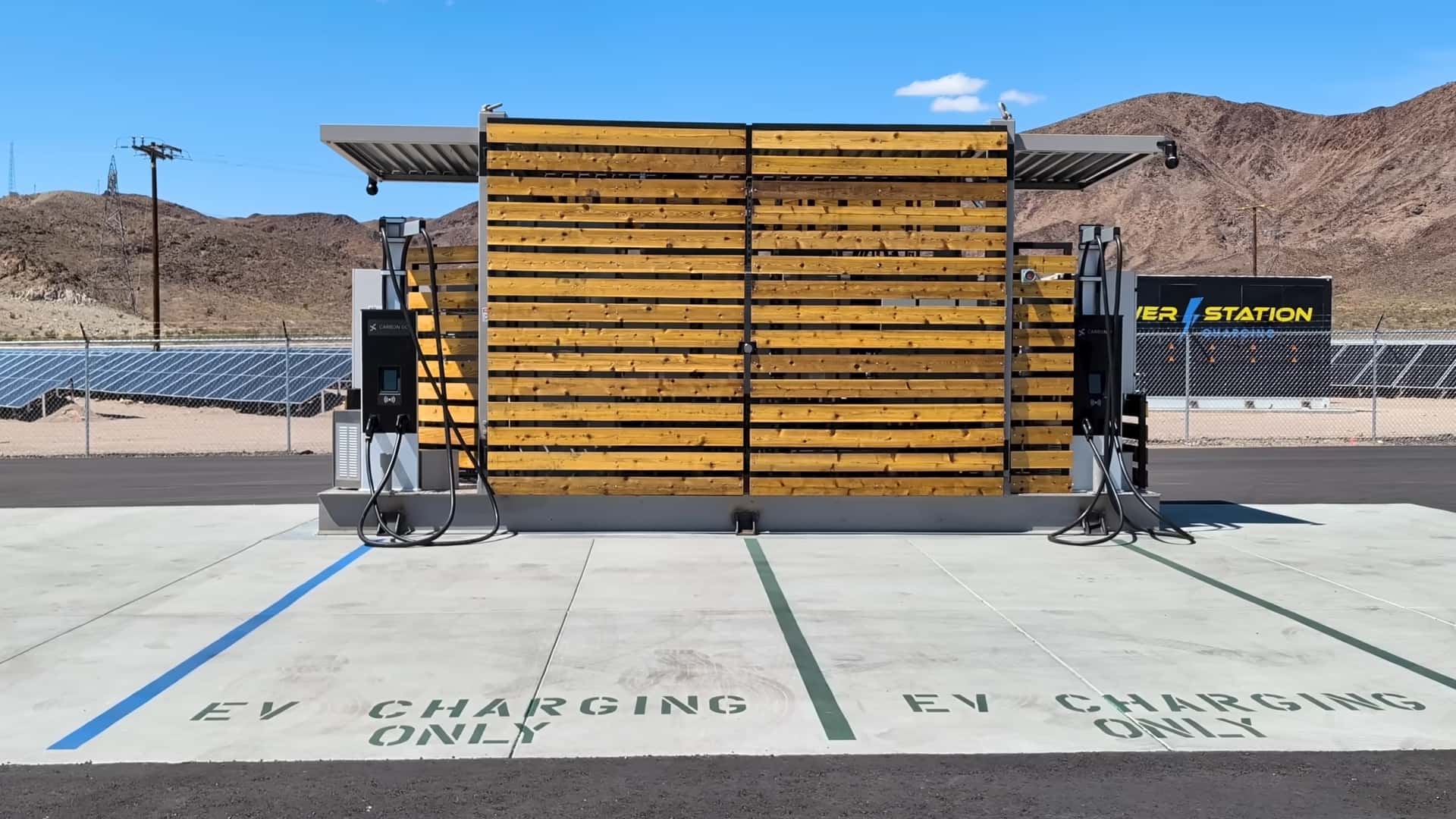
- A California startup, PowerStation Charging, has activated its first fully solar-powered DC fast charging station.
- Located off I-15 in Baker, California, the facility operates entirely off the traditional power grid.
- The station features 1,080 solar panels generating up to 640 kilowatts, backed by a substantial 3.4-megawatt-hour battery pack for round-the-clock operation.
- Initially offering four CCS1 ports with a shared 360 kW output, the station will expand to include six NACS ports and a total shared output of 600 kW.
- Charging is currently free until May 31, 2026, marking a significant incentive for electric vehicle drivers.
- This initiative represents a growing trend towards sustainable, grid-independent electric vehicle charging solutions across the United States.
BAKER, California – In a significant leap for sustainable transportation infrastructure, a new electric vehicle (EV) fast charging station in Baker, California, is making headlines for its innovative approach: it operates entirely off the traditional power grid and currently offers free charging to users. Developed by California-based startup PowerStation Charging, this facility leverages a massive solar array and battery storage system to provide reliable, clean energy for electric vehicles.
Situated strategically at the Rasor Road exit off Interstate 15 (I-15), a critical artery for travel in Southern California, the station addresses a key concern for EV owners: range anxiety, particularly in more remote areas. The absence of a grid connection demonstrates a bold vision for decentralised, resilient EV infrastructure.
Pioneering Off-Grid EV Charging Technology
The operational backbone of PowerStation’s inaugural site is its sophisticated energy ecosystem. The station harnesses solar power through no fewer than 1,080 photovoltaic panels, capable of generating up to 640 kilowatts (kW) of electricity. This substantial energy harvesting capability ensures continuous power generation during daylight hours.
Crucially, the intermittency of solar power is mitigated by an impressive 3.4-megawatt-hour (MWh) battery pack. This large-scale energy storage system allows the station to accumulate excess solar energy and discharge it as needed, ensuring that fast charging services remain available 24 hours a day, irrespective of sunlight availability. This robust design underpins the station’s grid-independent operation.
Current Capabilities and Future Expansion
As it stands, the PowerStation facility is equipped with four CCS1 (Combined Charging System 1) ports, which collectively deliver a shared output of 360 kW. This means that if a single electric vehicle is plugged in, it can benefit from the full charging power. When multiple vehicles are charging simultaneously, the total output is intelligently distributed among them.
The company has ambitious plans for expansion. Later this summer, the station is slated to add six NACS (North American Charging Standard) ports, catering to a broader range of electric vehicles, including Tesla models. With this upgrade, the shared power output is projected to increase significantly to 600 kW, further enhancing the station’s capacity and speed.
Beyond charging infrastructure, PowerStation Charging envisions a comprehensive motorist experience. Plans are underway for an 8,000-square-foot underground bunker that will house a lounge and restroom facilities, offering drivers a comfortable respite during their charging stops. This holistic approach aims to improve the overall electric vehicle travel experience.
The Incentive: Free Charging for a Limited Period
One of the most compelling aspects of this new off-grid EV charging station is its current policy of offering complimentary charging. Until May 31, 2026, electric vehicle owners can top up their batteries completely free of charge. PowerStation Charging has explicitly stated that no application or membership is required to access these services, streamlining the user experience.
Following this introductory period, the pricing structure will transition to a variable rate, ranging between $0.30/kWh and $0.45/kWh. These rates will be dynamically adjusted based on factors such as demand at the station and the prevailing brightness of the sun, reflecting a direct correlation to the cost of renewable energy generation and storage.
Strategic Rollout and Industry Trends
PowerStation Charging’s initiative in Baker is just the beginning of a broader network. The company’s official website indicates that three more solar-powered DC fast charging stations are in development. A second location on I-15, near Barstow, California, is expected to open later this year, further bolstering charging options along this vital corridor.
Looking further ahead, two additional stations are scheduled to become operational in 2027, targeting Interstate 10 (I-10) and Interstate 8 (I-8). This strategic expansion across major interstates in California underscores a commitment to establishing a resilient and widely accessible off-grid EV charging network.
This development is reflective of a growing national trend towards renewable-fed and battery-backed charging solutions across the United States. As electric vehicle adoption accelerates, the demand for robust and sustainable charging infrastructure, independent of traditional grid constraints, becomes increasingly vital.
Drawing Parallels: Tesla’s Megacharger at Lost Hills
The concept of large-scale, off-grid EV charging is not entirely new, with industry leaders also exploring similar models. Tesla, for instance, inaugurated its largest Supercharger station late last year in Lost Hills, California. This monumental facility can energise up to 164 electric vehicles simultaneously, relying entirely on solar power and extensive battery storage.
Tesla’s Lost Hills Supercharger integrates 11 megawatts (MW) of solar panels, which ingeniously double as canopies providing shade for parking spots. This colossal solar capacity is paired with 10 Megapack batteries, collectively offering a staggering 39 MWh of energy storage. Such large-scale projects, including PowerStation’s initiative, highlight the technical feasibility and strategic importance of grid-independent charging hubs.
The Significance of Grid-Independent Infrastructure
The emergence of dedicated off-grid EV charging stations offers numerous benefits beyond simple convenience. These facilities contribute to grid resilience by reducing strain on local electricity networks, particularly during peak demand. They also represent a significant step towards decarbonising the transportation sector by ensuring that the energy used for charging is sourced entirely from clean, renewable resources.
By deploying such innovative solutions in key travel corridors, companies like PowerStation Charging are not only addressing immediate charging needs but also laying the groundwork for a more sustainable and robust future for electric mobility. The free charging period acts as a powerful catalyst for encouraging greater EV adoption and demonstrating the viability of advanced renewable energy solutions in public infrastructure.
FAQs About Off-Grid EV Charging
What is an off-grid EV charging station?
An off-grid EV charging station is an electric vehicle charging facility that operates independently of the traditional electricity grid. It generates its own power, typically from renewable sources like solar panels, and stores it in large battery systems to ensure continuous operation, day and night.
How does the PowerStation Charging facility get its power?
The PowerStation Charging station in Baker, California, is powered by 1,080 solar panels that can generate up to 640 kilowatts of electricity. This solar power is stored in a substantial 3.4-megawatt-hour battery pack, enabling the station to provide fast charging services around the clock, even without sunlight.
Where is PowerStation Charging’s first off-grid station located?
The first pioneering off-grid EV charging station by PowerStation Charging is located at the Rasor Road exit off Interstate 15 (I-15) in Baker, California. This strategic placement along a major interstate aims to alleviate range anxiety for EV drivers in key travel corridors.
How long will charging be free at this new station?
Electric vehicle charging at the PowerStation facility is currently free for all users until May 31, 2026. After this date, a variable pricing structure ranging from $0.30/kWh to $0.45/kWh will be introduced, adjusted based on demand and solar availability.
Will the station support different types of electric vehicles?
Currently, the station provides four CCS1 ports. However, PowerStation Charging plans to expand its compatibility later this summer by adding six NACS (North American Charging Standard) ports, which will allow a broader range of electric vehicles, including Tesla models, to utilise the charging services.
What are the future expansion plans for PowerStation Charging?
PowerStation Charging intends to open a second station on I-15 near Barstow this year. Additionally, two more solar-powered DC fast charging stations are scheduled to become operational in 2027, located along Interstate 10 (I-10) and Interstate 8 (I-8) in California.
How does off-grid charging benefit the environment and energy grid?
Off-grid charging stations like PowerStation’s reduce reliance on the conventional power grid, decreasing strain during peak hours and enhancing grid resilience. By utilising renewable energy sources like solar, they significantly lower carbon emissions associated with electric vehicle charging, promoting a cleaner, more sustainable transportation ecosystem.