
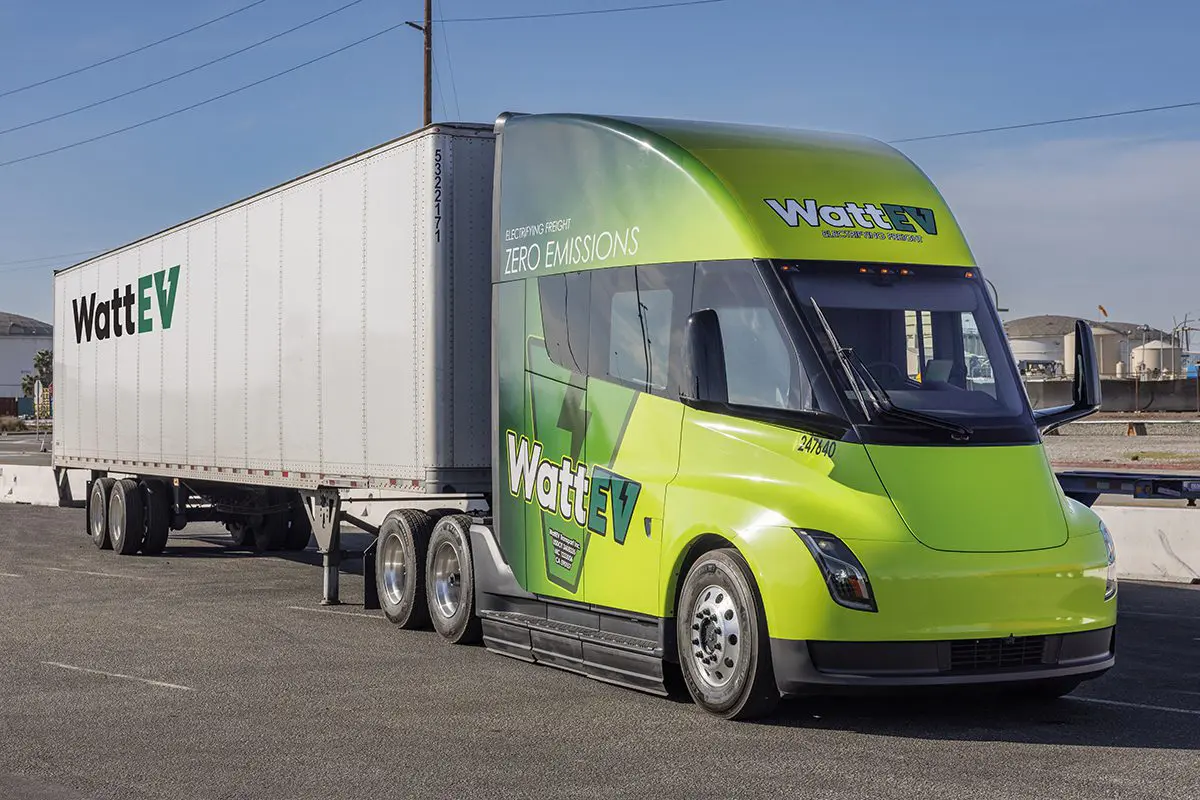
Key Takeaways:
- The Tesla Semi electric truck fleet demonstrated over 95% uptime during its first year of trial operations, significantly surpassing the 90-92% average for traditional diesel trucks.
- A notable 75% of service requirements for the Semi were completed within 24 hours, highlighting efficient maintenance protocols.
- High-volume commercial production of the Tesla Semi has commenced at Tesla’s Gigafactory in Nevada, nearly a decade after its initial unveiling.
- Two variants are available: a Standard Range with a 548 kWh battery offering over 500 km range, and a Long Range model with an 822 kWh battery providing over 800 km range.
- Both models utilise Tesla’s advanced 4680 cells and can be charged at speeds up to 1.2 MW using dedicated Megachargers.
- Major logistics and retail giants, including PepsiCo, Walmart, Costco, and DHL, have been actively trialling the electric truck, yielding positive real-world data.
In a significant development for the heavy-duty trucking industry, Tesla has announced that its Semi electric trucks have achieved an impressive uptime exceeding 95% during their initial year of trial operations. This figure starkly contrasts with the industry average for diesel-powered trucking fleets, which typically register downtimes significantly higher, hovering around 90% to 92% uptime.

The data, released by the electric vehicle pioneer, underscores a potential paradigm shift in commercial logistics, promising enhanced operational efficiency and reduced costs for transport operators. This announcement coincides with the long-awaited ramp-up of high-volume commercial production for the Tesla Semi at the company’s Gigafactory in Nevada.
Revolutionising Fleet Operations: The Uptime Advantage
The operational efficiency of any commercial fleet is paramount, with every hour a vehicle is off the road translating directly into lost revenue. The data shared by Tesla indicates a substantial reduction in downtime for operators employing the Tesla Semi electric truck in various trials. The reported figure of less than five per cent downtime represents a significant improvement over conventional diesel trucks.
Beyond just raw uptime statistics, Tesla also highlighted the efficiency of its service network for the heavy-duty electric vehicle. According to the company, approximately 75% of all service visits for the Semi were concluded within a 24-hour window. This rapid turnaround for maintenance and repairs is a critical factor for logistics companies striving to maintain continuous operations and tight delivery schedules.

“In 2025, the Semi fleet achieved >95% uptime, with 75% of service visits completed in under 24 hours,” the company formally stated on X, reiterating the trial’s success. This performance metric is particularly noteworthy considering that a broader, more expansive service network is anticipated to be established as the Tesla Semi electric truck gains wider adoption and its presence on roads increases in the coming years.
Contrasting with Diesel Truck Performance
The comparison with diesel trucks further accentuates the Tesla Semi’s operational advantages. Industry data consistently indicates that conventional diesel fleets typically experience an average uptime of 90% to 92%. Moreover, when these vehicles do require servicing, the average service time tends to extend over two to three days. Such prolonged service periods can severely impact supply chains and lead to considerable operational expenditures.
The superior uptime and quicker service resolution offered by the Tesla Semi electric truck not only promise substantial savings in maintenance and operational costs but also ensure higher asset utilisation for fleet owners. This directly contributes to greater productivity and reliability across the logistics sector, a vital consideration for businesses reliant on timely transport.
Scaling Up: High-Volume Production at Nevada Gigafactory
The journey of the Tesla Semi has been a long one, almost a decade since its initial unveiling in 2017. The commencement of high-volume commercial production at Tesla’s Gigafactory in Nevada marks a pivotal moment for the company and the electric trucking industry. This facility is reportedly capable of producing up to 50,000 semi-trucks annually, signalling Tesla’s serious intent to electrify the heavy-duty segment.
The move from trial phases to mass production is a testament to the advancements made in electric vehicle technology and manufacturing processes. It paves the way for a more widespread adoption of electric commercial vehicles, which is crucial for achieving global emissions reduction targets in the transportation sector.
Advanced Specifications: Powering the Future of Freight
Beyond its impressive uptime, the Tesla Semi electric truck offers robust technical specifications designed to meet the rigorous demands of commercial hauling. Details regarding the Semi’s variants have now been made public, providing clarity on its capabilities for different operational needs.
The Standard Range variant of the Tesla Semi is equipped with a 548 kWh battery pack, delivering a substantial range of over 500 kilometres on a single charge. For longer hauls, the Long Range variant features a larger 822 kWh battery pack, extending its operational range to more than 800 kilometres, even when carrying a heavy load of 37 tonnes.
Cutting-Edge Battery and Charging Technology
Both Tesla Semi electric truck variants leverage Tesla’s innovative 4680 cells, featuring NMCA (Nickel, Manganese, Cobalt, Aluminium) chemistry. These advanced battery cells are central to the Semi’s performance and efficiency. A key feature is the charging capability: the trucks can be charged at an astounding rate of up to 1.2 MW. This rapid charging is facilitated by Tesla’s proprietary Megachargers, which have been specifically engineered to meet the substantial power requirements of the Tesla Semi.
This high-speed charging capability is critical for commercial applications, minimising downtime during charging stops and maximising the operational hours of the vehicle. It addresses a core concern for fleet operators transitioning from traditional refuelling practices to electric charging infrastructure.
Real-World Deployments: Customer Trials and Feedback
Before ramping up to high-volume production, the Tesla Semi electric truck underwent extensive trials with some of the world’s largest logistics and retail companies. Multiple sightings and reports have confirmed that the truck has been in active testing with prominent entities such as Walmart, retail giant Costco, and global logistics powerhouses like DHL.
The initial low-volume production of the Tesla Semi commenced in 2022, with the first deliveries made in the US as part of a crucial trial with PepsiCo, a major food and beverage customer. Learnings from these early deployments and other subsequent trials were instrumental in refining the vehicle’s design and performance.
Last year, Tesla unveiled an updated Semi design, incorporating several class-leading upgrades based on real-world feedback. These enhancements included improved range, faster charging specifications, increased payload capacity, and the upgraded 1.2 MW charging speeds, all of which are highly beneficial for fleet operators across various industries.
According to trials conducted in 2025 with DHL, the Tesla Semi electric truck consistently delivered over 800 km of range and demonstrated remarkable energy consumption as low as 1.06 kWh/km. Such performance metrics are vital for convincing more fleets to electrify their operations and for realising significant reductions in transportation costs and carbon emissions.
The Road Ahead for Electric Trucking
The compelling data from Tesla Semi electric truck trials, coupled with the commencement of high-volume production, paints an optimistic picture for the future of electric heavy-duty trucking. As more real-world case studies emerge from customers operating and servicing these trucks across the US and potentially in Europe, the industry will gain further insights into the long-term benefits and operational realities of electrifying commercial fleets.
The shift towards electric trucks is not merely about technological advancement; it represents a strategic imperative for businesses looking to enhance sustainability, reduce operational expenses tied to volatile fuel prices, and comply with increasingly stringent environmental regulations. The documented efficiency and reliability of the Tesla Semi position it as a formidable contender in this evolving landscape.
The continued rollout and performance monitoring of the Tesla Semi electric truck will provide invaluable data, contributing to the broader understanding of electric vehicle capabilities in heavy transportation. This will undoubtedly encourage more fleets to transition, accelerating the reduction of transport emissions and fostering a more sustainable logistics ecosystem globally. Readers interested in broader EV market trends can find detailed data on Australian electric vehicle sales by month in 2026, including breakdowns by model and brand.
Frequently Asked Questions (FAQ)
Q1: What is the primary advantage of the Tesla Semi electric truck according to recent data?
A: The Tesla Semi demonstrated over 95% uptime in its first year of trial operations, which is significantly higher than the 90-92% average for traditional diesel trucks, leading to greater operational efficiency.
Q2: Where is the Tesla Semi electric truck currently being produced?
A: High-volume commercial production of the Tesla Semi has commenced at Tesla’s Gigafactory located in Nevada, with a reported capacity to produce up to 50,000 semi-trucks annually.
Q3: What are the range options available for the Tesla Semi?
A: There are two variants: a Standard Range offering over 500 km of range with a 548 kWh battery pack, and a Long Range model delivering over 800 km of range with an 822 kWh battery pack while carrying a 37-tonne load.
Q4: How fast can the Tesla Semi electric truck be charged?
A: The Tesla Semi can be charged at an impressive rate of up to 1.2 MW using Tesla’s custom-designed Megachargers, facilitating rapid turnaround times crucial for commercial operations.
Q5: Which major companies have been trialling the Tesla Semi?
A: Prominent companies such as PepsiCo, Walmart, Costco, and DHL have been actively trialling the Tesla Semi electric truck, providing real-world operational data and feedback for its development.
Q6: How does the service time for the Tesla Semi compare to diesel trucks?
A: Tesla reports that 75% of service visits for the Semi were completed within 24 hours, which is considerably faster than the typical two to three days required for servicing average diesel trucks.