
Key Takeaways
- The 222-mile range of the Jeep Recon Moab, despite its $66,995 starting price, has drawn criticism for seemingly underperforming in an increasingly competitive EV market.
- However, this range is a direct consequence of engineering choices prioritising extreme off-road capability over maximum on-road efficiency or lower cost.
- Features like high ground clearance, aggressive gearing (15:1 for the rear motor), heavy skid plates, 33-inch all-terrain tires, and a boxy design significantly reduce electric vehicle efficiency.
- This trade-off is common across the off-road vehicle segment, whether petrol-powered or electric, as demonstrated by the less capable but more efficient Wagoneer S (294 miles) or the high-priced, high-capability Mercedes G580 EQ Technology (239 miles).
- The industry faces an inherent challenge in electrifying highly inefficient vehicle types, requiring consumers to adjust expectations regarding range and price for capable electric off-roaders.
The announcement of the all-electric Jeep Recon Moab’s range, reportedly under 230 miles, has ignited considerable discussion among automotive journalists and potential consumers. With a 222-mile estimated range and a starting price of $66,995, many critics voiced concerns about its market competitiveness, particularly regarding the balance between cost and range.
During recent test drives, these critiques resurfaced, with a consensus emerging that Jeep could have delivered greater range at a lower price point. However, this perspective may overlook the fundamental engineering compromises inherent in developing a vehicle designed for both advanced electric propulsion and robust off-road performance.

The automotive industry, particularly in the specialised segment of off-roading, operates on a principle of trade-offs. Achieving superior off-road capabilities often necessitates sacrifices in areas such as fuel efficiency, on-road comfort, and, in the case of electric vehicles, driving range and cost. The Jeep Recon Moab exemplifies these complex engineering decisions.
Understanding Off-Road Vehicle Inefficiencies
The inherent design requirements for a capable off-road vehicle naturally lead to reduced efficiency, a principle long understood by enthusiasts of internal combustion engine (ICE) vehicles. A gas-powered, body-on-frame, 4×4 truck equipped with a lifted suspension and aggressive gearing typically delivers less than 20 miles per gallon (mpg), often closer to 10 or 15 mpg.
This reality is not a flaw but a consequence of optimising for specific, demanding use cases. Off-roaders are built to conquer rugged terrain, a task that prioritises durability, traction, and obstacle clearance over aerodynamic sleekness or fuel economy.

The Physics of Off-Roading and Fuel Economy
Several key design elements contribute to this diminished efficiency. Tall suspension systems, while vital for increased ground clearance to navigate rocks and uneven surfaces, significantly amplify a vehicle’s frontal area. This increase in aerodynamic resistance becomes particularly pronounced at higher speeds, requiring more energy to maintain momentum.
Similarly, the choice of tires plays a critical role. Large, knobby, all-terrain (AT) tires are indispensable for gripping loose surfaces like mud, sand, and gravel. However, their aggressive tread patterns and higher rolling resistance make them far less efficient than smooth, low-profile street tires when driving at 70 mph on paved roads, and they often generate more road noise.
A robust 4×4 system, while offering crucial traction in slippery or challenging conditions, introduces additional mechanical drag when engaged. Furthermore, aggressive gearing, designed to maximise torque at the wheels for superior climbing ability and low-speed control, means the engine (or motors in an EV) operates at higher revolutions per minute (RPM) for a given road speed, consuming more fuel or electricity during highway cruising.
For instance, a conventional SUV, even one not explicitly designed for extreme off-roading but equipped with 33-inch AT tires, a 4WD system with low range, and a powerful V-8 engine, might yield around 13 mpg in city driving conditions. This illustrates the fundamental trade-off: enhancing off-road capability almost invariably reduces on-road efficiency.
How EV Design Principles Intersect with Off-Road Demands
The principles of efficiency compromise observed in gasoline-powered off-road vehicles translate directly to electric vehicles (EVs). While EVs eliminate the combustion engine, the physical characteristics required for off-roading still heavily impact their battery range and overall energy consumption.
The design choices that make an EV formidable off-road – such as elevated ground clearance, a robust dual-motor configuration, oversized tires, and a utilitarian, boxy aesthetic – inherently diminish its efficiency. These elements are not merely desirable but often essential for a vehicle to credibly claim off-road prowess, directly contributing to a reduction in the available driving range.
Impact of Physical Attributes on EV Range
High ground clearance, a cornerstone of off-road capability, increases aerodynamic drag in EVs just as it does in ICE vehicles. A taller stance means more air resistance, translating into greater energy demand, particularly at cruising speeds. Similarly, heavy-duty components like reinforced chassis elements, protective skid plates, and larger, rugged all-terrain tires add significant weight and rolling resistance.
The boxy, upright design often favoured for off-roaders provides superior approach and departure angles, crucial for navigating obstacles without scraping the vehicle’s body. However, this shape is aerodynamically inefficient compared to the sleek, low-slung profiles of EVs designed purely for on-road range maximisation.
The Critical Role of Gearing in Electric Off-Roaders
Even though EVs lack multi-speed transmissions in the traditional sense, they still employ gear ratios that dictate how electric motors deliver torque to the wheels. These ratios are fundamental to balancing performance and efficiency.
Taller gear ratios, characterised by a lower numerical value (e.g., 9:1), are optimised for higher speeds and better energy efficiency, making them suitable for highway cruising. Conversely, shorter, more aggressive gear ratios (e.g., 15:1) dramatically increase torque at the wheels from a standstill, providing exceptional pulling power and climbing ability crucial for off-roading. However, this comes at the cost of reduced efficiency at higher speeds.
Decoding the Jeep Recon’s Range: A Deep Dive into Design Choices
The 2026 Jeep Recon Moab’s design priorities unequivocally lean towards formidable off-road capability. This strategic choice by Jeep directly influences its stated electric range, differentiating it from more urban-focused electric vehicles.
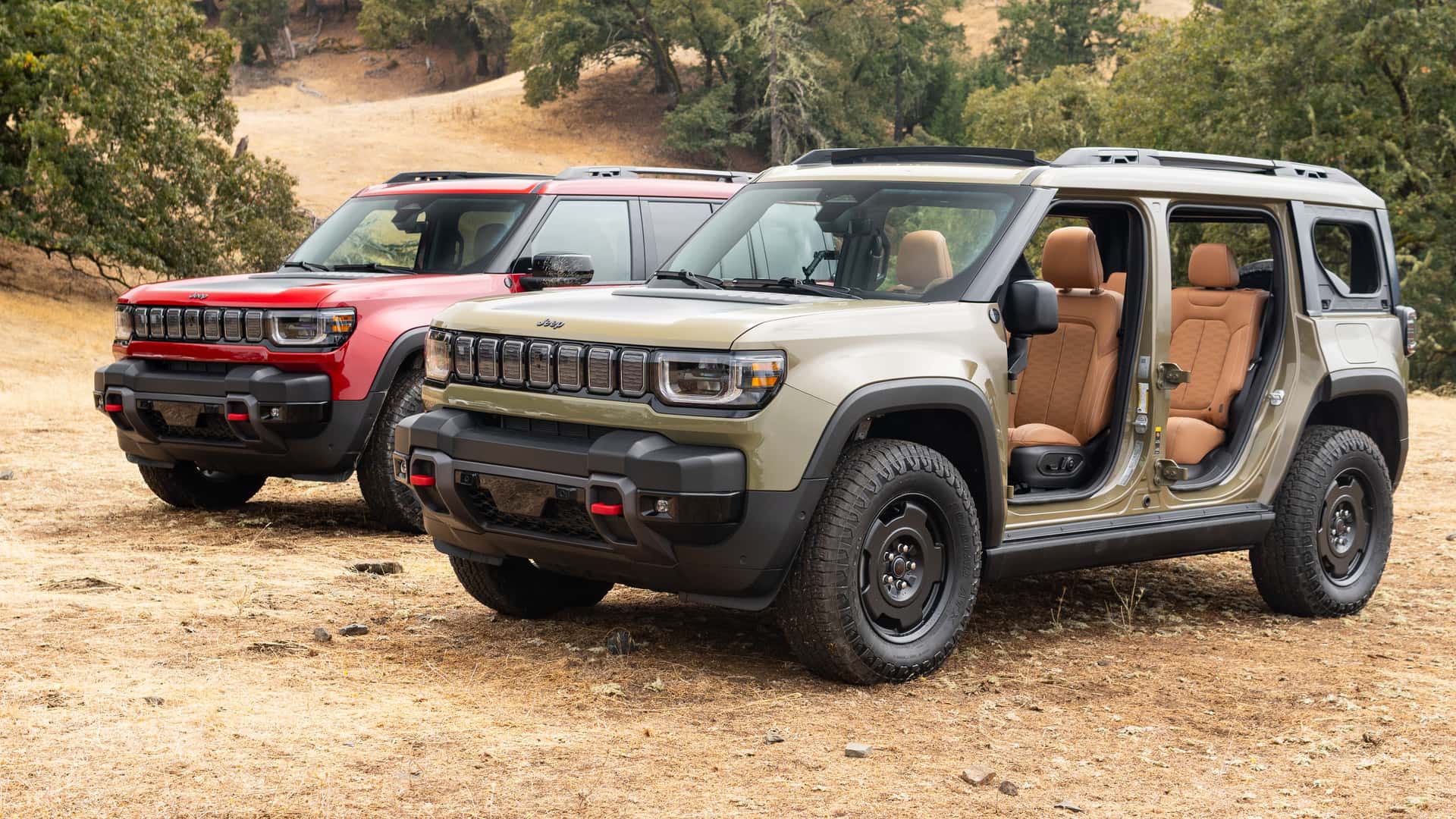
The Recon features 9.1 inches of ground clearance, a substantial improvement necessary for clearing obstacles on rugged trails. It is also equipped with a suite of heavy skid plates, offering crucial underbody protection from rocks and debris, further adding to the vehicle’s overall weight. The standard fitment of 33-inch all-terrain tires, while essential for traction in challenging environments, introduces considerable rolling resistance and a less efficient contact patch on pavement. Furthermore, its upright design, optimised for superior approach and departure angles, prioritises utility over aerodynamics.
Recon vs. Wagoneer S: A Tale of Two Jeeps
To understand the impact of these choices, one can look at Jeep’s own portfolio. The Jeep Wagoneer S, an all-electric SUV designed with on-road performance and efficiency in mind, shares the same 100.5 kWh battery pack as the Recon Moab. Yet, the Wagoneer S achieves an estimated range of up to 294 miles.
The significant difference in range—72 miles—can be largely attributed to the Wagoneer S’s design. It boasts a lower 6 inches of ground clearance, lacks the heavy-duty off-road specific armour, and rides on street-optimised tires. Its aerodynamic profile is meticulously sculpted for minimal drag, highlighting how fundamental vehicle design choices directly translate into vastly different efficiency outcomes, even with identical battery capacities.
A critical engineering decision for the Recon is its aggressive gearing. With off-roading success heavily dependent on low-end torque, the Recon’s rear motor is fitted with a 15:1 gear ratio. This configuration maximises the torque delivered to the wheels, enabling the vehicle to climb steep inclines and power through challenging obstacles with greater ease. An additional benefit of this high torque setup is brisk acceleration, allowing the Recon to reach 60 mph in a swift 3.6 seconds.
However, this aggressive gearing inherently compromises efficiency. During initial evaluations, the Recon reportedly achieved an efficiency of just 2.5 miles per kilowatt-hour (kWh). This figure underscores the direct link between mechanical configurations optimised for extreme performance and their impact on overall energy consumption and, consequently, driving range.
The Broader EV Off-Roading Landscape and Cost Implications
The challenges and compromises observed in the Jeep Recon are not unique; they are inherent across the emerging segment of electric off-road vehicles. Competitors in this nascent market also grapple with balancing range, capability, and price, often showcasing similar trade-offs.
Rivian R1S: Balancing Range and Off-Road Prowess
Consider the Rivian R1S, a formidable electric SUV known for its blend of luxury and capability. While generally more efficient than the Recon, especially in its standard configurations, Rivian itself highlights the impact of off-road features on range. The company does not even offer all-terrain tires on models equipped with its base 108-kWh battery pack. To opt for AT tires, customers must upgrade to the larger 140 kWh version of the battery.
Even with this larger battery, the range of the Rivian R1S drops from an impressive 410 miles with standard tires to 370 miles with AT tires. This still offers substantial range, but the vehicle’s price point with this configuration reaches approximately $96,000. Moreover, the R1S features taller gearing and lacks the dedicated locking rear differential present in the Recon, meaning it makes different compromises in its pursuit of capability.
Mercedes G580 EQ Technology: Premium Capability at a Premium Price
At the pinnacle of electric off-roading stands the Mercedes G580 with EQ Technology. This vehicle pushes the boundaries of capability even further than the Recon or R1S. It boasts separate low-range gears for each of its four motors, allowing for unparalleled climbing ability and precise torque control in extreme off-road scenarios.
Crucially, its sophisticated drivetrain can then switch to higher gears for more efficient on-road cruising, attempting to mitigate some of the efficiency penalties. Despite this clever engineering, a massive 116 kWh of usable battery capacity, and a staggering $163,000 price tag, the G580 EQ Technology still achieves an EPA-estimated range of only 239 miles.
These examples collectively demonstrate that for any electric off-road vehicle, highway range typically falls significantly below combined range estimates. The combined effects of aerodynamic drag, rolling resistance from aggressive tires, vehicle weight, and the energy demands of complex 4×4 systems compound at higher speeds, making long-distance highway travel the ultimate test of an EV’s efficiency.
The Future of Electric Off-Roading: Navigating Inherent Compromises
The journey towards a fully electrified automotive future is marked by various technical and economic challenges, particularly pronounced in segments that prioritise raw capability over pure efficiency. The electric Jeep Recon’s range serves as a salient example of these inherent compromises within the burgeoning electric off-roader market.
It underlines a critical takeaway for consumers and industry observers alike: expectations for electric vehicles designed for demanding off-road use must be adjusted. The very features that bestow exceptional trail performance—such as a large, boxy profile, substantial weight, aggressive all-terrain tires, enhanced ground clearance, and performance-optimised gearing—collectively act as significant detractors to electric range.
Equipping an off-roader with an absurdly large battery pack to compensate for these inefficiencies is technically possible but comes with substantial financial implications, inflating the vehicle’s price significantly. A 91- or 100-kWh battery pack, like that in the Recon, is far from small by EV standards, yet its energy simply cannot propel a large, heavy, and aerodynamically challenged vehicle as far as it would a sleeker, lighter model.
As battery technology continues to advance, offering higher energy density and faster charging capabilities, and as the charging infrastructure expands globally, these present challenges will gradually diminish. However, for the foreseeable future, prospective buyers seeking robust electric off-roading capabilities will likely need to accept a trade-off, balancing desirable range figures with their willingness to pay a premium price.
Frequently Asked Questions (FAQ)
Why does the Jeep Recon EV have a lower range compared to other electric vehicles?
The Jeep Recon EV’s 222-mile range is a direct result of its design for extreme off-road capability. Features like 9.1 inches of ground clearance, heavy skid plates, large 33-inch all-terrain tires, a boxy shape, and aggressive 15:1 gearing for high torque all significantly increase energy consumption, thereby reducing its overall range.
Is the Jeep Recon’s price justified given its range?
The $66,995 starting price of the Jeep Recon reflects the advanced engineering and specialised components required for its severe off-road capability, including a substantial 100.5 kWh battery and powerful electric motors. While the range may seem modest, it’s a consequence of prioritising a specific performance niche rather than pure range efficiency.
How do off-road features impact an EV’s efficiency?
Off-road features like high ground clearance and large, aggressive tires increase aerodynamic drag and rolling resistance. Heavy-duty protective components add weight. Aggressive gearing, essential for low-end torque on trails, makes the vehicle less efficient at highway speeds, all contributing to higher energy consumption and reduced EV range.
How does the Recon’s range compare to other electric off-roaders?
Compared to other electric off-roaders like the Rivian R1S (up to 370 miles with AT tires at $96,000) or the Mercedes G580 EQ Technology (239 miles at $163,000), the Recon’s 222-mile range positions it within a competitive segment where capability often dictates range and price compromises.
Will the range of electric off-road vehicles improve in the future?
Yes, as battery technology evolves to offer higher energy density and faster charging, and as charging infrastructure becomes more widespread, the range limitations of electric off-road vehicles are expected to improve. However, the fundamental physics of off-roading will always necessitate some degree of compromise compared to on-road focused EVs.
What is the significance of the 15:1 gearing in the Jeep Recon?
The 15:1 gearing on the Recon’s rear motor is crucial for maximising low-end torque, which is vital for climbing steep obstacles and navigating challenging off-road terrain. This aggressive gearing enhances the vehicle’s ability to push through tough conditions, directly contributing to its off-road prowess but sacrificing high-speed efficiency.