
Key Takeaways:
- The 222-mile Jeep Recon range has drawn criticism, but this figure reflects inherent engineering trade-offs for extreme off-road capability.
- Designing a robust electric off-roader requires features like high ground clearance, aggressive tires, and specific gear ratios, all of which significantly impact battery efficiency.
- The pursuit of superior off-road performance in an EV often leads to lower overall range and higher production costs compared to road-focused electric vehicles.
- Comparisons with other electric vehicles like the Jeep Wagoneer S, Rivian R1S, and Mercedes G580 highlight how different design priorities directly affect range and price.
- As the electric vehicle market matures, consumers may need to adjust expectations for dedicated off-road EVs, balancing desired capability with available range and cost.
The unveiling of the all-electric Jeep Recon Moab, with an estimated range of under 230 miles and a starting price of $66,995, has ignited considerable debate among automotive journalists and potential buyers. Many have voiced dissatisfaction, arguing that the vehicle’s Jeep Recon range is insufficient, especially given its premium cost.

However, this widespread critique often overlooks a fundamental principle of automotive engineering: the art of compromise. The notion that Jeep could have delivered greater range for less money without sacrificing the Recon’s core off-road prowess is a perspective that misunderstands the intricate balance required in vehicle design, particularly within the nascent segment of electric vehicle off-roading.
The Inherent Trade-offs in Off-Road Design
To truly understand the Jeep Recon range, one must first grasp the efficiency challenges inherent in vehicles built for rugged terrain. Gasoline-powered, body-on-frame 4×4 trucks, especially those with lifted suspensions and aggressive gearing, typically deliver significantly low fuel economy, often registering between 10 to 20 miles per gallon. This reality is an accepted truth for experienced off-road enthusiasts.
Several design elements crucial for off-road capability directly contribute to reduced efficiency. Tall suspension systems provide essential ground clearance for rock crawling but dramatically increase aerodynamic drag. Large, knobby all-terrain tires, while excellent for traction in mud and dirt, are far less efficient at highway speeds and generate more noise.

Furthermore, a robust 4×4 system, indispensable in slippery conditions, consumes more energy when engaged. Aggressive gearing enhances torque delivery at the wheels, vastly improving climbing ability, but simultaneously causes the engine to rev higher and consume more fuel during highway cruising.
For instance, an older Chevrolet Tahoe equipped with 33-inch all-terrain tires, a 4WD system with low range, and a powerful V-8 engine might average around 13 miles per gallon in city driving. This illustrates the direct correlation between off-road features and decreased fuel efficiency in traditional internal combustion vehicles.
The engineering principles dictating these trade-offs are not exclusive to gasoline vehicles; they apply equally to electric vehicles. High ground clearance, dual-motor drivetrains, large tires, and a boxy aerodynamic profile all diminish an EV’s energy efficiency. Yet, for an authentic off-road vehicle, many of these features are not merely desirable but absolutely essential. A vehicle with minimal ground clearance and thin tires simply cannot claim serious off-road credentials.
Jeep Recon’s Engineering Priorities
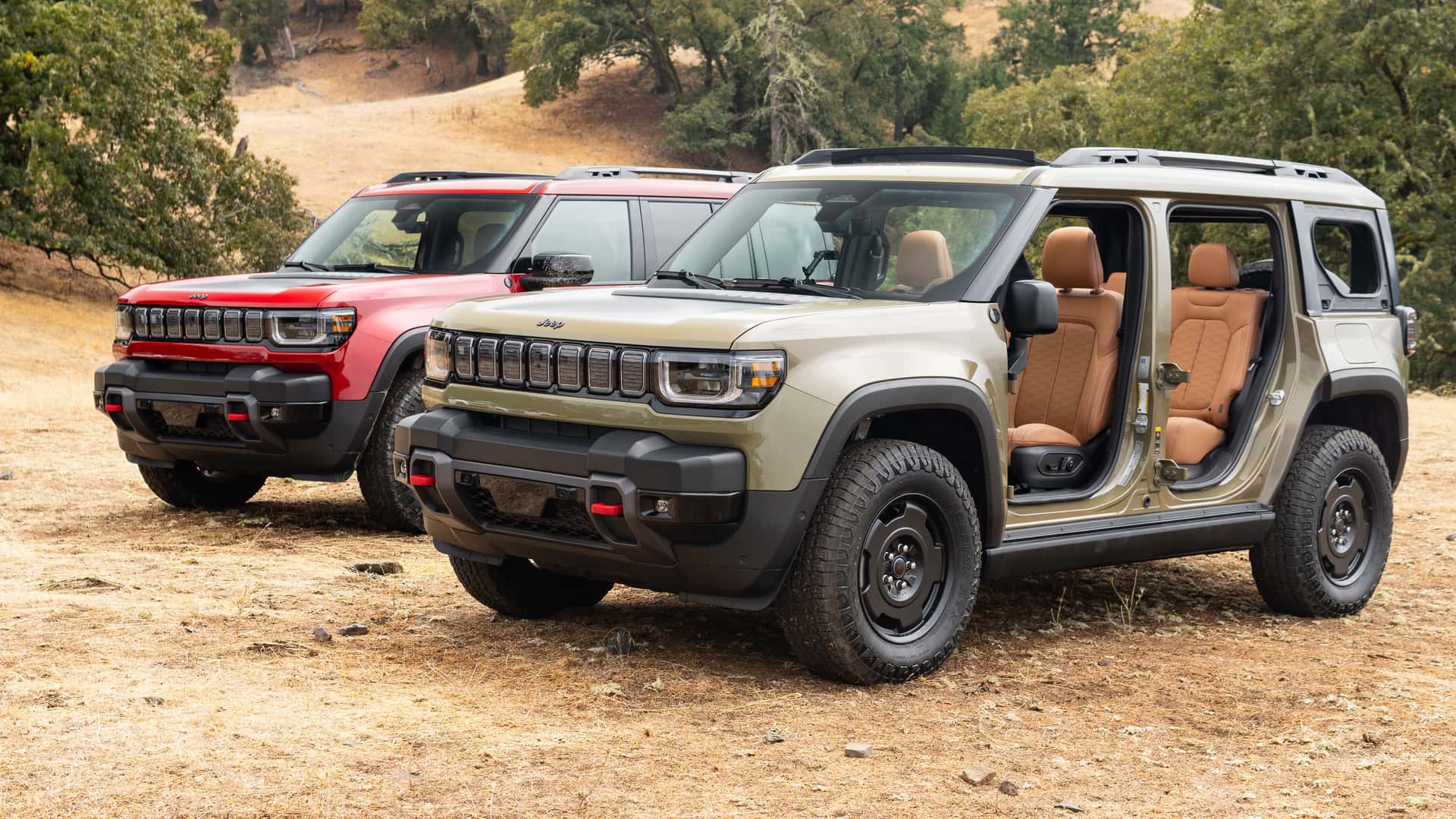
Jeep has made distinct design choices with the Recon, prioritizing formidable off-road capability over maximum range. The vehicle boasts 9.1 inches of ground clearance, a suite of heavy skid plates for underbody protection, robust 33-inch all-terrain tires, and an upright body design engineered for optimal approach and departure angles.
These specific enhancements are critical for traversing difficult terrain but come at a direct cost to energy efficiency and, consequently, the Jeep Recon range. The heavier build and less aerodynamic shape necessitate more energy to move, directly impacting how far the vehicle can travel on a single charge.
A often-overlooked factor in electric off-roaders is the gear ratio. While EVs lack conventional transmissions, they still utilize gear ratios to manage torque delivery from the electric motors. Taller ratios, characterized by a lower first number (e.g., 9:1 for an EV), are optimized for cruising efficiency.
Conversely, shorter gearing amplifies torque at the wheels from a standstill, significantly improving the vehicle’s ability to climb obstacles and navigate challenging terrain. The Recon’s rear motor, for example, features a 15:1 gearing ratio. This focus on low-end torque is paramount for off-roading, enabling the vehicle to surmount tougher obstacles. An additional benefit of this configuration is quicker acceleration, allowing the Recon to reach 60 mph in a swift 3.6 seconds.
However, this engineering decision comes with an inherent compromise: shorter gearing negatively affects overall efficiency. Observations during testing showed the Recon achieving approximately 2.5 miles per kilowatt-hour, a figure directly influenced by these capability-enhancing choices.
Comparative Landscape: Electric Off-Roaders and Their Ranges
To further contextualize the Jeep Recon range, it is useful to examine how other manufacturers navigate the balance between off-road prowess and electric efficiency.
Jeep Wagoneer S: A Tale of Two Jeeps
The Jeep Wagoneer S offers a stark contrast to the Recon, despite sharing the same 100.5 kWh battery pack. Designed with a focus on on-road comfort and aerodynamics, the Wagoneer S achieves an impressive 294 miles of range, courtesy of its 6 inches of ground clearance and street-oriented tires. This clearly illustrates how prioritizing a different use case, specifically less demanding driving conditions, can yield substantially better range from an identical battery.
Rivian R1S: Expanding Capability at a Cost
The Rivian R1S, a heavier electric SUV, generally demonstrates higher efficiency than the Recon. However, Rivian does not even offer all-terrain tires on models equipped with its base 108-kWh battery pack. To opt for all-terrain tires, buyers must upgrade to the larger 140-kWh version. Even then, the estimated range drops significantly from 410 miles to 370 miles, with the vehicle’s price point rising to approximately $96,000.
Moreover, despite its impressive capabilities, the Rivian R1S features taller gearing and lacks a locking rear differential, meaning it foregoes some of the specific off-road advantages engineered into the Jeep Recon.
Mercedes G580 with EQ Technology: Pinnacle of Off-Road EVs
The Mercedes G580 with EQ Technology represents the extreme end of electric off-road capability. It surpasses both the Recon and the R1S by offering separate low-range gears for each of its four motors. This advanced hardware allows it to excel in climbing situations, then switch to higher gears for more efficient on-road cruising.
Despite this clever engineering, a hefty price tag of $163,000, and a substantial 116 kWh of usable battery capacity, the G580 still achieves an EPA estimated range of only 239 miles. For all these dedicated off-road EVs, it is also crucial to anticipate that highway range will likely be notably lower than combined range estimates, as the aforementioned factors compound at higher speeds.
The Future of Electric Off-Roading
The experiences with vehicles like the Volkswagen ID. Buzz and the Jeep Recon underscore a critical industry-wide reality: electrifying the most inefficient vehicle segments presents the greatest challenges. Integrating a massive battery, such as a 91- or 100-kWh pack, is already a significant cost factor.
However, the sheer energy density of these batteries diminishes rapidly when propelling a large, boxy, and heavy vehicle. This effect is compounded further by the addition of all-terrain tires, increased ground clearance, and aggressive gearing – all vital for an authentic off-road experience. As battery technology advances, charging times decrease, and the charging network expands, these issues will gradually subside.
For the foreseeable future, however, consumers seeking robust electric vehicle off-roading capabilities will likely need to reconcile with inherent compromises on both overall range and purchase price. The trade-off between uncompromising capability and extensive electric range remains a defining characteristic of this specialized automotive segment.
Frequently Asked Questions (FAQs)
What factors limit the Jeep Recon’s electric range?
The Jeep Recon’s range is limited by its design for extreme off-road capability. High ground clearance, a boxy shape, heavy skid plates, aggressive all-terrain tires, and specialized low-end gearing all increase energy consumption, significantly reducing how far the vehicle can travel on a single charge compared to more aerodynamic, road-focused EVs.
Why is off-road capability inherently less efficient for electric vehicles?
Off-road features like tall suspensions, knobby tires, heavy-duty components, and specific gear ratios (designed for torque rather than sustained speed) create more aerodynamic drag, rolling resistance, and mechanical losses. These factors demand more power from the battery, directly leading to lower overall efficiency and reduced electric range.
How does the Recon’s gearing affect its range?
The Jeep Recon utilizes a 15:1 gear ratio on its rear motor, prioritizing low-end torque for superior climbing ability and off-road obstacle navigation. While excellent for performance in challenging terrain, this shorter gearing is less efficient at higher speeds, contributing to increased energy consumption and a lower Jeep Recon range compared to vehicles with taller, efficiency-focused gearing.
Is the Jeep Recon’s 222-mile range comparable to other electric off-roaders?
The Jeep Recon range is broadly comparable to other dedicated electric off-roaders when factoring in their respective capabilities and battery sizes. For example, the Mercedes G580, with even more advanced off-road hardware and a larger battery, achieves an EPA range of 239 miles, illustrating that robust off-road design universally impacts electric range.
Will electric off-road vehicle ranges improve significantly in the future?
Yes, significant improvements are anticipated. As battery technology advances, offering higher energy density and faster charging capabilities, and as charging infrastructure expands, the limitations on electric off-road vehicle ranges will gradually lessen. However, the fundamental engineering compromises for extreme capability will likely always mean a trade-off with absolute maximum range.