
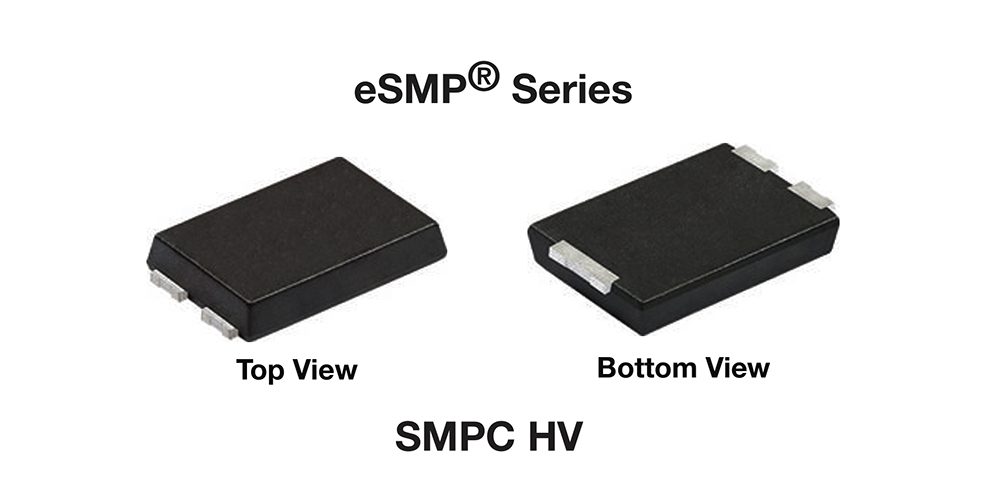
Vishay Intertechnology, a global leader in discrete semiconductors and passive electronic components, has significantly expanded its Gen 7 family of 1200 V FRED Pt® Hyperfast rectifiers. This latest introduction brings six new diodes to the market, all housed in the company’s advanced eSMP-series SMPC HV package.
These cutting-edge components are meticulously engineered to address critical demands for efficiency and performance in modern power conversion systems. With current ratings of 1 A, 2 A, and 3 A, these devices are poised to enhance a wide array of industrial, automotive, and energy-related designs by substantially reducing switching losses.

Key Takeaways
Vishay’s latest Gen 7 FRED Pt Hyperfast rectifiers operate at 1200 V, setting a new benchmark in efficiency. They are specifically designed to minimise switching losses, a critical factor in high-frequency applications like electric vehicle on-board chargers. These rectifiers boast ultra-low reverse recovery charge (Qrr) and a reduced forward voltage drop (Vf), optimising power conversion.
Available in 1 A, 2 A, and 3 A variants, the series includes AEC-Q101 qualified options, making them suitable for demanding automotive electronics. Their compact SMPC HV package offers high power density and space efficiency, crucial for modern system designs. These components are ideal for electric vehicles, industrial drives, and energy storage systems, offering enhanced reliability and stringent environmental compliance.
Advancing Power Efficiency with Gen 7 Technology
The newly launched rectifiers are crucial for high-voltage power conversion, leveraging Vishay’s proprietary Gen 7 FRED Pt technology. This design philosophy focuses on delivering an optimal balance between low reverse recovery charge and minimal forward voltage drop, two parameters vital for improving overall system efficiency.

By reducing these inherent losses, the Vishay’s new 1,200 V hyperfast rectifiers enable developers to design more compact and reliable power stages. This directly translates into less wasted energy, lower operating temperatures, and potentially smaller heat sinks, which are significant benefits in space-constrained and thermal-sensitive applications.
Key Specifications and Performance Metrics
The six new parts introduced comprise three standard versions: the VS-E7SX0112-M3V, VS-E7SX0212-M3V, and VS-E7SX0312-M3V. Additionally, three AEC-Q101 qualified versions, specifically designed for stringent automotive applications, are available: the VS-E7SX0112HM3V, VS-E7SX0212HM3V, and VS-E7SX0312HM3V.
Across this versatile range, these rectifiers demonstrate impressive performance characteristics. They achieve a fast recovery time of 50 nanoseconds (ns), which is crucial for high-speed switching. The reverse recovery charge (Qrr) is remarkably low, typically 105 nC, indicating minimal energy loss during the turn-off transient.
Furthermore, the forward voltage (Vf) falls to a low 1.45 V, contributing to reduced conduction losses. The junction capacitance stands at 7.25 pF, which is among the lowest in its class, further enhancing high-frequency operation. These devices also boast a robust non-repetitive peak surge current capability of up to 70 A, ensuring resilience against transient overloads.
Innovative Package Design and Compatibility
The Vishay’s new 1,200 V hyperfast rectifiers are encapsulated in the compact SMPC HV package, measuring 4.3 mm by 6.5 mm with a low profile of just 1.1 mm in height. This small footprint is significant for modern electronic designs where space optimisation is paramount.
Notably, this package is footprint-compatible with the widely used TO-277A package. This compatibility simplifies board layout and component replacement for designers, offering flexibility in migrating to these advanced rectifiers without major redesigns of existing printed circuit board (PCB) layouts.
The Science Behind Reduced Switching Losses
One of the most critical advantages of these new rectifiers lies in their ability to significantly reduce switching losses. A lower reverse recovery charge (Qrr) means that the diode releases less stored charge each time it transitions from ON to OFF. This translates directly into less energy wasted per switching cycle.
This reduction in energy dissipation is particularly impactful in high-frequency converters, where the number of switching cycles per second is very high. As switching frequency increases, recovery losses typically climb, making a lower Qrr an invaluable characteristic for optimising the power stage efficiency and thermal management.
Vishay achieves this superior performance through a sophisticated internal structure. The planar construction, combined with platinum-doped lifetime control, effectively minimises the stored charge and recovery current that are primary contributors to switching loss and overall power dissipation. This meticulous engineering ensures that Vishay’s new 1,200 V hyperfast rectifiers offer the best Qrr-to-forward-voltage trade-off in their class, alongside the lowest junction capacitance and recovery time, delivering unparalleled efficiency.
Ensuring Safety and Reliability in High-Voltage Circuits
Beyond performance, safety and reliability are paramount in high-voltage applications. The new rectifiers from Vishay address these concerns with a minimum 5.4 mm creepage distance. Creepage distance is the shortest path between two conductive parts along the surface of an insulating material, crucial for preventing electrical breakdown in high-voltage environments.
Moreover, the molding compound used in the SMPC HV package is rated with a comparative tracking index (CTI) of 600 or higher, classifying it under Material Group I. This high CTI rating indicates superior resistance to electrical tracking, where a conductive path forms on the surface of an insulating material due to electrical stress.
These features enable the diodes to meet the stringent spacing rules outlined in IEC 60664-1 for high-voltage circuits. Compliance with such standards allows designers to potentially reduce component counts and simplify board layouts, leading to a lower Bill of Material (BOM) cost and enhanced system robustness by optimising the insulation coordination.
Diverse Applications Across Key Industries
The versatility of Vishay’s new 1,200 V hyperfast rectifiers makes them suitable for an extensive range of critical applications across multiple high-growth sectors. In power conversion circuits, they function effectively as clamp, snubber, and freewheeling diodes.
Specifically, they are highly effective in flyback auxiliary supplies, which are crucial for providing isolated power to control circuits. They also excel as high-frequency rectifiers for bootstrap driver stages, essential for driving high-side MOSFETs or IGBTs. Furthermore, these rectifiers offer robust desaturation protection for fast-switching IGBTs and high-voltage Silicon (Si) and Silicon Carbide (SiC) MOSFETs, safeguarding expensive power devices from damage during fault conditions.
Impact on Electric Vehicles and Industrial Systems
The industrial sector stands to benefit significantly from these advancements, with typical applications including industrial drives and tools where high efficiency and reliability are critical. In the rapidly expanding electric vehicle (EV) market, the rectifiers are ideal for EV on-board chargers and EV motors, where efficient power delivery directly impacts range and charging times.
The energy sector also sees substantial advantages, particularly in energy generation and storage systems, contributing to more sustainable and effective power management. Additionally, they are well-suited for advanced power topologies such as cuk converters and LED SEPIC (Single-Ended Primary Inductor Converter) circuitry, demonstrating their broad applicability in high-performance electronics.
Environmental Compliance and Operational Robustness
In line with global environmental directives, Vishay’s new 1,200 V hyperfast rectifiers are fully RoHS-compliant and halogen-free, ensuring they meet stringent regulations for hazardous substances. This commitment to environmental responsibility is a critical consideration for manufacturers and end-users alike.
The rectifiers also carry a moisture sensitivity level (MSL) of 1 under J-STD-020, indicating they are not sensitive to moisture and can withstand standard reflow soldering processes without pre-baking. This simplifies manufacturing and reduces potential failures. Moreover, these devices are designed to operate reliably at elevated temperatures, supporting continuous operation at ambient temperatures up to 175 °C, crucial for demanding industrial and automotive environments.
Availability and Lead Time
Samples and production quantities of Vishay’s new 1,200 V hyperfast rectifiers are currently available to customers. The standard lead time for these components is eight weeks, allowing manufacturers to plan their production schedules effectively and integrate these high-performance rectifiers into their next-generation designs.
Source: Vishay Intertechnology
Frequently Asked Questions (FAQs)
What is the primary benefit of Vishay’s new 1,200 V hyperfast rectifiers?
The primary benefit is their ability to significantly cut switching losses. By combining a low reverse recovery charge (Qrr) with a low forward voltage drop (Vf), these rectifiers improve the overall energy efficiency of power conversion systems, leading to less wasted energy and reduced heat generation in applications like EV chargers and industrial drives.
What are the key technical specifications of these new rectifiers?
These rectifiers offer a 1200 V rating with current options of 1 A, 2 A, and 3 A. They feature a fast recovery time of 50 ns, a low typical reverse recovery charge (Qrr) of 105 nC, and a forward voltage (Vf) of 1.45 V. Junction capacitance is 7.25 pF, and they can handle a non-repetitive peak surge current up to 70 A, ensuring robust performance.
Why is a low reverse recovery charge (Qrr) important for efficiency?
A low Qrr means the diode releases less stored electrical charge each time it switches off. This translates directly to less energy being wasted during each switching cycle, especially critical in high-frequency converters. Reduced energy waste leads to higher overall system efficiency and minimises heat dissipation, improving component longevity and reliability.
What package are these hyperfast rectifiers available in?
The Vishay’s new 1,200 V hyperfast rectifiers are housed in the eSMP-series SMPC HV package. This compact package measures 4.3 mm x 6.5 mm with a low profile of 1.1 mm. It is also footprint-compatible with the TO-277A package, offering designers flexibility and ease of integration into existing or new board layouts.
Are these new rectifiers suitable for automotive applications?
Yes, a portion of the new product line, specifically the VS-E7SX0112HM3V, VS-E7SX0212HM3V, and VS-E7SX0312HM3V models, are AEC-Q101 qualified. This stringent qualification ensures they meet the high reliability and performance standards required for automotive electronics, making them ideal for EV on-board chargers and other automotive power systems.
What types of applications will benefit most from these rectifiers?
These rectifiers are particularly beneficial for applications requiring high efficiency and robust power conversion. Key use cases include clamp, snubber, and freewheeling diodes in flyback auxiliary supplies, high-frequency rectifiers for bootstrap driver stages, and desaturation protection for IGBTs and Si/SiC MOSFETs in industrial drives, EV on-board chargers, energy generation, and storage systems.
How do these rectifiers ensure safety in high-voltage circuits?
Safety is ensured through a minimum 5.4 mm creepage distance and a high-performance molding compound with a comparative tracking index (CTI) of 600 or higher (Material Group I). These features enable the diodes to comply with IEC 60664-1 spacing rules for high-voltage circuits, contributing to enhanced system safety and potentially reducing Bill of Material costs.