
Key Takeaways
- Ionna and Walmart are aggressively expanding their electric vehicle (EV) fast charging networks across North America.
- Both companies are offering significantly lower per-kilowatt-hour (kWh) prices compared to established players like Tesla and Electrify America.
- This strategic pricing, coupled with rapid infrastructure deployment, suggests the nascent stages of a competitive price war in the EV fast charging sector.
- The intensified competition is poised to benefit EV owners through more affordable charging options and enhanced amenities.
The landscape of electric vehicle (EV) charging is undergoing a significant transformation. After years of focusing primarily on network build-out to combat range anxiety, the industry is now entering a new, highly competitive phase. At the forefront of this shift are Ionna and Walmart, whose aggressive expansion and pricing strategies appear to be igniting a potential EV fast charging price war across the United States and Canada.
This evolving market dynamic signifies a maturation of the EV ecosystem, where availability is increasingly met with affordability. As more consumers embrace electric mobility, the battle for their charging business is intensifying, pushing providers to innovate not only in speed and reliability but also in cost-effectiveness.
New Entrants Reshape the EV Charging Landscape
The emergence of well-backed new players like Ionna and the strategic pivot by retail giants such as Walmart are disrupting the established order. Their combined efforts are rapidly expanding the accessible EV charging infrastructure while simultaneously introducing a potent element of price competition.
Ionna’s Ambitious Network Rollout
Ionna, a joint venture backed by eight prominent automakers—BMW, General Motors, Honda, Hyundai, Kia, Mercedes-Benz, Stellantis, and Toyota—harbours grand ambitions. The consortium has pledged to deploy an impressive 30,000 fast chargers across the U.S. and Canada by 2030.
These stations are designed to offer comprehensive amenities, mirroring traditional gas stations with convenience stores and restrooms, thereby enhancing the charging experience for EV drivers. Crucially, Ionna’s chargers will feature both North American Charging Standard (NACS) and Combined Charging System (CCS) plugs, ensuring broad compatibility across the rapidly diversifying EV market.
Walmart’s Strategic Expansion into EV Charging
Walmart, initially a partner in Electrify America’s charging efforts, is now robustly expanding its proprietary EV charging network. This strategic move underscores the retail giant’s recognition of EV charging as a significant driver for store traffic and customer loyalty.
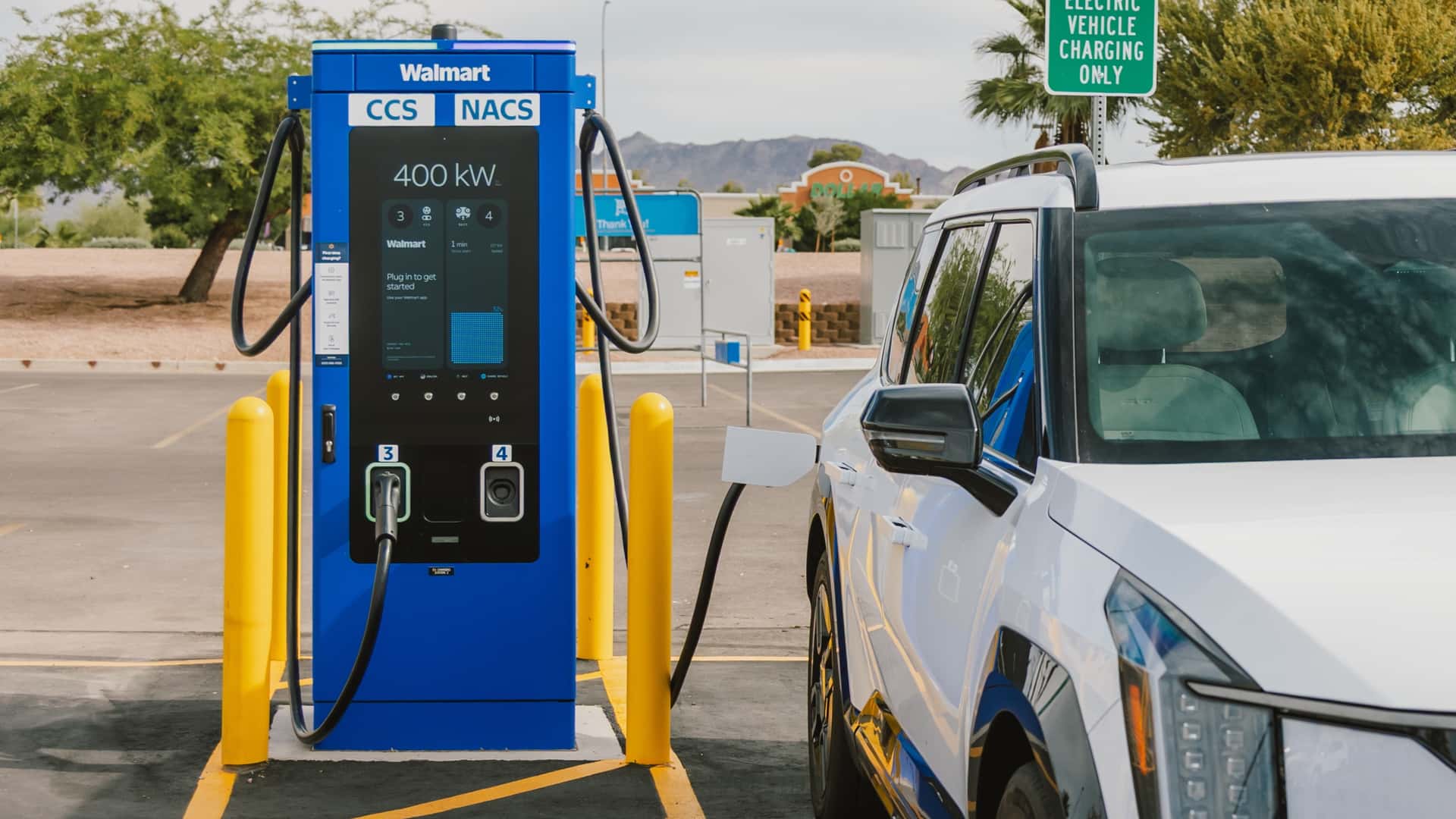
The company is deploying 400-kW Alpitronic chargers, equipped with both NACS and CCS plugs, catering to a wide array of electric vehicles. An additional incentive for shoppers is a 10% discount on charging for Walmart+ customers, directly linking charging services to its loyalty program. The rollout has been notably aggressive, with hundreds of new chargers installed in recent months, marking Walmart as a serious contender in the EV fast charging arena.
Aggressive Pricing: The Core of the Strategy
A key tactic employed by both Ionna and Walmart to attract a significant customer base is aggressive pricing. Data compiled by Chargenomics analyst, Paren, indicates that these new networks are consistently offering electricity rates below the industry average, directly challenging the pricing models of older, more entrenched networks.
According to Paren’s analysis, Ionna currently boasts the lowest average rate among 17 networks, charging approximately $0.37 per kWh. Walmart, while slightly higher, ranks as the fourth cheapest, with an average price of $0.43 per kWh, placing it below Shell Recharge and Rocky Mountain Power, but significantly more competitive than leading incumbents.
In contrast, established networks like Tesla and Electrify America currently charge an average of $0.56 per kWh. This translates to substantial savings for consumers; for instance, a driver charging at an Ionna station could save around 40% compared to using an Electrify America station. Such a differential is a powerful incentive designed to shift consumer habits.
Challenging the Incumbents and Consumer Inertia
Disrupting the dominance of well-established networks like Tesla’s Supercharger and Electrify America requires more than just new infrastructure; it demands a compelling reason for consumers to change their charging routines. Loren McDonald, CEO and chief analyst at Chargenomics, articulated this challenge clearly.
“They’re the new kid on the block. You and me and the everybody on LinkedIn in the EV industry know who Ionna is. But your average new driver who goes down to the Hyundai dealer or Ford dealer and gets an EV, they have no idea what an ‘Ionna’ is. They’ve heard of Tesla. They’ve probably heard of Electrify America, maybe EVGo,” McDonald noted, highlighting the brand awareness gap.
Existing networks benefit from seamless integration with vehicle navigation systems, pre-loaded charging credits, and user-friendly features like Tesla’s plug-and-charge functionality. To overcome this ingrained user inertia, new players must offer significant monetary advantages. McDonald also observed that Ionna has strategically offered aggressive holiday and new-station discounts, at times lowering prices to the $0.20 per kWh range, often cheaper than residential electricity rates, explicitly to build brand recognition and attract new customers.
Walmart’s Unique Value Proposition in Charging
Walmart’s foray into EV charging is driven by a distinct business model. As McDonald explained, “Walmart, obviously, is in the business for a very different reason.” With thousands of stores nationwide, Walmart possesses inherent advantages that allow it to offer competitive pricing and rapid deployment.
The company’s massive scale facilitates strong negotiations with equipment suppliers and utility providers, driving down operational costs. Furthermore, its extensive parking lots provide readily available real estate for charger installation, reducing infrastructure expenses and accelerating deployment timelines. Crucially, the chargers serve a dual purpose: they generate direct revenue while simultaneously acting as a powerful magnet for in-store traffic.
“The stereotypical demographic and psychographic of EV drivers is not like, Walmart customers, right? So they can attract a new customer base and then, the key for them obviously is getting people inside the store for 40 minutes, spending $50 or $100, not just the $22 out front,” McDonald elaborated. This strategy leverages charging sessions to boost retail sales, offering a significant competitive edge.
The Evolving EV Charging Ecosystem
For many years, the primary objective of the EV charging industry was simply to expand network coverage and alleviate drivers’ range anxiety. This focus on scale often meant that if a charging location was the only viable option, operators could command higher prices. The significant capital expenditure required for network build-outs and the burden of utility demand charges contributed to these elevated costs.
However, as the industry matures and more players enter the market, the dynamic is shifting. The emphasis is moving beyond mere availability to include competitive pricing and an enhanced user experience. This pivot signifies a new era where efficiency and consumer value become paramount.
Cost Comparison: EV Fast Charging Versus Gasoline
The cost effectiveness of EV fast charging, while improving, still presents a mixed picture when compared directly to gasoline, particularly in high-cost areas. For instance, completely filling a 2024 Chevy Blazer EV, offering 279 miles of EPA range, costs approximately $47.60 at the average rate of $0.56 per kWh for established fast charging networks.
To cover the same distance in a gasoline-powered 2024 Chevy Blazer AWD, requiring 12.68 gallons of fuel at the current U.S. average of $4.07 per gallon, the cost would be around $51.61. While the EV option is slightly cheaper in this scenario, the savings can diminish rapidly at more expensive fast charging stations.
At a premium Tesla Supercharger, for example, prices can reach $0.74 per kWh, pushing a full charge for the Blazer EV to $62.90. This demonstrates the significant variability in fast charging costs. It is important to note that over 90% of EV charging typically occurs at home, where the average American electricity cost is a much lower $0.18 per kWh, making home-charged EVs considerably more economical than gasoline vehicles.
Furthermore, Level 2 public chargers, which are becoming increasingly common, offer a more affordable alternative to DC fast charging. These chargers are cheaper to install and operate, as they do not require the expensive high-output AC-to-DC converters or incur the extreme demand charges associated with fast charging, thus offering a more cost-effective solution for everyday charging needs.
Beyond Price: The Future of Charging Experience
While price competition is a significant development, the future of EV charging also encompasses a broader focus on amenities and service quality. Several companies are distinguishing themselves through unique offerings:
- Mercedes-Benz High Power Charging is prioritizing premium amenities and reservation systems to offer a superior, seamless experience.
- BP is strategically developing large-scale charging hubs, aiming to provide comprehensive service points for long-distance travel.
- Innovative upstarts like Rove are focusing on creating giant charging hubs with attached premium markets, enhancing the wait time with high-quality retail experiences.
- Established players such as Tesla, Electrify America, and EVGo continue to grow their networks and expand membership benefits to retain customer loyalty.
This multi-faceted competition, driven by both pricing and enhanced services, signifies a positive outlook for electric vehicle owners. As more providers vie for market share, the industry is poised to deliver a more convenient, reliable, and ultimately, more affordable EV charging experience. The next era of EV charging promises significant advancements that will further accelerate electric mobility adoption.
FAQ Section
Q1: What is fueling the potential EV fast charging price war?
The potential EV fast charging price war is primarily driven by new entrants like Ionna and Walmart aggressively expanding their networks. They are leveraging lower pricing strategies and rapid infrastructure deployment to attract customers and compete with established players, marking a significant shift in the EV charging market dynamic.
Q2: Which companies are leading the charge in offering lower EV fast charging prices?
Ionna, a consortium of major automakers, and retail giant Walmart are leading the charge in offering lower EV fast charging prices. Data from Chargenomics indicates Ionna has the lowest average rate at $0.37 per kWh, with Walmart ranking fourth cheapest at $0.43 per kWh, significantly undercutting market leaders.
Q3: How much cheaper are Ionna and Walmart’s EV fast charging rates compared to competitors?
Ionna’s average rate of $0.37 per kWh and Walmart’s $0.43 per kWh are considerably cheaper than the $0.56 per kWh average charged by networks like Tesla and Electrify America. This can result in savings of up to 40% for consumers, making these new options highly attractive.
Q4: Why are new entrants like Ionna and Walmart adopting aggressive pricing?
New entrants are using aggressive pricing to overcome brand awareness gaps and customer inertia. As Loren McDonald of Chargenomics noted, lower prices provide a strong incentive for drivers to switch from established networks, helping new players quickly build market share and customer loyalty in a competitive landscape.
Q5: What unique advantages does Walmart have in building its EV charging network?
Walmart leverages its massive scale for strong negotiations with suppliers and utilities, reducing costs. Its extensive parking lots provide readily available, low-cost real estate for rapid charger deployment. Critically, EV charging attracts customers who may then spend money inside the store, providing dual revenue streams.
Q6: How does the cost of EV fast charging compare to gasoline?
At average rates, EV fast charging is often slightly cheaper than gasoline for the same distance (e.g., ~$47 for an EV vs. ~$51 for gas for 279 miles). However, premium fast charging can be more expensive. Crucially, over 90% of EV charging happens at home, where electricity is far cheaper ($0.18/kWh average), making EVs significantly more economical overall.
Q7: What does this increased competition mean for EV owners?
Increased competition from players like Walmart and Ionna signifies a positive future for EV owners. It is expected to lead to more affordable charging options, greater network availability, improved reliability, and an enhanced overall charging experience, including better amenities and services, accelerating electric vehicle adoption.