
Key Takeaways:
- Wolfspeed has launched its fifth-generation silicon carbide (SiC) MOSFET technology, targeting 1,200 V and 750 V automotive and industrial applications.
- These new SiC MOSFETs offer the lowest specific on-resistance (RSP) in a compact 5×5 mm SiC footprint, enhancing efficiency and enabling smaller traction inverters.
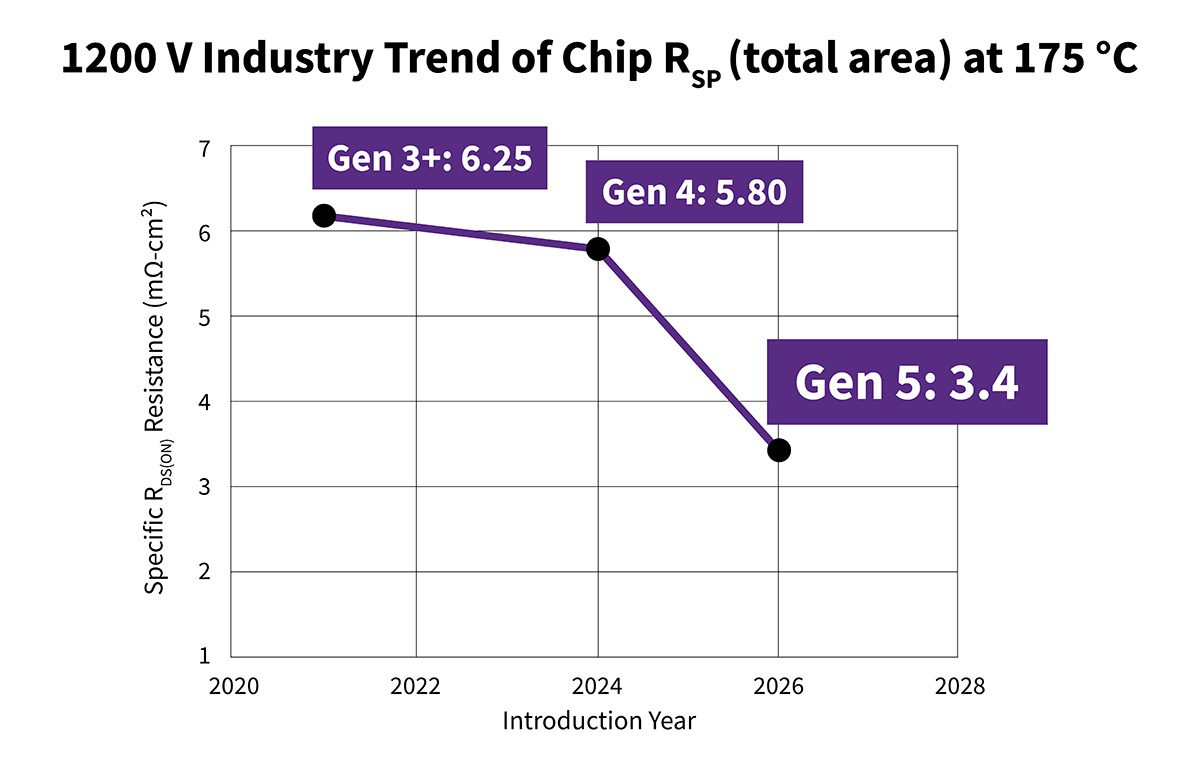
- Key advancements include a chip-level RSP of 3.4 mΩ·cm² for 1,200 V parts and 2.0 mΩ·cm² for 750 V parts, alongside a continuous junction temperature rating of 200° C.
- The Gen 5 technology is built on Wolfspeed’s 200 mm wafer platform, ensuring a low-risk, faster integration path for existing customers without requiring new manufacturing toolsets.
- Improved performance translates to better efficiency at high temperatures, potential for downsizing battery packs, and enabling robust solid-state circuit breaker designs in electric vehicles.
GLOBAL — Wolfspeed, a leader in silicon carbide technology, has announced the introduction of its fifth-generation SiC MOSFETs, poised to significantly advance power electronics in the rapidly expanding electric vehicle (EV) sector. These new semiconductors are engineered for both 1,200 V and 750 V automotive and industrial applications, offering unparalleled performance metrics that could reshape the design and efficiency of EV traction inverters.

The latest iteration of Wolfspeed’s silicon carbide MOSFETs represents a critical step forward in addressing the demanding requirements of modern electric powertrains. The technology promises to deliver enhanced power density, reduced energy losses, and improved thermal management, all crucial factors in extending range, optimizing performance, and lowering the overall cost of electric vehicles.
Setting New Benchmarks in On-Resistance for EV Traction Inverters
At the core of Wolfspeed’s Gen 5 innovation is the achievement of the lowest specific on-resistance (RSP) currently available in a 5×5 mm SiC footprint. This benchmark is particularly significant for applications like EV traction inverters, where every milliohm of resistance contributes to power loss and heat generation.
For the 1,200 V QEM50120-025D10 part, Wolfspeed reports an impressive chip-level RSP of 3.4 mΩ·cm² when measured at 175° C. Similarly, the 750 V QEM50075-025D10 achieves an RSP of 2.0 mΩ·cm² at the same operating temperature. These figures highlight the substantial gains in conductive efficiency offered by the new generation of SiC MOSFETs.

Beyond the raw RSP numbers, a crucial engineering advantage lies in the tight distribution of the RDS(ON) — the drain-source on-resistance — which is held to ±18%. This consistency across individual components significantly reduces the design margin that engineers typically must account for due to part-to-part variation. For EV traction inverters, this translates directly into more predictable thermal and efficiency budgets, simplifying design complexities and accelerating development cycles.
Enhanced Thermal Performance and Reduced Switching Losses
The Gen 5 SiC MOSFETs also introduce significant advancements in thermal robustness and dynamic performance. The continuous junction temperature rating has been elevated to 200° C, with a limited-life rating extending to 215° C. This higher thermal tolerance allows for more aggressive operating conditions and improved reliability, particularly in high-power, high-temperature EV environments where thermal management is a persistent challenge.
Maintaining thermal stability is paramount for the longevity and performance of power electronics in electric vehicles. The increased junction temperature rating of these SiC MOSFETs provides greater flexibility for inverter designs, potentially reducing the need for elaborate and heavy cooling systems, thereby contributing to overall weight reduction and system compactness.
Furthermore, the Gen 5 technology retains the “soft body diode” characteristic of its Gen 4 predecessor, a feature critical for robust operation in inverter circuits. Coupled with a notable reduction in reverse recovery charge, the overall switching losses of these SiC MOSFETs have been significantly improved. This reduction in both conduction and switching losses directly translates into higher efficiency for EV traction inverters, meaning less energy is wasted as heat and more power is delivered to the electric motor.
Transformative Impact on EV System Design and Efficiency
The cumulative effect of lower specific on-resistance, enhanced thermal performance, and reduced switching losses is profound for electric vehicle system architecture. The ability to pass more current through a fixed die area, thanks to the lower RSP, directly enables the development of smaller and more power-dense traction inverters. This miniaturization is critical for optimizing space within the increasingly compact designs of modern EVs.
Improved efficiency at high temperatures also means that EV traction inverters can operate more effectively under various driving conditions, including sustained high-power demands. This directly impacts the vehicle’s range and performance, providing a more consistent and reliable driving experience. For EV manufacturers, the advancements offer a compelling opportunity to downsize battery packs, rather than having to compensate for inverter losses with additional battery capacity. This could lead to lighter vehicles, further cost reductions, and potentially faster charging capabilities.
Beyond traction inverters, Wolfspeed highlights another innovative application for its Gen 5 SiC MOSFETs: the enablement of solid-state circuit breaker designs. These advanced breakers can replace traditional mechanical relays in EV architectures, offering faster response times, greater reliability, and potentially reduced maintenance over the vehicle’s lifespan. This integration of robust solid-state solutions underscores the versatility and broad applicability of the new SiC technology across various EV subsystems.
Leveraging a Proven Manufacturing Platform for Rapid Market Integration
Significantly, the Gen 5 SiC MOSFETs represent the second generation of Wolfspeed’s technology built on the company’s advanced 200 mm wafer platform at its Mohawk Valley facility in New York. This strategic choice means that the new SiC MOSFETs require no new manufacturing toolsets for volume production.
This deliberate design and manufacturing strategy positions the Gen 5 as a low-risk upgrade path for customers who are already qualified on Wolfspeed’s previous Gen 4 devices. The continuity in manufacturing processes streamlines the adoption cycle for EV manufacturers, allowing for quicker integration into existing production lines.
Dr. Adam Barkley, VP of Power Device and Package Development at Wolfspeed, emphasized the customer-centric benefits of this approach. “For customers facing compressed development timelines, that means faster validation, faster qualification, and faster time to market — without sacrificing the performance they know and trust,” Barkley stated. This accelerated pathway is critical for an industry characterized by rapid innovation and intense competition, where speed to market can be a decisive competitive advantage.
The Evolving Landscape of SiC Technology in Electric Mobility
The introduction of Wolfspeed’s Gen 5 SiC MOSFETs further solidifies silicon carbide’s pivotal role in the ongoing transformation of electric mobility. As the automotive industry continues its shift towards electrification, the demand for highly efficient, compact, and reliable power semiconductors is escalating.
SiC technology offers inherent advantages over traditional silicon-based devices, particularly in high-voltage, high-frequency, and high-temperature applications. These characteristics make SiC MOSFETs ideal for critical EV components such such as traction inverters, on-board chargers, and DC-DC converters. Wolfspeed’s latest offering contributes to the continuous performance improvement curve expected from advanced semiconductor materials.
The consistent evolution of SiC technology, exemplified by this Gen 5 release, promises to unlock new possibilities for EV designers. It empowers engineers to push the boundaries of energy efficiency and power density, ultimately contributing to more sustainable, cost-effective, and higher-performing electric vehicles for consumers worldwide. As the industry advances, innovations like these SiC MOSFETs will remain at the forefront of enabling the next generation of electric transportation.
Frequently Asked Questions (FAQ)
What are SiC MOSFETs and why are they important for EVs?
SiC MOSFETs (Silicon Carbide Metal-Oxide-Semiconductor Field-Effect Transistors) are power semiconductor devices made from silicon carbide. They are crucial for EVs because they offer superior performance compared to traditional silicon-based transistors, especially in high-voltage, high-frequency, and high-temperature environments. This translates to greater efficiency, smaller component sizes, and improved range for electric vehicles.
What specific improvements do Wolfspeed’s Gen 5 SiC MOSFETs offer?
Wolfspeed’s Gen 5 SiC MOSFETs introduce the lowest specific on-resistance (RSP) in a 5×5 mm SiC footprint, leading to higher efficiency. They also feature an elevated continuous junction temperature rating of 200°C and reduced reverse recovery charge, which minimizes switching losses. These improvements result in better thermal performance and overall energy efficiency for EV traction inverters.
How does lower specific on-resistance (RSP) benefit EV performance?
Lower RSP means less energy is lost as heat during operation, directly increasing the efficiency of EV traction inverters. This improved efficiency allows for more power delivery to the motor, potentially enabling smaller and lighter inverter designs. It can also reduce the overall power requirements, potentially allowing for smaller, lighter battery packs and longer driving ranges for electric vehicles.
What is the significance of the 200° C continuous junction temperature?
A 200° C continuous junction temperature rating enhances the thermal robustness and reliability of the SiC MOSFETs. It allows the devices to operate effectively in hotter environments, common in high-power EV applications, without compromising performance or lifespan. This improved thermal tolerance can simplify cooling system designs, reduce vehicle weight, and contribute to system stability under demanding conditions.
How does the Gen 5 technology impact manufacturing and adoption for customers?
Gen 5 SiC MOSFETs are built on Wolfspeed’s existing 200 mm wafer platform, meaning no new manufacturing toolsets are required for volume production. This provides a low-risk upgrade path for customers already using Gen 4 devices. It facilitates faster validation, qualification, and time to market, allowing EV manufacturers to integrate the advanced technology more quickly into their product development cycles.
Can these SiC MOSFETs be used beyond EV traction inverters?
Yes, while primarily highlighted for EV traction inverters, Wolfspeed’s Gen 5 SiC MOSFETs are designed for both 1,200 V and 750 V automotive and industrial applications. Their robust performance and efficiency benefits make them suitable for a wide range of power electronics, including on-board chargers, DC-DC converters, and industrial power supplies. They also enable advanced solutions like solid-state circuit breakers in EV architectures.