
Key Takeaways:
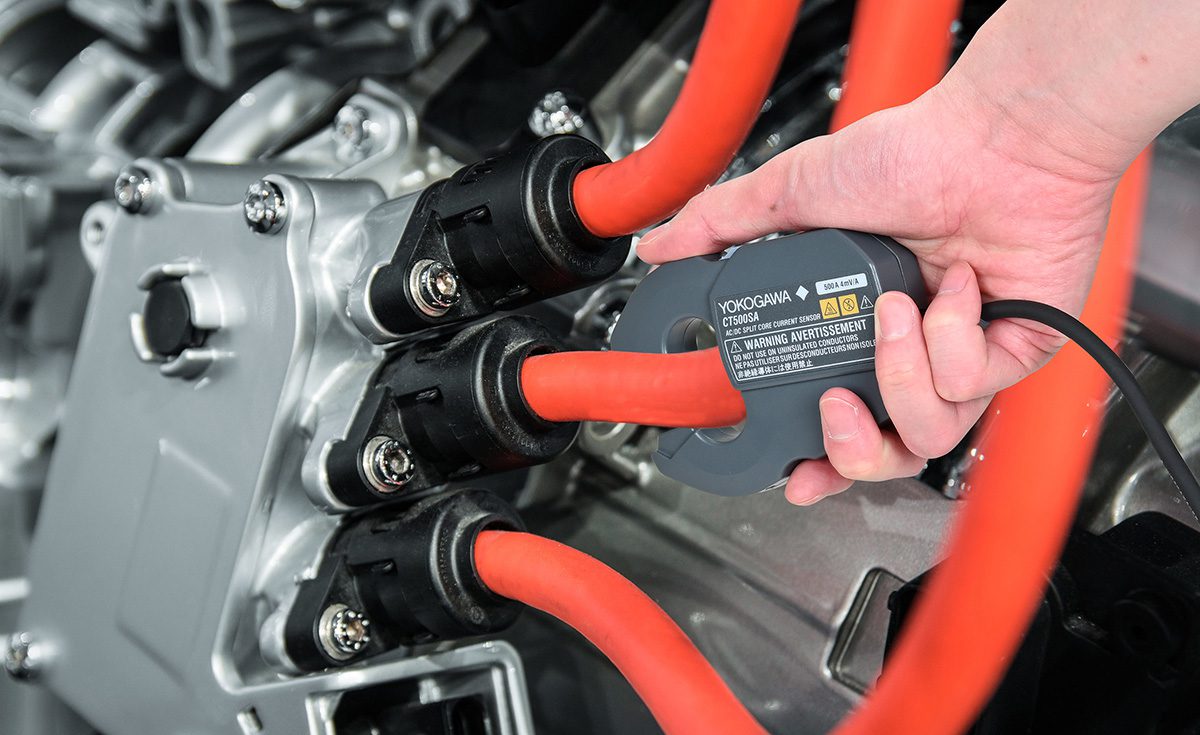
- Yokogawa Test & Measurement has introduced the CT500SA and CT200SA, a new generation of AC/DC split core current sensors.
- These sensors are specifically engineered for tight, space-constrained environments prevalent in electric vehicle (EV) testing and post-assembly validation.
- They offer exceptional accuracy, reaching up to ±0.09% of reading, rivalling the performance of through-hole type sensors despite their clamp-on design.
- With wide frequency bandwidths up to 1 MHz, the sensors are capable of measuring high switching frequencies essential for motor inverter validation.
- A significant innovation allows direct connection to both power analyzers and waveform measurement instruments, simplifying workflow and eliminating sensor swaps for comprehensive EV testing.
New Delhi, India – As the global automotive industry accelerates towards electrification, the demand for sophisticated and precise measurement tools in electric vehicle (EV) development continues to surge. Addressing critical challenges in accuracy and accessibility, Yokogawa Test & Measurement has announced the launch of its second-generation AC/DC split core current sensors, the CT500SA and CT200SA.

These innovative devices are poised to redefine current measurement capabilities, especially within the cramped confines of in-vehicle testing environments where traditional methods often fall short. They directly clamp onto conductors, offering a practical solution when cables cannot be severed to accommodate through-hole sensors, making them indispensable for advanced EV testing current sensors.
Revolutionising Measurement in Space-Constrained EV Environments
The development of electric vehicles necessitates rigorous and precise testing at every stage, from component validation to full system integration. One significant hurdle in this process is the limited space around components, particularly during post-assembly validation of inverters and motors.
Conventional sensors, especially those designed for higher current ratings like Yokogawa’s existing CT1000S, often prove too bulky for these compact vehicle architectures. The CT500SA and CT200SA directly tackle this issue, offering a significantly smaller footprint without compromising performance.

Compact Design and Ergonomic Operation
Each main sensor unit measures a mere 110 mm wide by 62 mm high by 25 mm deep, making them exceptionally compact. This diminutive size is critical for navigating the tight spaces commonly encountered during in-vehicle diagnostics and component analysis.
Engineers can operate these sensors with remarkable ease. A single unlock-and-open button facilitates one-handed operation, streamlining the measurement process. Furthermore, the body of each sensor incorporates an M4 screw hole and a cable tie slot, providing robust options for fixing the sensor in place. Yokogawa underscores that securing the sensor significantly enhances measurement repeatability, a crucial factor for reliable data in sensitive EV testing applications.
Setting New Standards in Accuracy and Bandwidth for EV Testing Current Sensors
Accuracy is paramount in EV development, where even minor discrepancies in current measurement can impact efficiency calculations, battery management systems, and overall vehicle performance. The new CT500SA and CT200SA sensors deliver industry-leading accuracy, a notable advancement for split-core designs.
Unprecedented Measurement Precision
Yokogawa states that these sensors achieve an impressive accuracy of ±0.1% across a broad temperature range from -40°C to 85°C. This precision further refines to ±0.09% of reading plus 0.01% of full scale within a more controlled temperature environment of 23 ±5°C.
The phase accuracy is equally remarkable, measured at ±0.1° between 0.1 Hz and 1 kHz. The company highlights that this level of accuracy is an order of magnitude better than conventional current sensors and is on par with the performance typically expected from through-hole type sensors. This breakthrough addresses the historical challenge where conventional split core sensors struggled to meet the stringent accuracy requirements of modern EV applications due to their clamp-on nature.
Wide Frequency Response for Inverter Validation
Modern electric vehicles rely heavily on advanced motor inverters, which operate at high switching frequencies. Accurate measurement of these frequencies is vital for validating inverter performance and efficiency. The CT500SA offers a frequency bandwidth of 500 kHz (-3 dB), while the CT200SA extends this capability even further to 1 MHz (-3 dB).
This wideband measurement capability ensures that both sensors can effectively capture and analyze the complex switching frequencies inherent in motor inverter validation. This is particularly crucial for evaluating pulse width modulation (PWM) outputs and understanding their harmonic content, directly impacting the overall efficiency analysis during EV testing.
Streamlined Workflow with Dual Instrument Compatibility
A significant innovation integrated into the CT500SA and CT200SA is their unprecedented compatibility with different types of measurement instruments. Traditionally, a current sensor is designed for use with either a power analyzer for efficiency and power measurements or a waveform measurement instrument for detailed signal analysis.
Yokogawa’s new sensors break this barrier by allowing direct connection to both instrument classes without the need for conversion connectors or supporting accessories. This eliminates the time-consuming process of swapping sensors between different test phases, greatly enhancing the efficiency of the measurement workflow.
Furthermore, measuring identical signals with the same sensor across various instruments removes the complexities associated with synchronizing data afterward. This seamless transition between waveform and power analysis empowers engineers to conduct more thorough and integrated EV testing with greater ease and confidence.
Versatile Applications Beyond EV Testing
While primarily engineered to address the specific demands of EV testing, the CT500SA and CT200SA sensors offer broad utility across a range of other industrial and research applications. Their high accuracy, wide bandwidth, and flexible deployment make them valuable tools in various sectors.
Additional applications include precise photovoltaic output measurement, comprehensive HVAC current monitoring, and detailed inverter efficiency analysis of PWM outputs with their associated harmonic content. This versatility underscores the advanced engineering and practical design principles underpinning Yokogawa’s latest offering.
Availability and Future Impact
Both the CT500SA and CT200SA current sensors are scheduled for global release on September 9, 2026. Their introduction is expected to significantly impact the efficiency and accuracy of EV development and testing protocols worldwide, providing engineers with the advanced tools necessary to drive the next generation of electric vehicle innovation.
Source: Yokogawa Test & Measurement
Frequently Asked Questions (FAQ)
What are the main advantages of the new Yokogawa CT500SA and CT200SA sensors?
These sensors offer high accuracy comparable to through-hole types, wide frequency bandwidths up to 1 MHz, and a compact, clamp-on design suitable for tight spaces. They also feature dual compatibility with both power analyzers and waveform measurement instruments.
Why are these sensors particularly suitable for EV testing?
Their compact size and clamp-on design are ideal for space-constrained EV environments where cables cannot be cut. High accuracy and wide bandwidth are critical for precise motor inverter validation and efficiency analysis in electric vehicles.
How does the compact design benefit engineers?
The small form factor (110x62x25 mm) allows easy integration into congested test setups. The single-button, one-hand operation and robust mounting options (M4 screw hole, cable tie slot) improve usability and measurement repeatability in challenging environments.
What levels of accuracy can be expected from these EV testing current sensors?
The sensors provide an impressive accuracy of ±0.1% from -40°C to 85°C, improving to ±0.09% of reading plus 0.01% of full scale at 23 ±5°C. Phase accuracy is rated at ±0.1° between 0.1 Hz and 1 kHz.
Can these sensors be used for both waveform and power analysis?
Yes, a key feature is their ability to connect directly to both power analyzers and waveform measurement instruments. This eliminates the need for sensor swaps and data synchronization, streamlining the testing process significantly.
When will the CT500SA and CT200SA sensors be available?
Yokogawa Test & Measurement has scheduled the release of both the CT500SA and CT200SA current sensors for September 9, 2026.