
Key Takeaways:
- Yokogawa Test & Measurement introduces new CT500SA and CT200SA AC/DC split-core current sensors.
- These second-generation models offer unprecedented accuracy for non-intrusive current measurement in tight spaces.
- Designed specifically for demanding EV engineering applications, particularly in-vehicle testing where cables cannot be cut.
- Boast superior accuracy (up to ±0.09%) and wide frequency bandwidths (up to 1 MHz), surpassing conventional split-core sensors.
- Feature a unique dual-instrument compatibility, connecting directly to both power analyzers and waveform measurement instruments.
- Compact, single-hand operable design enhances usability and measurement repeatability in confined automotive architectures.
- Scheduled for global release on September 9, 2026, targeting a broad range of high-precision measurement needs.
Addressing Critical Challenges in EV Engineering
The rapid evolution of electric vehicle (EV) technology continues to push the boundaries of design and testing. As automotive manufacturers strive for greater efficiency, performance, and compact architectures, the tools used for validation and analysis must keep pace. A significant hurdle in this advanced EV engineering landscape involves accurately measuring current in complex, often inaccessible, vehicle electrical systems.

Traditional methods frequently fall short, particularly when direct access to conductors is limited or when cables cannot be severed for through-hole sensor installation. This challenge is especially pronounced during post-assembly validation of critical components like inverters and motors, where space around the components is minimal and the integrity of the cabling must be maintained.
The Imperative for Precision in Electric Vehicles
Electric vehicles rely on intricate power electronics, demanding highly accurate current measurement for optimal performance, safety, and efficiency. Every millivolt and microampere contributes to the overall energy management system, influencing battery life, motor control, and inverter efficiency. Imprecise measurements can lead to flawed designs, suboptimal performance, and increased development costs, underscoring the critical need for advanced testing equipment.
Conventional split-core current sensors have historically presented limitations in achieving the exacting accuracy required for these sophisticated applications due to inherent challenges in their clamp-on design. This gap in measurement capability has prompted a demand for instruments that combine the flexibility of non-intrusive clamping with the precision typically associated with more intrusive, high-end through-hole sensors.

Space Constraints in Modern Automotive Design
Modern vehicle architectures are becoming increasingly lightweight and compact, leading to densely packed electronic compartments. This design philosophy, while beneficial for overall vehicle performance and energy consumption, severely restricts physical access for test and measurement equipment. Existing current sensors, particularly larger models designed for higher current ratings like Yokogawa’s 1,000 A CT1000S, often prove impractical in these confined spaces, especially for applications at lower current levels.
Engineers engaged in EV engineering and validation require tools that are not only accurate but also physically small and easy to deploy. The ability to secure a sensor in place within a tight environment is paramount for ensuring consistent and repeatable measurements, which is crucial for reliable data acquisition during demanding test cycles.
Next-Generation Current Sensing Technology
Addressing these multifaceted challenges, Yokogawa Test & Measurement has unveiled its latest innovations: the CT500SA and CT200SA AC/DC split-core current sensors. These second-generation models are engineered to provide highly precise current measurement capabilities without requiring the interruption of electrical circuits, marking a significant advancement for the industry.
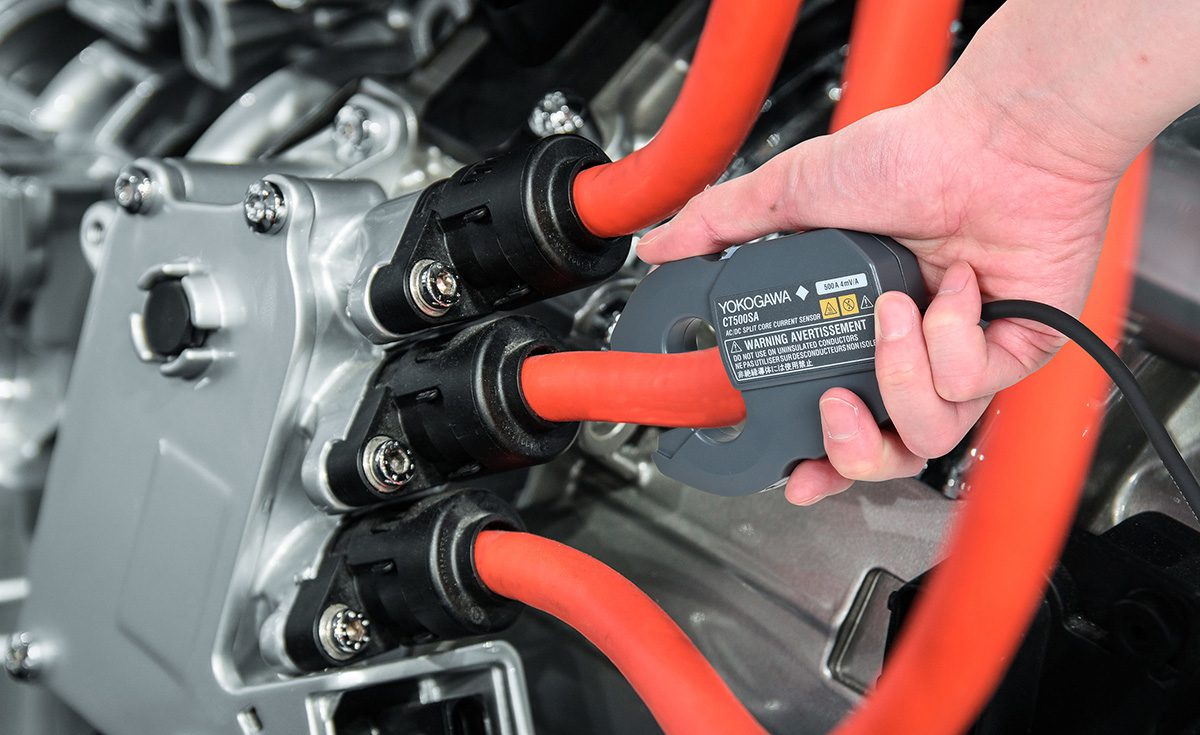
Specifically designed to clamp directly onto electrical conductors, these sensors eliminate the need to cut cables, making them ideal for in-vehicle testing and other space-constrained environments prevalent in advanced EV engineering. The CT500SA targets the 500 A range, while the CT200SA covers the 200 A range, catering to a diverse array of measurement requirements.
Introducing the CT500SA and CT200SA
The main sensor unit for both models boasts a compact footprint, measuring just 110 mm wide by 62 mm high by 25 mm deep. This streamlined form factor ensures they can be comfortably deployed in the cramped conditions often encountered within electric vehicles and their sub-systems. A key design element is the intuitive single unlock-and-open button, enabling convenient one-hand operation—a practical advantage when working in tight, awkward positions.
Furthermore, both sensors are equipped with an M4 screw hole and a dedicated cable tie slot. These provisions allow engineers to securely fix the sensor in place, a critical feature that Yokogawa emphasizes is vital for improving measurement repeatability. The stability provided by these mounting options mitigates potential errors caused by sensor movement or improper positioning during critical testing sequences.
Unprecedented Accuracy and Bandwidth
The CT500SA and CT200SA sensors set new benchmarks for accuracy in split-core designs. Yokogawa reports an impressive accuracy of ±0.1% across a broad operational temperature range from -40°C to 85°C. For even more precise laboratory conditions, accuracy improves to ±0.09% of reading plus 0.01% of full scale within a 23 ±5°C temperature window. This level of precision is critical for the rigorous demands of EV engineering and validation.
Beyond amplitude accuracy, phase accuracy stands at ±0.1° between 0.1 Hz and 1 kHz. According to Yokogawa, this represents an order of magnitude improvement over conventional current sensors, placing these new models on par with the performance typically expected from through-hole type sensors. This significant leap addresses the long-standing limitation where conventional split-core sensors struggled to meet the stringent accuracy requirements of modern applications due to their inherent design challenges.
The frequency bandwidth capabilities further underscore their advanced technical specifications. The CT500SA delivers a frequency bandwidth of 500 kHz (-3 dB), while the CT200SA extends this even further to 1 MHz (-3 dB). These wideband measurement capabilities are essential for accurately capturing the high-frequency switching characteristics found in motor inverter validation. Such detailed frequency analysis is indispensable for engineers optimizing inverter performance and identifying potential issues related to harmonic content and electromagnetic compatibility.
Streamlined Workflow for Engineers
One of the most notable features of the CT500SA and CT200SA sensors is their ability to simplify the testing workflow for engineers. In a typical test environment, engineers often switch between different types of instruments—such as waveform recorders and power analyzers—as they progress through various test phases. This traditionally required a change in sensors, each optimized for a specific instrument class, leading to time-consuming swaps and potential data synchronization issues.
Dual-Purpose Functionality for Seamless Analysis
Yokogawa’s new sensors break this barrier by offering direct compatibility with both power analyzers and waveform measurement instruments. This innovative dual-purpose functionality means that a single sensor can be used across different analytical stages without the need for conversion connectors or supplementary accessories. This capability is a significant advantage in dynamic testing environments, particularly in complex EV engineering scenarios.
By eliminating sensor swaps, engineers can achieve a more continuous and efficient testing process. Furthermore, measuring identical signals with the same sensor for both waveform and power analysis removes the inherent challenges of synchronizing data from different sensors. This ensures higher data integrity and reduces the potential for discrepancies, leading to more reliable and accurate test results crucial for product development and validation.
Ergonomic Design for Demanding Environments
The physical design of the CT500SA and CT200SA has been meticulously crafted to support engineers operating in challenging conditions. The compact dimensions and the one-hand operable unlock-and-open button are direct responses to the practical difficulties encountered in congested testing setups. When space is at a premium, as is often the case in modern vehicle interiors or tight laboratory rigs, ease of handling becomes as important as technical performance.
The integrated M4 screw hole and cable tie slot are not merely minor additions; they are fundamental to achieving consistent measurement quality. In high-vibration or dynamically changing test environments, securing the sensor firmly prevents unintended movement, which can introduce errors or reduce the precision of readings. This thoughtful design directly contributes to improved measurement repeatability and overall data reliability, empowering engineers to trust their test outcomes with greater confidence.
Broadening the Scope: Beyond EV Testing
While the CT500SA and CT200SA sensors are particularly well-suited for the rigorous demands of EV engineering, their advanced capabilities extend far beyond the automotive sector. Their high accuracy, wide frequency response, and versatile connectivity make them invaluable tools across a spectrum of industrial and research applications where precise current measurement is critical.
Versatility Across Renewable Energy and HVAC
One key application area is photovoltaic output measurement. As solar energy systems become more widespread, accurate monitoring of their current output is essential for efficiency analysis, fault detection, and system optimization. The sensors’ ability to handle AC/DC currents and their high precision make them ideal for evaluating the performance of solar inverters and panel arrays.
Similarly, in the realm of HVAC (Heating, Ventilation, and Air Conditioning) systems, precise current monitoring is vital for energy efficiency analysis and predictive maintenance. These sensors can effectively monitor the current consumption of motors, compressors, and fans, enabling engineers to identify inefficiencies, detect anomalies, and optimize system operation for reduced energy consumption and improved longevity. Their non-intrusive nature is particularly beneficial in these installed systems where cutting cables is impractical.
Furthermore, the sensors are highly effective for inverter efficiency analysis of pulse width modulation (PWM) outputs, which are commonly found in a wide range of industrial motor drives and power conversion systems. The ability to accurately capture and analyze harmonic content within these complex waveforms provides critical insights into system performance and potential electromagnetic interference, thereby supporting comprehensive system diagnostics and optimization.
Market Impact and Future Outlook
The introduction of the CT500SA and CT200SA current sensors by Yokogawa Test & Measurement represents a significant milestone in the field of precision measurement. By addressing the specific needs of modern EV engineering—including space constraints, the inability to cut cables, and the demand for unparalleled accuracy—these devices are poised to become indispensable tools for automotive R&D and manufacturing.
Their versatility ensures they will also play a crucial role in advancing renewable energy, HVAC, and industrial automation. With a scheduled release date of September 9, 2026, the industry anticipates that these sensors will empower engineers to achieve higher levels of precision, efficiency, and reliability in their testing and validation processes, ultimately contributing to the development of more advanced and sustainable technologies.
Frequently Asked Questions (FAQ)
What are the primary applications of the new Yokogawa current sensors?
The CT500SA and CT200SA are primarily designed for high-precision current measurement in electric vehicle (EV) testing, especially in-vehicle scenarios. Additionally, they are highly suitable for photovoltaic output measurement, HVAC current monitoring, and detailed inverter efficiency analysis of pulse width modulation (PWM) outputs, due to their accuracy and wide bandwidth.
How do these sensors address challenges in EV engineering?
These split-core sensors directly clamp onto cables, eliminating the need to cut conductors—a critical advantage in EV validation where cables cannot be modified. Their compact size (110x62x25 mm) and one-hand operation address space constraints in modern compact vehicle architectures, enabling precise measurements in tight environments.
What makes the accuracy of these new sensors stand out?
Yokogawa reports an accuracy of ±0.1% over a wide temperature range (-40°C to 85°C), improving to ±0.09% under optimal conditions. Their phase accuracy is ±0.1° between 0.1 Hz and 1 kHz. This is claimed to be an order of magnitude better than conventional split-core sensors, achieving precision comparable to through-hole types previously considered superior.
Can these sensors connect to different types of test instruments?
Yes, a key innovation is their dual-instrument compatibility. The CT500SA and CT200SA can connect directly to both power analyzers and waveform measurement instruments without requiring conversion connectors or supporting accessories. This eliminates sensor swaps and the need for data synchronization, streamlining the testing workflow for engineers.
When will the CT500SA and CT200SA sensors be available?
Yokogawa Test & Measurement has scheduled the global release for both the CT500SA and CT200SA current sensors on September 9, 2026. This eagerly awaited release will make these advanced measurement tools available to professionals across various industries, enhancing their testing capabilities significantly.