
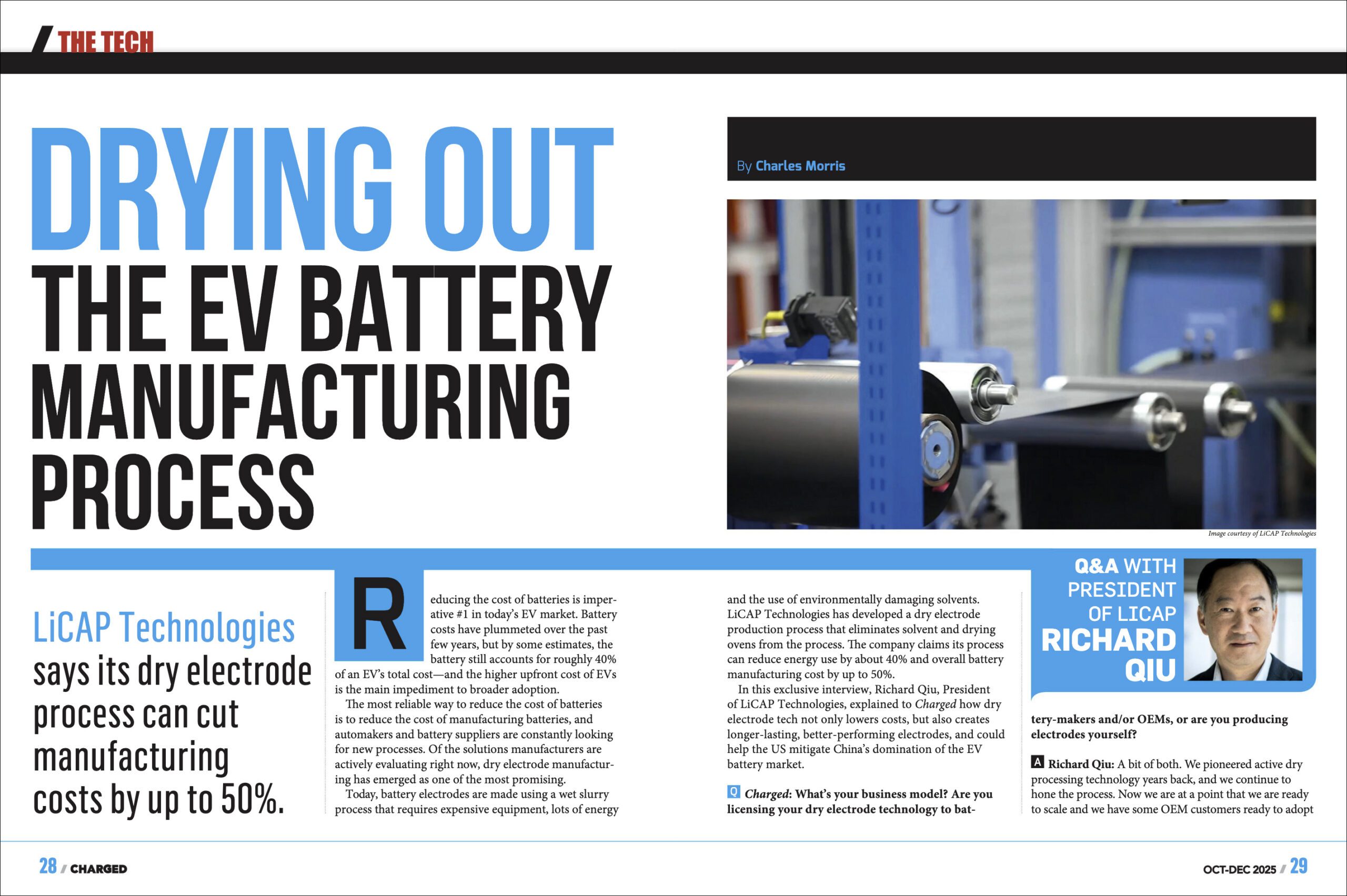
The electric vehicle (EV) market is witnessing a significant push towards cost reduction, with battery manufacturing identified as a key area for innovation. LiCAP Technologies has developed a novel dry electrode manufacturing process that could slash production costs by as much as 50% and reduce energy consumption by 40%, potentially accelerating EV adoption.
The Imperative for Cheaper EV Batteries
While the cost of EV batteries has seen a substantial decline in recent years, they still represent a significant portion, estimated at around 40%, of an EV’s overall price. This high upfront cost remains a primary barrier for many consumers considering the switch to electric mobility. Consequently, innovations in battery manufacturing that can lower production expenses are crucial for wider market penetration.

Automakers and battery suppliers are actively exploring new manufacturing techniques to achieve these cost savings. Among the most promising solutions currently under evaluation is dry electrode manufacturing, which offers a departure from traditional, energy-intensive methods.
LiCAP’s Dry Electrode Process: A Game Changer
Traditional battery electrode production relies on a wet slurry process. This method involves mixing active materials, binders, and solvents into a paste, which is then coated onto current collectors and subsequently dried in energy-intensive ovens. This process is not only costly due to equipment and energy demands but also raises environmental concerns due to the use of solvents.
LiCAP Technologies’ proprietary dry electrode production process eliminates the need for both solvents and drying ovens. Richard Qiu, President of LiCAP Technologies, explained in an interview with Charged that this approach not only reduces costs and energy use but also results in longer-lasting, higher-performing electrodes.
Business Model: Licensing and Production
LiCAP Technologies employs a dual business model to deploy its innovative technology. The company licenses its active dry processing technology and the associated equipment to battery manufacturers and original equipment manufacturers (OEMs).
“We pioneered active dry processing technology years back, and we continue to hone the process,” Qiu stated. “Now we are at a point that we are ready to scale and we have some OEM customers ready to adopt our technology to do so. Because it takes quite a bit of time and effort to build a large-scale production line, we’re working with OEMs to license our technology.”
To support this, LiCAP has partnered with Dürr, a major equipment manufacturer, which will produce and install the necessary equipment for OEMs. In addition to licensing, LiCAP maintains a small-scale manufacturing facility in Sacramento to supply dry electrodes for OEMs who require product for piloting, testing, and ongoing innovation before their large-scale manufacturing lines are operational.
Simplifying the Manufacturing Process
The conventional wet slurry process typically involves five complex steps. LiCAP’s dry process consolidates these into just three, significantly reducing complexity and the required facility footprint.
“The traditional wet process primarily consists of five steps. That may not seem like too many, but it’s five gigantic steps, each with a lot of moving pieces. Obviously, you can improve each step, but the better way to improve the process is actually to eliminate some of those steps,” Qiu elaborated. “So, we shrink the five steps into three steps, which substantially reduces the complexity of the process, as well as the size of the facility required to install the equipment.”
The three-step process involves initial material mixing and formulation, followed by the creation of a freestanding film, and finally, densification and calendering. A key advantage of producing a freestanding film is its “chemistry-agnostic” nature, allowing for flexibility in material formulations.
Enhanced Sustainability and Material Efficiency
A significant benefit of the dry process is its improved sustainability. By eliminating solvents and drying ovens, the environmental impact is reduced. Furthermore, the process allows for near-total recycling of waste materials.
“A key element of that is that any waste because of process irregularity or the edge of the film, you can 100% recycle, meaning that you will save tremendous amounts of raw materials,” Qiu noted. “As we all know, battery raw materials are expensive and they’re hard to find, particularly here in the US, so 100% recycling is tremendous.”
After the freestanding film is produced, densification is performed based on the specific application requirements, whether for EVs, energy storage, or other uses.
Adoption and Timelines: Greenfield vs. Retrofit
The transition to dry electrode technology is progressing at different speeds for new facilities (greenfield) versus upgrading existing ones (retrofit projects).
Partnerships and Pilot Projects
LiCAP is actively engaged with two key OEM customers. Cellforce, a subsidiary of Porsche in Europe, is working with LiCAP to integrate the technology into a new gigafactory for a high-performance car, focusing on both performance metrics and cost savings.
In Japan, LiCAP is collaborating with Nissan on developing new technology for next-generation all-solid-state EV batteries. This strategic partnership, which has been ongoing for a couple of years, aims to overcome barriers to mass-producing solid-state batteries, targeting production by 2028. Nissan is already constructing a portion of the plant, with LiCAP assisting in refining the technology and supporting the gigafactory build-out.
Cost and Facility Benefits
For greenfield projects, LiCAP’s technology offers substantial advantages. The incremental capital expenditure (CapEx) is typically 50% lower compared to building a facility for the wet process. Facility size can shrink by approximately 60%, and incremental operational expenditure (OpEx) is reduced by 60-70%.
“When you need to build a new facility, our technology makes it easier for people to do so, because incremental investment for CapEx is typically 50% of what you have to invest for the wet process,” Qiu explained. “And the facility size probably shrinks by 60% and incremental OpEx is reduced by 60-70%.”
The elimination of energy-intensive drying equipment, which accounts for about 60% of electricity used in electrode manufacturing, is a major contributor to these savings. LiCAP’s process sidesteps this entirely.
Retrofitting Challenges and Opportunities
For companies with existing multi-billion-dollar investments in wet processing lines, the decision to convert to dry technology involves a different timeline and set of considerations. While some existing equipment may be compatible or require modification, the elimination of large solution-drying equipment represents a significant shift.
“We start to see people have those conversations about at what point they will convert from wet to dry,” Qiu noted. “This is no different than any other technology adoption curve. You will always have better technology coming up, probably cheaper, better, faster. But what are you going to do? You have to switch to new technology.”
LiCAP anticipates earlier adoption in greenfield projects due to the inherent efficiencies and cost benefits of building new facilities around their technology, while conversion projects will follow as the technology matures and demonstrates its value in existing infrastructures.
Chemistry Agnosticism and Flexibility
LiCAP’s dry process offers greater flexibility compared to the wet method, largely due to its simplified nature.
“Our platform is typically more flexible than the wet process, because as you simplify the process, there are fewer things you need to adjust,” Qiu said. “From our perspective, it’s really two things. One is the chemistry and how you mix the materials.”
The company has successfully adapted its process for over half a dozen different chemistries, catering to the diverse needs of its OEM partners. For instance, a major US energy storage application customer utilizes a different chemistry, process, and electrode thickness, demonstrating the platform’s adaptability.
Advancing Solid-State Battery Technology
The collaboration with Nissan highlights LiCAP’s role in enabling next-generation battery technologies, specifically all-solid-state batteries.
“For all-solid-state batteries, it’s a different, new chemistry, and some of the elements are sensitive to the environment, the temperature, that sort of thing, so you have to make them in controlled settings,” Qiu explained. “The solid-state battery has very strong performance metrics and people really love it—fast charging and all this good stuff—but it requires a different manufacturing process.”
LiCAP’s expertise in process development is crucial for overcoming the manufacturing challenges associated with solid-state batteries. The joint development effort with Nissan focuses on selecting the right chemistry, ensuring ionic connectivity, and achieving the required production throughput for mass-scale manufacturing, with a target of 2028.
Performance Enhancements and Recycling Prowess
Beyond cost and sustainability, LiCAP’s dry process also contributes to improved battery performance.
“In our process, we don’t use toxic solutions in drying out. Normally, with the wet process, when you dry a solution out, you take things out. For us, because we start out with the mixing technology activation, we can stretch materials, almost like cotton candy,” Qiu described. “But as a result, because there’s no toxic solution drying out and we put the binder activation in that way, all those things actually make the materials stronger. Not to get into material science too deeply, but all those things result in stronger binding, so it creates better density and better ionic connectivity.”
While the industry’s current focus is primarily on cost reduction, LiCAP acknowledges that its process also achieves performance improvements, including higher energy and power density. “We don’t really talk too much about the performance improvement, because today the industry is really focused on cost reduction. But we actually achieve both,” Qiu emphasized.
Revolutionizing Scrap Recycling
The recyclability of scrap material is another significant advantage. Unlike traditional methods where separating and recycling layered materials is complex and costly, LiCAP’s freestanding film can be fed back into the process almost entirely.
“If you don’t use freestanding film, it will be really hard to recycle because as you produce the electrode, you laminate other materials to the electrode material,” Qiu stated. “To recycle, you have to peel those other layers back… But for us, the freestanding film before densification is almost like the raw material, so you can send 100% back to the feedstock. We don’t say 100% because people make arguments—we normally say 98 or 99%. So that’s one key piece.”
Material trimmed from the edges of the freestanding film, a common occurrence in high-speed production, can also be 100% returned to the feedstock, further enhancing material efficiency.
Competitive Landscape and LiCAP’s Unique Edge
The dry coating technology space includes other players, such as AM Batteries and Tesla, which acquired Maxwell Technologies in 2019. Maxwell Technologies’ founding team was instrumental in LiCAP’s own founding. While Tesla has reportedly made progress with dry anode production, integrating chemistry, process, and equipment remains a complex challenge.
“I believe we are ahead of all this competition, in the best position to capitalize on this opportunity in the market,” Qiu asserted. He highlighted that producing high-speed, high-quality film requires a deep understanding of both mechanical engineering and material science, including the right mix, binders, and activation agents.
“Our team is a combination of material science, chemistry and mechanical equipment guys, and we work together with an integrated approach, a very cross-functional team,” Qiu concluded. “Most companies out there, they focus on one, maybe two of these pieces, but we focus on all three together, and that’s unique.” This integrated, cross-functional approach is LiCAP’s key differentiator in the competitive landscape of dry electrode manufacturing.