
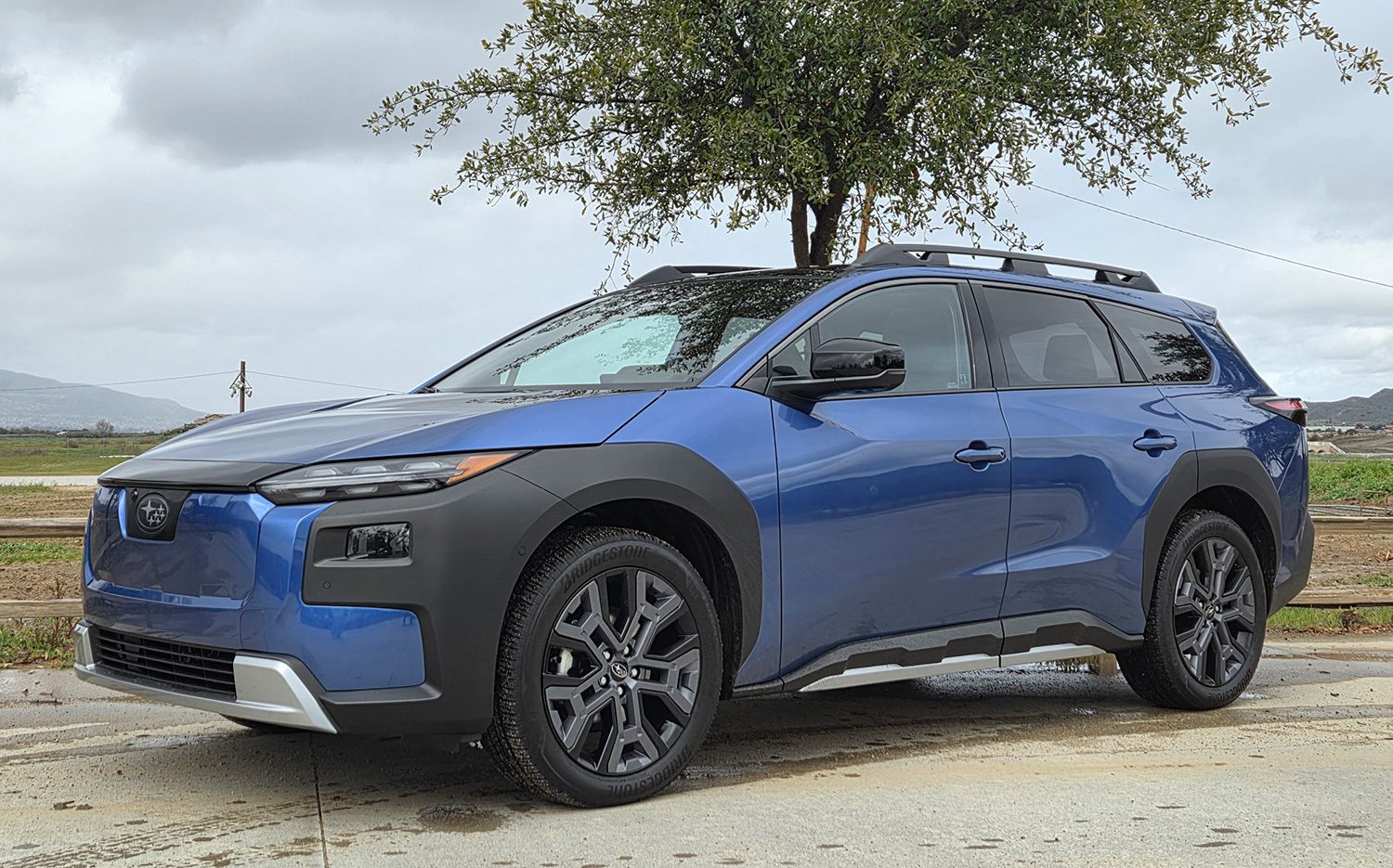
The 2026 Subaru Trailseeker EV has arrived, aiming to capture the essence of the Subaru brand in an all-electric package. Visually distinct and competent both on and off the pavement, this new model offers a lighter alternative to its electric SUV competitors.
A Distinctly Subaru Aesthetic
“When we showed them the side view, without any badges, and asked them what brand it was, everyone said, ‘It’s a Subaru!’,” said Garrick Goh, car line planning manager for the 2026 Subaru Trailseeker. This latest all-electric offering from Subaru is designed to be the most identifiably Subaru of its EV lineup.
The Trailseeker’s design features a classic wagon silhouette, a hallmark of the brand, complemented by standard roof rails. These rails are crucial for Subaru’s outdoorsy customer base, allowing for the attachment of luggage bins, ski racks, snowboard carriers, or surfboard carriers, supporting an “active lifestyle.” Notably, it is the only electric SUV to feature ladder-type roof rails, accommodating a wide array of aftermarket accessories.
Additional cues reinforcing its Subaru identity include a standard rear wiper, which, despite its aerodynamic impact, is retained for practicality. Standard headlamp washers further enhance its rugged appeal. During design clinics, potential buyers described the EV as “spacious and versatile,” “rugged and adventurous,” possessing an “outdoorsy spirit” while still appearing capable of handling varied terrains comfortably.
This reception mirrors the traits associated with the popular Subaru Outback. Coincidentally, the Outback has recently seen its own dimensions increase and its design become more SUV-like. The Trailseeker’s familiar shape could therefore serve as a compelling option for existing Outback owners seeking to transition to an electric vehicle.
Platform and Powertrain: A Shared Foundation
Developed in collaboration with Toyota, the Trailseeker shares its underpinnings with the Subaru Solterra, which has been available since 2023. The Trailseeker is essentially a wagon variant of the Solterra, sharing the same structure from the rear doors forward. The primary modifications involve the roofline, rear windows, and tailgate.
While Toyota offers its version as the bZ4X Woodland Edition, Subaru has opted for a distinct model name and identity for its wagon variant, a strategic move likely influenced by its recognizable design.
Both the Trailseeker and the recently introduced 2026 Subaru Uncharted hatchback utilize the same 74.7-kilowatt-hour battery pack. Production of the Trailseeker takes place at Subaru’s Gunma Yajima plant in Japan, marking Subaru’s first significant EV production in two decades, unlike the Solterra which is assembled at Toyota’s Motomachi plant.
The smaller Uncharted, in its front-wheel-drive configuration, starts at $36,500 (including delivery) and boasts an EPA-rated range of 307 miles. This front-wheel-drive model is significant as it marks Subaru’s first FWD-only offering in the U.S. in thirty years.
Performance and Capability
All Trailseeker models come standard with all-wheel drive, powered by dual electric motors producing a combined output of 280 kilowatts (375 horsepower). Subaru claims a 0-to-60-mph acceleration time of 4.4 seconds when in ‘Power’ mode, with ‘Normal’ and ‘Eco’ modes also available. The Trailseeker is rated to tow up to 3,500 pounds, features a class-leading 8.5 inches of ground clearance, and offers 31.3 cubic feet of cargo capacity with the rear seats folded.
During its launch presentation, Subaru highlighted data indicating a high likelihood of its owners owning pets, particularly dogs, reinforcing the vehicle’s compatibility with an active, family-oriented lifestyle.
On-Road and Off-Road Experience
A pre-production top-trim Trailseeker Touring was tested in the varied terrain of Orange County, California. While heavy rains disrupted planned extensive off-road excursions, a temporary course allowed for testing its capabilities over dips, rises, and uneven surfaces, demonstrating its 8.5-inch ground clearance.
The X-Mode drive setting proved adept at navigating hills, ruts, gullies, and situations where wheels might lift off the ground, performing similarly to other all-wheel-drive Subarus. This capability often surpasses that of more expensive and larger SUVs with overtly aggressive off-road styling.
The X-Mode’s Multi-Terrain monitor, featuring a front-facing camera, was particularly useful for visibility on steep downhill descents. However, a limitation noted was that this camera view deactivates above 6 mph, reportedly a Toyota safety measure. This required repeated stops and menu navigation to re-engage the view on subsequent obstacles, an inconvenience that could be perceived as a safety concern.
On paved surfaces, the Trailseeker delivered a predictable, competent, and quiet ride. As an electric vehicle, it lacks the signature Subaru boxer engine thrum, a sound that has been a brand identifier alongside AWD since the 1970s. The upright design provides good frontal visibility over a relatively low cowl and improved over-the-shoulder visibility compared to the Solterra’s more angled roof pillars.
The regenerative braking system, while learnable, was not among the strongest in its class. A desire for a stronger regen setting was expressed by testers. This limitation may stem from Toyota’s powertrain engineering decisions aimed at optimizing battery life, similar to power delivery constraints.
Steering feel is described as predictable but numb. The tires feature sufficiently tall sidewalls, contributing to a smoother ride compared to competitors employing low-profile tires on larger wheels.
Weight Advantage and Efficiency
A key metric highlighted is the Trailseeker’s weight. The Premium model weighs just under 4,400 pounds, making it over 300 pounds lighter than its closest competitor. This weight difference can extend to over 800 pounds when compared to models like the Honda Prologue Touring AWD, which features a larger battery.
The collaborative efforts between Toyota and Subaru engineers have resulted in a lighter EV. This reduction in weight, despite the aerodynamic compromises of roof rails, a rear wiper, and high ground clearance, allows the vehicle to achieve acceptable range from its comparatively smaller battery, thus helping to manage costs.
Interior and Exterior Design Cues
The exterior design incorporates a blend of Toyota and Subaru styling elements, with the slab-sided wagon shape being distinctly Subaru. The tailgate features individual illuminated letters spelling out ‘Subaru’ on higher trims, rather than a central logo.
Inside, optional two-tone blue leather upholstery inserts provide a welcome contrast to typical all-black cabins. A grey two-tone option is also available. The cabin predominantly features hard plastic surfaces. The instrumentation is sourced from Toyota, including a digital gauge cluster positioned at the base of the windshield and a vertical center touchscreen.
The steering wheel is a unique rectangular shape with rounded corners, designed to ensure visibility of the gauge cluster. This design was found to be easily adaptable. A notable omission is the lack of a glove box.
Charging and Connectivity
The Trailseeker is equipped with a North American Charging Standard (NACS) port, enabling charging at Tesla Supercharger stations. Under optimal conditions, it can charge from 10% to 80% in approximately 28 minutes using a DC fast charger capable of a consistent 150-kW output.
The vehicle supports charging at both Version 3 and Version 4 Tesla Supercharger stations. Owners in colder climates will benefit from the built-in battery preconditioning feature. The car comes standard with adapters for CCS and J-1772 charging stations, accommodating both DC and AC charging.
Target Audience and Market Position
Subaru’s internal data suggests that over one-third of its loyal customer base would consider an EV for their next vehicle. This places Subaru third among non-Tesla brands in owner consideration for electric vehicles, trailing only Volkswagen and Mazda.
Subaru positions the Trailseeker against competitors such as the Chevrolet Blazer EV, Ford Mustang Mach-E Rally, Honda Prologue AWD Touring, Hyundai Ioniq 5 XRT, Kia EV6 Long Range AWD, and the Volkswagen ID.4 AWD. These comparisons focus on AWD models with off-road-oriented trim levels. The Tesla Model Y, a leading seller in the compact premium electric SUV segment, was notably absent from Subaru’s comparison set, despite experiencing sales declines in recent years.
Pricing and Availability
The 2026 Subaru Trailseeker starts at $41,445 for the Premium model, which offers an estimated range of 281 miles. The Limited and Touring trims, priced at $45,445 and $48,005 respectively, come with an estimated range of 274 miles. All prices include a mandatory $1,450 destination fee.
Subaru executives indicated that the Trailseeker models are expected to begin arriving at dealerships around April.