
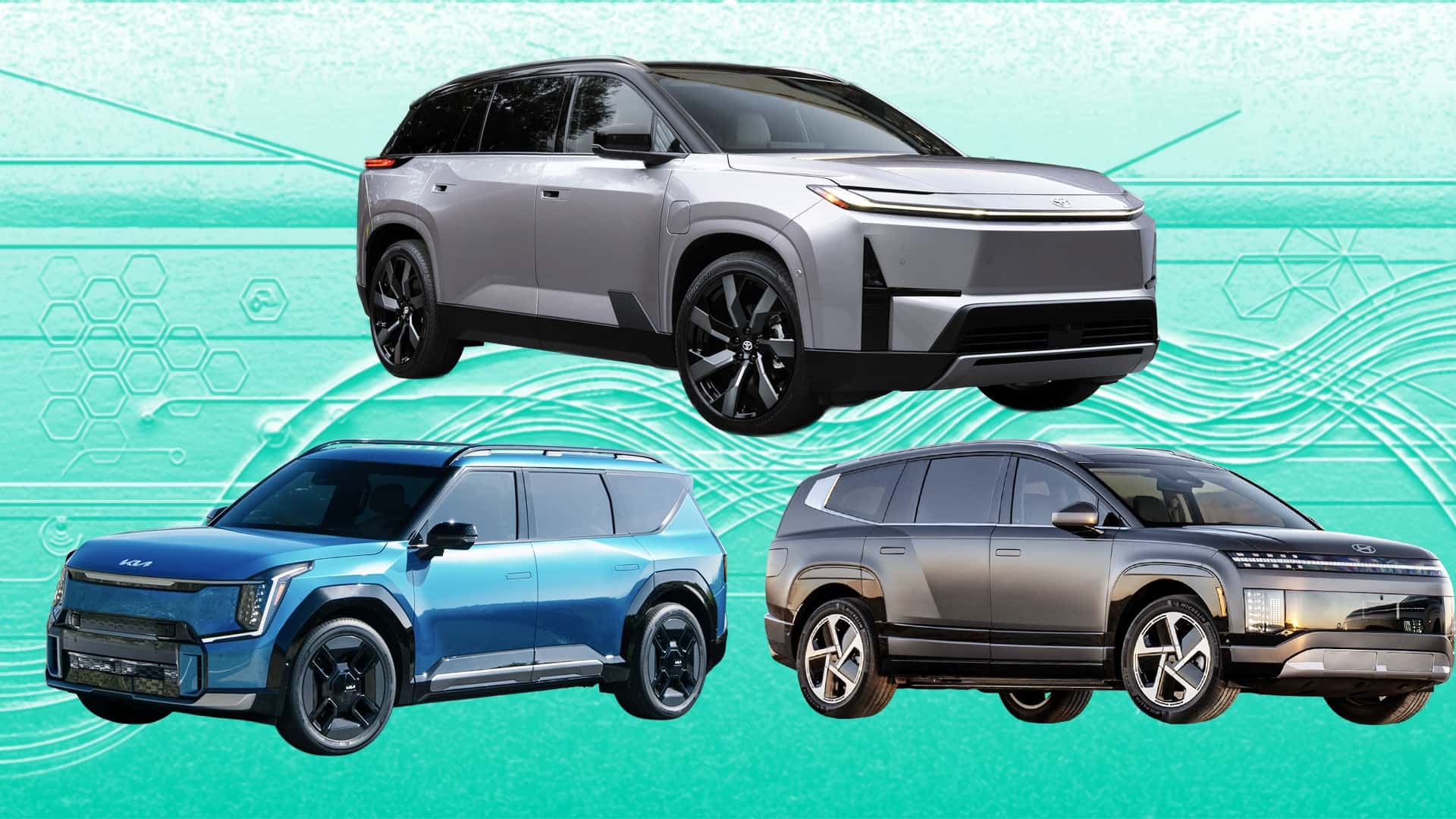
The electric vehicle landscape is heating up, particularly in the family-oriented three-row SUV segment. Toyota has entered the fray with its new Highlander EV, a vehicle seemingly designed to go head-to-head with established rivals like the Kia EV9 and the Hyundai Ioniq 9. This new contender aims to leverage Toyota’s trusted brand reputation against the strengths of its Korean competitors, which have already carved out significant market share.
A Crowded Segment for Electric Family Haulers
The emergence of the Toyota Highlander EV highlights the growing demand for electric vehicles capable of accommodating larger families. The Kia EV9 has demonstrated strong sales, with over 15,000 units sold last year, while the Hyundai Ioniq 9, despite a later launch in May 2025, has already registered nearly 5,200 sales. Notably, both these models have outsold the more premium Rivian R1S, which sold nearly 25,000 units, even with a considerable price difference of approximately $20,000.
Toyota appears to have meticulously studied the EV9 and Ioniq 9, recognizing their appeal as among the first mainstream three-row EVs priced below the more expensive Rivian R1S and Tesla Model X. The Highlander EV is positioned to compete directly with these models on size, specifications, and features, although the Korean duo’s advanced 800-volt architecture offers a distinct advantage in charging speed.
Comparing Dimensions and Interior Space
When it comes to sheer size, the Hyundai Ioniq 9 takes the lead. It measures 199.2 inches in length with a wheelbase of 123.2 inches, offering slightly more third-row legroom and a larger cargo area of 21.9 cubic feet compared to the Kia EV9’s 197 inches length and 122-inch wheelbase, which provides 20.2 cubic feet of trunk space.
The Toyota Highlander EV slots in between the two in overall length at 198 inches, but it features the shortest wheelbase at 120.1 inches. This translates to the smallest trunk capacity among the three, measuring 15.9 cubic feet. Toyota has yet to release specific passenger room figures, but the shorter wheelbase may present a challenge in matching the interior spaciousness of its rivals.
However, with the third-row seats folded down, the interior space rankings shift. The Ioniq 9 still leads with 46.7 cubic feet of cargo volume, followed closely by the Highlander EV at 45.6 cubic feet. The EV9 trails slightly with 43.5 cubic feet in this configuration.
For context, both the Kia EV9 and Hyundai Ioniq 9 offer 42.8 inches of legroom in the second row. The Hyundai claims 32 inches of third-row legroom. Kia’s figures vary based on the second-row seat configuration: 32 inches with captain’s chairs and 29.9 inches with the larger ‘relaxation’ seats.
Visually, the Kia EV9 presents a more traditional SUV profile with its upright design and tall greenhouse, contributing to a spacious cabin feel. In contrast, both the Hyundai Ioniq 9 and Toyota Highlander EV incorporate sportier, coupe-like rooflines that slope towards the rear, lending them a more dynamic and less utilitarian appearance.
Powertrain, Range, and Charging Capabilities
The Hyundai Ioniq 9 stands out with its standard 110.3-kilowatt-hour battery pack across all its variants. This substantial battery offers an impressive EPA-estimated range of up to 335 miles for rear-wheel-drive models and 320 miles for the dual-motor all-wheel-drive version. It is the only model among the three that does not offer a smaller, standard-range battery option.
The Kia EV9 provides two battery choices: a 76.1 kWh pack delivering an estimated 230 miles of range, and a larger 99.8 kWh pack that extends the range to 305 miles. The Toyota Highlander EV will also come with dual battery options, a 77 kWh unit and a larger 95.8 kWh pack. The latter is projected to offer up to 320 miles of range, though this is a preliminary estimate subject to change.
A significant differentiator lies in the charging technology. The Hyundai Ioniq 9 and Kia EV9 benefit from an 800-volt platform, enabling them to accept ultra-fast charging speeds from 350 kW DC fast chargers. This allows the Ioniq 9 to charge from 10% to 80% in approximately 20 minutes and the EV9 in about 24 minutes. The Toyota Highlander EV, equipped with a 400-volt architecture, is slower, requiring an estimated 30 minutes for the same 10% to 80% charge.
All three electric SUVs feature native NACS (North American Charging Standard) ports, granting seamless access to the Tesla Supercharger network without the need for adapters. Additionally, each vehicle includes bidirectional charging capabilities, allowing them to power external devices or even homes.
In terms of power output, the base Toyota Highlander EV model boasts a single 221-horsepower motor driving the front wheels, making it slightly more powerful than the base rear-wheel-drive Ioniq 9 (215 hp) and EV9 (201 hp). The dual-motor all-wheel-drive Highlander delivers a more substantial 338 horsepower. However, this figure is surpassed by the top-tier all-wheel-drive versions of the Kia and Hyundai, which produce 379 hp and 422 hp, respectively. Kia had previously explored a high-performance EV9 GT variant, but its U.S. market introduction is reportedly postponed, with its future uncertain.
Conclusion: A Tight Race Hinges on Pricing
The Toyota Highlander EV enters a competitive arena, clearly designed with the Kia EV9 and Hyundai Ioniq 9 as benchmarks. It appears to hold its own across most comparable metrics, positioning itself as a viable alternative rather than a segment disruptor. Its ultimate success will likely be determined by its pricing strategy, which has yet to be announced.
On paper, the Highlander EV is well-equipped to attract buyers currently considering the Ioniq 9 and EV9. Consumer choice may also be influenced by brand loyalty, with some potential buyers likely to favor the established trust associated with the Toyota badge and its recent strides in EV development.
The Hyundai Ioniq 9 emerges as the most spacious and arguably most capable of the trio, albeit with slightly slower charging speeds than the EV9 and a price premium of around $5,000 over the Kia. Its standard, larger battery pack, however, helps justify this higher cost. The strong sales figures for both the EV9 and Ioniq 9 underscore a significant market for three-row electric SUVs, and for the Highlander EV, competitive pricing will be the critical factor in its market penetration.