
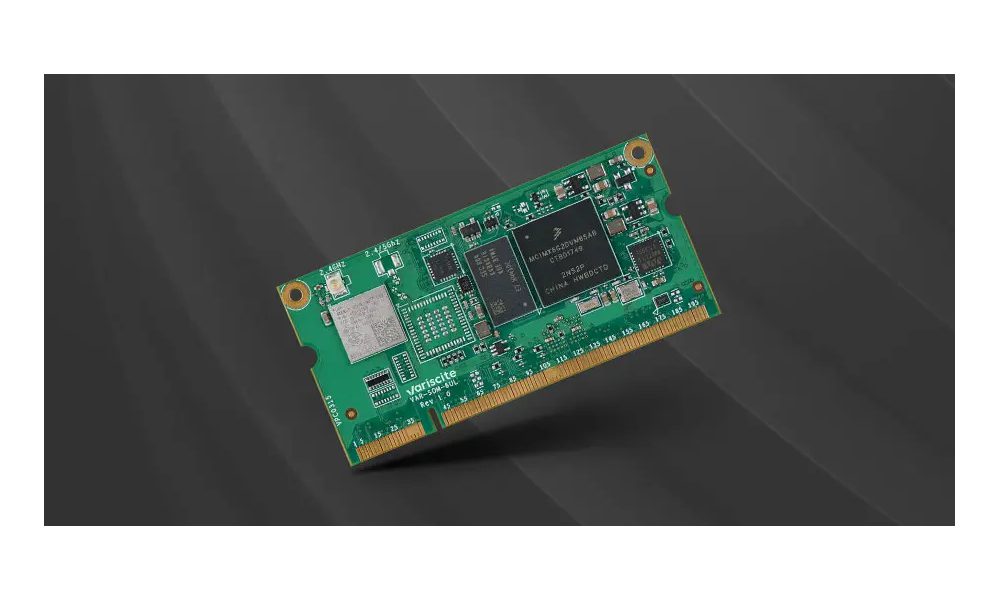
Variscite, a provider of embedded solutions, has announced a significant reduction in development timelines for electric vehicle (EV) charging station manufacturers. A recent case study highlights how adopting Variscite’s System-on-Module (SoM) platform enabled a US-based EV charger manufacturer to cut its development cycle by approximately 50%.
Accelerating EVSE Production with Advanced SoM Technology
The findings suggest that Variscite’s SoM platform offers a streamlined approach for EVSE (Electric Vehicle Supply Equipment) makers aiming for faster production hardware integration. A key feature of the platform is its pin-compatible module families. This design allows developers to enhance performance or introduce new features without the need for extensive carrier board redesigns.

Variscite’s Pin2Pin families are built on a common pinout architecture. This uniformity permits manufacturers to seamlessly swap in updated or alternative compatible SoMs as their project requirements evolve. Furthermore, it facilitates the development of diverse charger configurations, such as commercial and residential units, all while leveraging a unified hardware and software framework.
Robust Features for Demanding EV Infrastructure
The Variscite SoM platform is engineered to meet the rigorous demands of EV charging infrastructure. It boasts support for industrial operating temperature ranges, from -40°C to +85°C, ensuring reliability in varied environmental conditions. Integrated cybersecurity features and ISO 27001 certification are included to enhance security and compliance.
Variscite also emphasizes its commitment to long-term availability with extended longevity guarantees for its modules. The company’s in-house manufacturing capabilities enable clients to customize modules according to specific requirements, even for relatively small production runs as low as 20 units. This capability is particularly valuable for stabilizing lead times, especially during periods of global component shortages.

Developer-Centric Design for Scalability and Efficiency
Ofer Austerlitz, Variscite’s VP of Business Development and Sales, commented on the platform’s role in the evolving EV market. “Variscite SoMs are designed to power critical EV charging infrastructure at scale, providing a rugged, cost-effective platform that gets developers to market faster,” Austerlitz stated.
This emphasis on speed to market, combined with the platform’s adaptability and robust feature set, positions Variscite’s SoM solution as a strategic choice for companies looking to innovate and expand within the rapidly growing EV charging sector. The ability to reduce development cycles by half can translate into significant cost savings and a quicker response to market demands for advanced EV charging solutions.
Understanding System-on-Module (SoM) Technology
A System-on-Module (SoM) is a compact, integrated electronic circuit board containing essential processing components, memory, and often peripherals. Unlike a full System-on-Chip (SoC), which integrates all functions onto a single chip, an SoM integrates multiple components, including an SoC or microprocessor, onto a single board. This board is then designed to be plugged into a larger carrier board, which provides specific interfaces and connectors tailored to the end application.
For developers of complex systems like EV chargers, SoMs offer several advantages. They encapsulate the most intricate and costly parts of the design, allowing engineers to focus on the application-specific aspects of the carrier board and software. This modular approach accelerates the design process, reduces development risks, and simplifies upgrades.
The Impact of Pin-Compatibility in Embedded Design
Pin-compatibility, as highlighted by Variscite’s Pin2Pin architecture, is a crucial factor in embedded system development. It means that different SoMs, potentially offering varying levels of processing power or features, can be used interchangeably on the same carrier board simply by plugging them into the same connector. This capability is invaluable for product roadmaps.
For an EV charger manufacturer, this could mean developing a single carrier board design that can support multiple product tiers. A basic residential charger could use a lower-power SoM, while a high-performance commercial charger could utilize a more powerful, pin-compatible SoM on the identical carrier board. This dramatically reduces redundant design efforts and accelerates the launch of a product family.
Addressing Supply Chain Challenges in EV Hardware
The global electronics supply chain has faced unprecedented disruptions in recent years, impacting lead times for critical components. For manufacturers of essential infrastructure like EV chargers, securing reliable component supply is paramount. Variscite’s claim of in-house manufacturing and its ability to customize modules in smaller quantities addresses these concerns directly.
By controlling their manufacturing processes and offering flexibility in order sizes, Variscite aims to provide its customers with greater predictability and resilience against supply chain volatility. This is particularly important for companies investing heavily in scaling up EV charger production, where delays due to component unavailability can have significant financial consequences.
Variscite’s Role in the EV Charging Ecosystem
The case study’s focus on a US-based EV charging station manufacturer underscores Variscite’s strategic positioning within the burgeoning electric vehicle ecosystem. As the demand for reliable, fast, and scalable EV charging solutions continues to surge globally, companies like Variscite play a vital role in enabling the technological advancements required.
Their SoM platform not only promises faster development cycles but also provides a foundation that is rugged, secure, and designed for long-term operation – essential attributes for public and private charging infrastructure. The ability to meet industrial standards and offer customization further solidifies their offering for a demanding market.