
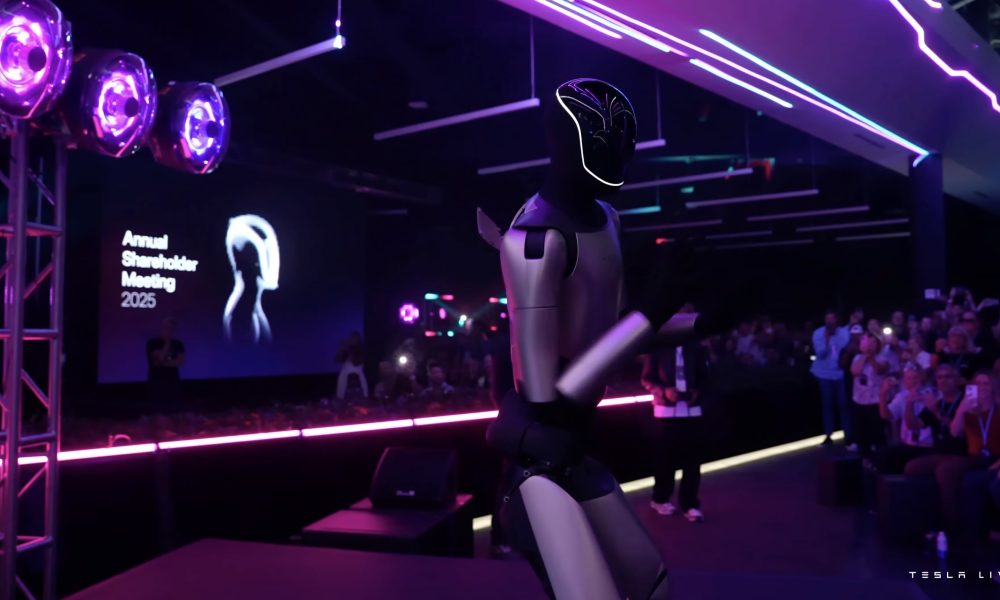
Elon Musk has stated that Tesla is poised to become a leader in the development of Artificial General Intelligence (AGI), particularly in a humanoid form. The prediction was shared via a post on the social media platform X, formerly known as Twitter.
Tesla’s Ambitions in Robotics and AI
In his statement, Musk articulated his vision: “Tesla will be one of the companies to make AGI and probably the first to make it in humanoid/atom-shaping form.” This assertion comes as Tesla significantly advances its development of the Optimus humanoid robot.

Recent strategic shifts at Tesla, including the phasing out of Model S and Model X production at its Fremont, California facility, are directly supporting the company’s robotics initiatives. The production line for these vehicles is being repurposed into a pilot line specifically for the Optimus robot. Tesla has set an ambitious initial production target of one million units of the humanoid robot annually.
Optimus and the Von Neumann Probe Concept
Musk has previously drawn parallels between the potential capabilities of the Optimus robot and the concept of a von Neumann probe. This theoretical self-replicating spacecraft, envisioned by mathematician John von Neumann, could utilize resources from planetary bodies to create copies of itself and travel to other star systems.
The realization of such a sophisticated capability for Optimus hinges on the robot achieving Artificial General Intelligence. AGI refers to AI that possesses human-like cognitive abilities, capable of understanding, learning, and applying knowledge across a wide range of tasks.

The original post from Elon Musk reads: Tesla will be one of the companies to make AGI and probably the first to make it in humanoid/atom-shaping form.
Broader AI Landscape and Potential Synergies
Musk’s comments place Tesla within a broader context of significant advancements and high expectations within the Artificial General Intelligence sector. Other prominent figures in AI have also voiced strong opinions on its transformative potential.
Demis Hassabis, CEO of Google DeepMind, recently commented on the technology’s impact at the India AI Impact Summit 2026. According to a Benzinga report, Hassabis stated, “It’s going to be something like ten times the impact of the Industrial Revolution, but happening at ten times the speed.”
The integration of AGI into a Tesla humanoid product could signify a deepening collaboration among Elon Musk’s various ventures. While Tesla is heavily invested in autonomous driving technology, its sister company xAI is directly pursuing AGI research and development through its Grok program.
The potential for an Optimus robot to be powered by xAI’s advanced AI models appears to be a logical progression, especially given Musk’s recent statements. Further consolidation among Musk’s companies is also on the horizon, with reports suggesting a potential merger encompassing Tesla, SpaceX, and xAI.
Related Developments in Musk’s Companies
In parallel to advancements in AI and robotics, Musk’s other companies are also progressing rapidly. SpaceX is preparing to launch its next-generation Starlink V2 satellites using the Starship rocket, tentatively beginning in mid-2027. SpaceX President Gwynne Shotwell and Starlink Vice President Mike Nicolls confirmed this timeline.
Nicolls stated that Starship’s capabilities would enable rapid constellation deployment, aiming for global and contiguous coverage within six months, requiring approximately 1,200 satellites. Each Starship launch could carry around 50 of the larger, more powerful Starlink V2 satellites. Starlink currently holds the position as the largest satellite network in orbit, with nearly 10,000 satellites deployed.
Additionally, Elon Musk’s social media platform X and his AI startup xAI are reportedly preparing to fully repay approximately $17.5 billion in outstanding debt. This debt includes $12.5 billion assumed during Musk’s acquisition of X (formerly Twitter) and $5 billion borrowed by xAI. The repayment plan, facilitated by Morgan Stanley, comes as Musk consolidates several of his businesses, with SpaceX recently acquiring xAI.
Tesla itself is also accelerating production plans for its Cybercab, the company’s purpose-built Robotaxi. Drone footage from Gigafactory Texas has revealed a significant increase in Cybercab units on-site, indicating a ramp-up in test manufacturing ahead of mass production, which is anticipated to begin within the next four to eight weeks.
The Cybercab, with its autonomous-only design and reliance on Tesla’s Full Self-Driving technology, is envisioned as a sub-$30,000 vehicle for robotaxi fleets, representing a significant step towards scalable autonomy. These developments across Tesla, SpaceX, and xAI highlight a concerted push towards advanced technologies, from humanoid robots and AI to satellite internet and autonomous vehicles.