
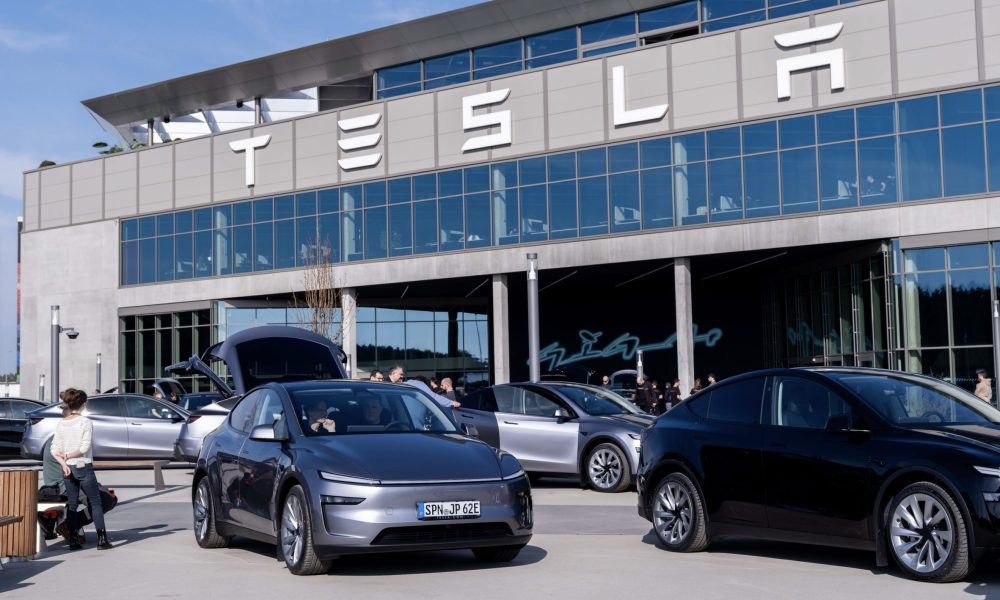
Andre Thierig, Senior Director of Manufacturing at Tesla’s Gigafactory Berlin, has publicly challenged a recent report by the German business publication Handelsblatt, asserting that the article contains significant inaccuracies regarding the Grünheide facility’s production and financial performance.
Giga Berlin Director Refutes Handelsblatt Claims
In a detailed post on LinkedIn, Thierig addressed several points raised in Handelsblatt‘s coverage. He specifically refuted the publication’s claim that Giga Berlin produced 149,000 Model Y vehicles in 2025. Thierig stated, “the article is simply filled from front to back with false information and claims!”

“I have to set the record straight here! In the last article about Tesla in Grünheide, the Handelsblatt speaks e.g. of 149,000 Model Ys built in 2025. WRONG!” Thierig wrote on the professional networking platform.
Tesla’s 2025 Production Exceeded 200,000 Units
Countering the reported figure, Thierig revealed that Giga Berlin produced over 200,000 vehicles in 2025. He emphasized that this achievement was secured despite a production halt in the first quarter for a Model Y update and a subsequent ramp-up to 5,000 units per week over several weeks.
He further noted that production at the Grünheide plant increased sequentially each quarter in 2025 compared to the preceding quarter. Since manufacturing commenced in 2022, the facility has produced more than 700,000 Model Y units. Looking ahead, Thierig confirmed that the factory aims for another production increase in the first quarter of 2026 compared to the final quarter of 2025.

Disputed Profit Margins and Investment Figures
Thierig also questioned Handelsblatt‘s reported profit margin of 0.74%, remarking that the method used for this calculation “remains reserved for their secret ‘calculation skills.’”
Beyond production metrics, Thierig highlighted Tesla’s substantial economic contribution to the region. He stated that the company has invested over €5 billion in the Grünheide facility since 2020, creating nearly 11,000 permanent, above-tariff jobs. Additionally, Tesla is currently investing approximately €100 million in battery cell production at the site, a project expected to create several hundred new positions.
Dialogue with the Publication
In a subsequent comment on his LinkedIn post, Thierig mentioned an attempt to re-establish a constructive dialogue with the publication. He stated that he had communicated with Handelsblatt‘s editor-in-chief, proposing a fresh start. However, he was informed that the publication’s existing approach was deemed effective for their purposes.
“Last year, I spoke to a representative of the Handelsblatt editor-in-chief and suggested that we ‘start anew’ again. Handelsblatt turned down this offer on the grounds that their current approach works well for them,” Thierig shared.
Handelsblatt’s Response
Sönke Iwersen, Head of Investigative Research at Handelsblatt, responded to Thierig’s assertions. Iwersen maintained that the newspaper’s figures were derived from Tesla’s own annual financial statements for the Grünheide entity. He cited reported 2024 figures including €7.68 billion in revenue, €156.8 million in operating profit, and €55.6 million in net income after taxes.
Iwersen also referenced comments previously made by Elon Musk regarding Cybertruck demand, drawing a parallel between reported pre-orders and actual annual sales figures. He questioned the discrepancy, suggesting it mirrors the situation with Giga Berlin’s reported production numbers.
Furthermore, Iwersen pointed to the works council election eligibility figures for Giga Berlin, stating that the number of eligible employees had decreased to 10,703 from 12,415 two years prior. “Two years ago, 12,415 people were eligible to vote. So there were exactly 1712 fewer from 2024 to 2026,” he wrote, implying a reduction in the workforce.
Regarding production figures, Iwersen clarified that the data originated from the data service provider Inovev, a source also cited in the article. He urged for a comparison with Elon Musk’s statements on Cybertruck demand, noting that despite one million pre-orders, only 39,000 units were sold in the first year and 20,000 in the second. Iwersen questioned how this aligns with the initial pre-order numbers.