
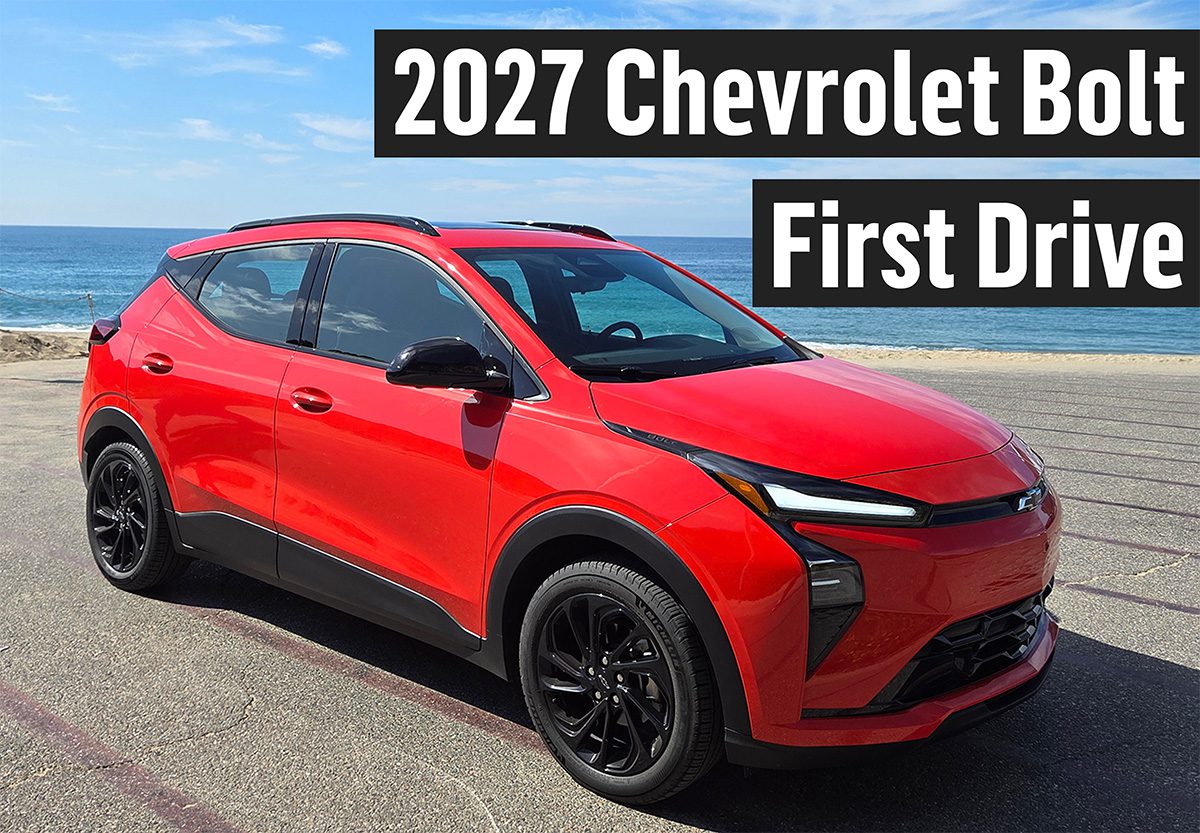
The Chevrolet Bolt is making a comeback for the 2027 model year, offering an updated yet familiar package for electric vehicle enthusiasts. Available at Chevrolet dealerships since February 2027, the revived Bolt retains its core identity as a practical and affordable small EV hatchback. This iteration boasts a driving range of 262 miles, a significant improvement that positions it as a compelling value proposition in today’s EV market, especially considering its accessible price point.
An Accessible Entry Point to EVs
The most striking aspect of the new 2027 Chevrolet Bolt is its pricing. The entry-level LT trim starts at an attractive $28,995, making it one of the most budget-friendly new EVs available. For those seeking a sportier aesthetic, the Bolt RS trim adds $4,000 to the price. The top-tier RS model, equipped with the Technology Package, Super Cruise, and a sunroof, is priced at $38,990. These prices include a mandatory destination fee of $1,395.

A Limited Run for a Beloved Model
Enthusiasts eager to own the new Bolt should act swiftly. Chevrolet has announced that the 2027 Bolt will have a “limited run,” with production expected to conclude by the end of 2027. This limited availability is due to the Fairfax assembly plant in Kansas transitioning to producing gasoline-powered Equinox compact SUVs in mid-2027. Chevrolet has remained tight-lipped about what will succeed the Bolt once its production ceases.
Exterior Familiarity, Interior Transformation
Externally, the 2027 Chevrolet Bolt presents a look that is remarkably similar to its initial debut in 2017. It effectively channels the enduring appeal of its predecessor, which first arrived in dealerships in December 2016, predating the Tesla Model 3. The Bolt notably skipped the 2024, 2025, and 2026 model years.
However, the 2027 model is based on the slightly larger Bolt EUV that was introduced for the 2022 model year. Both the “EV” and “EUV” designations have been dropped, with a single, larger Bolt model now offered. Despite sharing the same exterior dimensions and only minor updates to the front and rear fascia, Chevrolet has kept costs down by integrating components from other General Motors electric vehicles.

A Cabin Inspired by GM’s EV Lineup
Inside, however, current Bolt owners will discover a completely redesigned interior. It incorporates design cues and technology from various other GM EVs. A 11-inch digital instrument cluster, previously seen in the Equinox EV, is now standard. While the Equinox EV’s large central touchscreen was deemed too expansive for the Bolt, an 11.3-inch unit adapted from the Chevy Colorado midsize pickup truck has been integrated.
The column-mounted gear selector, a feature shared across other Chevy EVs, contributes to a more open feel in the center console area. During initial drives totaling approximately 65 miles in the temperate climate of Westlake Village, California, test vehicles included a top-spec RS model.
Driving Dynamics: Familiar and Refined
On the road, the 2027 Bolt delivers a driving experience that feels reassuringly familiar to its predecessors. It offers responsive acceleration when needed, coupled with a generally quiet and composed ride. The electric motor produces 156 kilowatts (210 horsepower), an increase of 10 hp over the 2022 model, and 169 pound-feet of torque. A revised final drive ratio contributes to slightly higher torque delivery to the wheels.
According to Bolt chief engineer Jeremy Short, the vehicle can achieve 0 to 60 mph in 6.8 seconds. Drivers can select from three regenerative braking levels: None, Normal, and Strong. The “Normal” setting proved to be the preferred choice for most driving scenarios, with “Strong” being notably aggressive.
Under the Hood: New Battery Technology
A significant portion of the 2027 Bolt’s components—approximately 57 percent—are either new or have been adapted from other GM electric vehicles. The most crucial update is the adoption of lithium iron phosphate (LFP) battery cells. This marks GM’s first major EV deployment of LFP technology, following a limited use in the 2014 Chevy Spark EV.
The new LFP cells, while offering 20 to 30 percent less energy density than the nickel-manganese-cobalt-aluminum chemistries used in other GM EVs, contribute to the 2027 Bolt’s 65 kWh battery pack. This energy capacity results in an improved EPA-rated range of 262 miles, up from the 2022 Bolt EUV’s 247-mile rating.
These prismatic LFP cells are housed within a battery pack of identical dimensions to previous Bolt models, utilizing existing mounting points. The pack employs a cell-to-pack configuration, where cells are arranged directly onto a cooling plate without intermediate modules. Despite the new battery pack being approximately 200 pounds heavier, overall weight gain is minimized to about 20 pounds compared to the 2023 Bolt EUV, thanks to weight reductions in other areas, such as a new front suspension cradle and integrated power electronics.
Sourcing and Future Production of LFP Cells
General Motors plans to produce LFP cells domestically starting in late 2027 at its Ultium Cells joint venture plant in Spring Hill, Tennessee. Until that facility reaches full-scale operation, GM will source LFP cells for the 2027 Bolt from external suppliers to maintain competitiveness for its most affordable EV. Reports from The Wall Street Journal indicated that Contemporary Amperex Technology Co. (CATL) of China is a likely vendor.
Enhanced Charging and Connectivity
The electrical architecture of the 2027 Bolt has been fundamentally redesigned, incorporating an all-new system beyond just the battery, motors, and power electronics. Notably, it now includes a heat pump for more efficient cabin and battery thermal management.
Faster Charging and NACS Port
The charging capability has seen a substantial upgrade, with the DC fast-charging rate nearly tripling to a maximum of 150 kW, compared to the previous Bolt’s 53 kW maximum. During testing, charging speeds of up to 119 kW were observed starting from a 19 percent state of charge. GM claims a 10 to 80 percent charge can be achieved in approximately 25 minutes under ideal conditions.
The 2027 Bolt features Chevrolet’s first standard J3400, or NACS (Tesla), charging port, located on the front-left fender. The onboard AC charger supports up to 11.5 kW. The vehicle comes with a portable charger capable of operating at 120 or 240 volts with interchangeable connectors. Chevrolet also offers adapters for J1772-to-NACS ($67) and CCS-to-NACS ($189).
Plug & Charge Compatibility and LFP Charging Practices
A current limitation of the 2027 Bolt is its lack of Plug & Charge compatibility, a feature that allows for seamless charging session initiation and payment. Chevrolet stated that the vehicle is “ISO 15118-ready” and that they are actively working with charging networks to enable this functionality. Tesla Superchargers are expected to be among the first compatible networks.
Regarding broader Plug & Charge availability on other networks, GM provided a general statement expressing commitment to working with partners to expand coverage and improve the charging experience. Specific timelines or confirmations for networks like Electrify America or Ionna were not provided.
An important consideration for LFP battery owners is the recommendation to charge to 100 percent regularly. This practice helps maintain accurate range estimation, a departure from the 80 or 90 percent charging caps often used with other battery chemistries. The vehicle will prompt owners to perform a full charge periodically.
Advanced Electrical Architecture and Features
The 2027 Bolt integrates GM’s “Global B” electrical architecture, a significant upgrade from the previous “Global A” system. This new architecture offers five times the processing power, enables over-the-air (OTA) software updates, and enhances cybersecurity. Buyers can opt for a wider array of advanced safety features, including automatic emergency braking, rear cross-traffic alert, and a Surround Vision Recorder.
The Global B architecture also supports the latest iteration of GM’s Super Cruise hands-free adaptive cruise control system, now featuring automatic lane changing. This advanced architecture is designed to facilitate the introduction of new apps and features, some of which may require subscriptions.
Subscription Services and Removed Features
In line with other GM EVs, the 2027 Bolt will not support Android Auto or Apple CarPlay. This move integrates the vehicle’s infotainment system with GM’s proprietary services. Chevrolet is offering OnStar Basics for free for the first eight years, which includes Google Maps, Voice Assistance, Automatic Crash Response, and mobile app features. Bolts equipped with Super Cruise will receive three years of OnStar One, which adds video streaming capabilities, followed by a Super Cruise subscription fee of $40 per month or $399 annually. For Bolts without Super Cruise, a one-month trial of OnStar One is included, after which it costs $35 per month.
The Future After the Bolt
The “limited run” announcement for the 2027 Bolt naturally raises questions about Chevrolet’s future EV strategy. GM executives have hinted at plans for a “family” of low-cost EVs to follow the Bolt. This suggests the development of a new, in-house low-cost EV platform, potentially replacing the previously announced collaboration with Honda.
Design sketches from early 2023 also revealed a small electric pickup truck concept, which could potentially compete in the midsize electric pickup segment. While the exact plans remain unconfirmed, the return of the Bolt signifies Chevrolet’s commitment to offering affordable electric mobility.
Chevrolet provided airfare, lodging, and meals to enable the author to bring this first-person drive report to readers.