
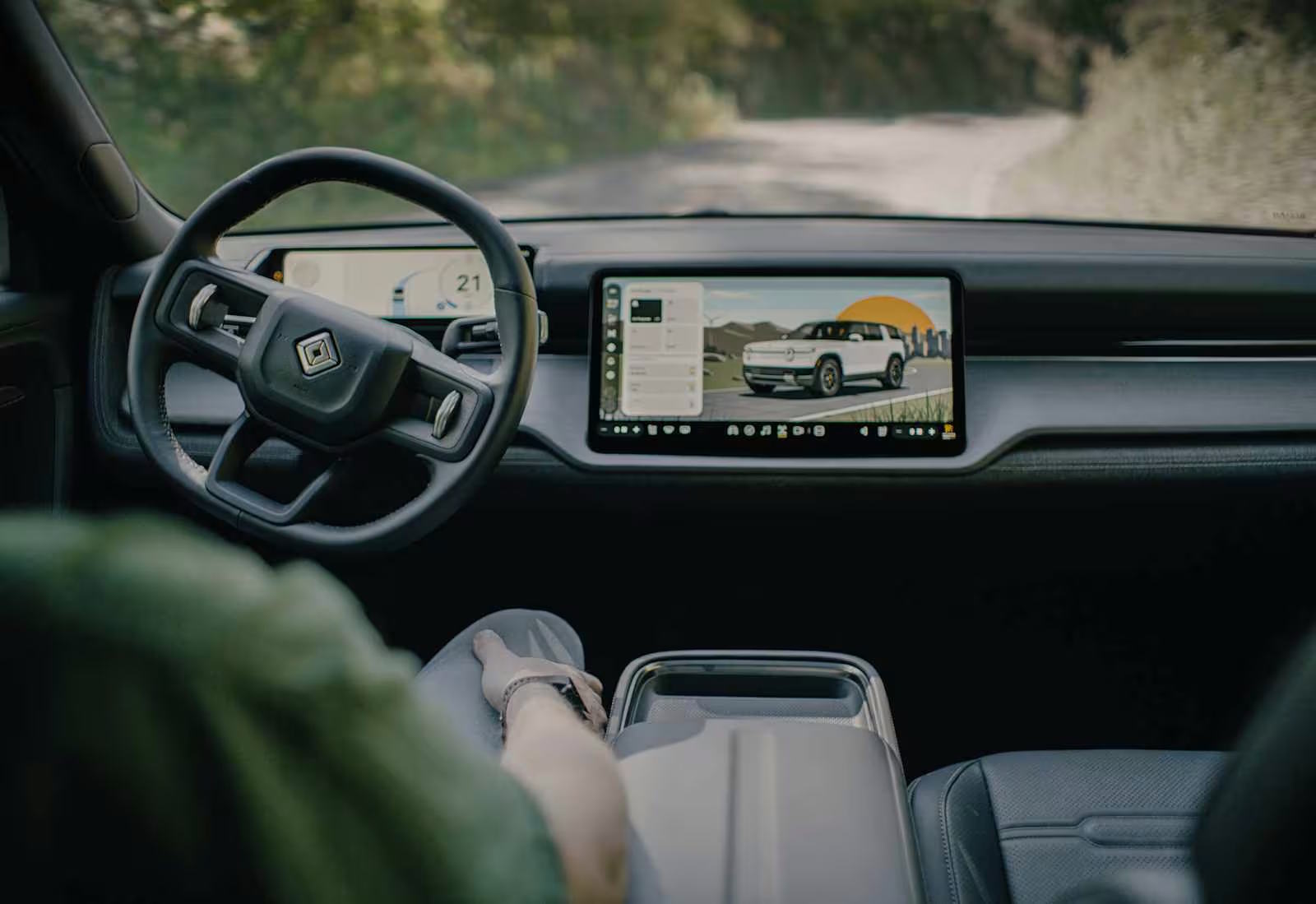
In a significant move set to accelerate the evolution of autonomous mobility, global ride-sharing leader Uber has committed a substantial investment of up to $US1.25 billion to electric vehicle (EV) innovator Rivian. This strategic partnership is poised to facilitate the large-scale robotaxi deployment of Rivian’s advanced R2 autonomous vehicles, with a potential fleet size reaching up to 50,000 units across key international markets.
The landmark deal, jointly announced by both companies last week, signals a concerted effort to intensify their respective ambitions in the burgeoning autonomous vehicle sector. It represents a powerful convergence of Uber’s vast ride-hailing infrastructure and Rivian’s pioneering capabilities in EV manufacturing and autonomous driving technology, aiming to expedite the commercial rollout of self-driving services.

Strategic Investment and Ambitious Fleet Targets
The multi-year investment framework, which extends through 2031, is meticulously structured, with funding disbursements tied to Rivian’s successful achievement of crucial autonomy milestones. As an integral part of this agreement, an initial order for 10,000 fully autonomous R2 robotaxis has been placed, laying the groundwork for the foundational fleet.
Adding a layer of strategic flexibility, the agreement also grants Uber, or its designated fleet partners, the exclusive option to procure an additional 40,000 vehicles starting from 2030. This provision allows for a phased expansion, potentially escalating the total number of R2 robotaxis under this partnership to an impressive 50,000 units.
Should these ambitious projections materialize, the collaborative vision of Uber and Rivian involves an extensive robotaxi deployment footprint. The companies aim to have their autonomous fleets operational across 25 major cities spanning the United States, Canada, and Europe by the close of 2031, underscoring the global scope and strategic importance of this alliance.

Leadership Endorsements and Vertical Integration Advantage
Dara Khosrowshahi, CEO of Uber, articulated the rationale behind the substantial investment, highlighting Rivian’s integrated approach. “We’re big believers in Rivian’s approach – designing the vehicle, compute platform, and software stack together, while maintaining end-to-end control of scaled manufacturing and supply in the US,” Khosrowshahi stated, emphasizing the strategic benefits of this comprehensive strategy.
Khosrowshahi further elaborated on the competitive advantages inherent in Rivian’s operational model. “That vertical integration, combined with data from their growing consumer vehicle base and experience managing the complexities of commercial fleets, gives us conviction to set these ambitious but achievable targets.” This statement underscores Uber’s confidence in Rivian’s ability to not only innovate technologically but also to execute large-scale manufacturing and fleet management effectively.
Advancing Level 4 Autonomy with Rivian’s Innovation
The partnership announcement closely follows Rivian’s recent unveiling of what the company described as “significant breakthroughs” in its third-generation autonomy platform. This advanced system is engineered to enable Level 4 autonomous driving capabilities, a crucial benchmark in the development of self-driving technology, signifying a high degree of automation where the vehicle can handle most driving situations independently within defined operational design domains.
This cutting-edge autonomy system is anticipated to make its debut in the R2 electric vehicle later this year, marking a pivotal moment for Rivian’s foray into fully autonomous operations. The R2’s introduction with Level 4 capabilities could set a new precedent for electric vehicles entering the robotaxi market.
RJ Scaringe, founder and CEO of Rivian, expressed enthusiasm about the collaboration, reiterating its strategic importance. “We couldn’t be more excited about this partnership with Uber — it will help accelerate our path to level 4 autonomy to create one of the safest and most convenient autonomous platforms in the world,” Scaringe affirmed, highlighting the mutual benefits and shared vision for safety and user experience.
Scaringe also pointed to the technological pillars supporting Rivian’s ambitious goals. “The scale of Rivian’s growing data flywheel coupled with RAP1, our state-of-the-art in-house inference platform, and our multi-modal perception platform make us incredibly excited for the rapid advancement of Rivian autonomy over the next couple of years.” This statement indicates a robust technological foundation, crucial for rapid progression in autonomous driving.
The Technological Backbone of Rivian’s Autonomy Platform
Rivian’s third-generation autonomy platform is built upon a sophisticated multi-modal sensor suite, meticulously designed to provide a comprehensive understanding of the vehicle’s surroundings. This suite includes eleven 65-megapixel cameras, offering high-resolution visual data, complemented by five radars for robust object detection in various weather conditions, and one LiDAR unit, which generates precise 3D point clouds for environmental mapping and obstacle perception.
All data streams from these advanced sensors are processed by Rivian’s proprietary consumer platform, which is powered by two of the company’s in-house RAP1 chips. These chips are formidable, boasting a combined capability of 1600 TOPS (Tera Operations Per Second) of AI compute performance. This immense processing power is vital for real-time analysis of sensor data, enabling complex decision-making required for Level 4 autonomous driving.
A key aspect of Rivian’s development strategy is its reliance on a “data flywheel.” The company explains that this platform actively utilizes vast amounts of data collected from its expanding fleet of consumer vehicles. This includes detailed 3D LiDAR point clouds, which continuously feed into the system, enabling rapid and iterative improvements to its autonomous driving algorithms and overall performance.
Navigating the Challenges of Large-Scale Robotaxi Deployment
Despite the optimism surrounding this partnership and the technological advancements, the path to widespread robotaxi deployment remains fraught with significant challenges. The autonomous vehicle industry has, historically, faced repeated delays in achieving its ambitious timelines, underscoring the immense complexity involved in developing and deploying self-driving technology at scale.
Level 4 autonomous systems, while highly advanced, are typically characterized by their operational limitations. These systems are often restricted to specific conditions and predefined geographic areas, commonly known as geofenced zones. Factors such as adverse weather conditions, intricate urban environments, and unexpected road events continue to present formidable hurdles that require sophisticated solutions.
The successful scaling of autonomous fleets demands not only technological prowess but also robust regulatory frameworks, public acceptance, and rigorous safety protocols. The collaboration between Uber and Rivian, while promising, will need to navigate these multifaceted challenges to realize its vision of transforming urban mobility through a widespread robotaxi deployment.