
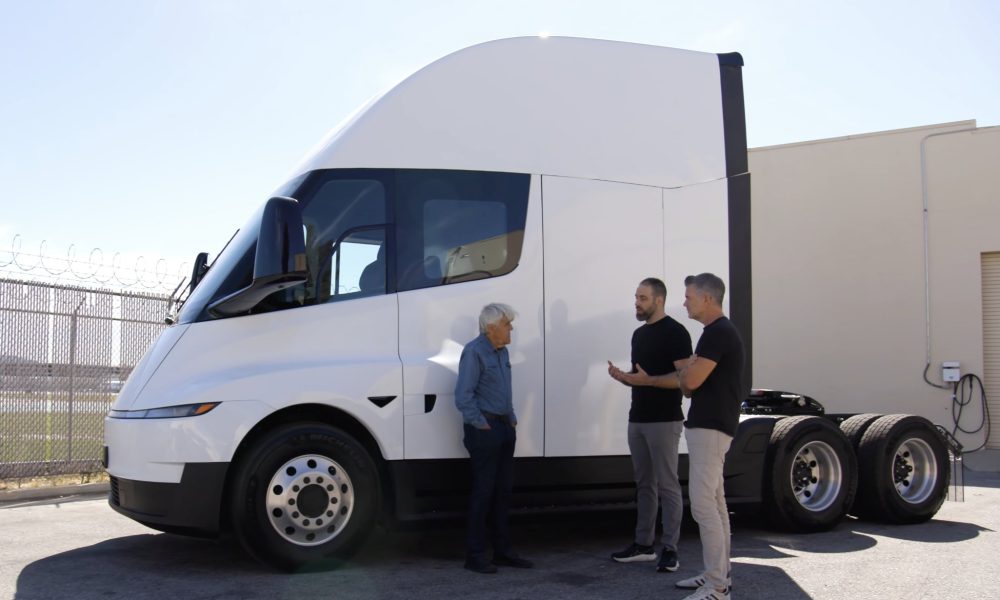
Tesla has showcased a series of significant enhancements to its all-electric Semi, offering a detailed look into the redesign and functional upgrades. These revelations came during a 47-minute segment on Jay Leno’s Garage, featuring Tesla Chief Designer Franz von Holzhausen and Semi Program Director Dan Priestley.
The comprehensive overview highlights critical advancements aimed at bolstering the electric heavy-duty truck’s performance, efficiency, and operational viability as it moves closer to high-volume production and wider market deployment this year.

Strategic Redesign for Enhanced Performance
The updated Tesla Semi design, which was initially unveiled late last year, incorporates both aesthetic refinements and crucial engineering improvements. Tesla’s approach aligns the Semi with the modern, aerodynamic signature seen across its other vehicle lines, including sleek profiles and integrated lighting.
Beyond visual appeal, these modifications are fundamentally geared towards enhancing the daily operational experience for drivers and the economic benefits for logistics fleets. The focus remains on making the Tesla Semi a formidable competitor in the Class 8 trucking sector.
Significant Weight Reduction Achieved
One of the most immediate and impactful Tesla Semi improvements is a substantial weight reduction. Program Director Dan Priestley confirmed that Tesla successfully shaved approximately 1,000 pounds from the Semi compared to its earlier iteration.

This reduction carries multifaceted benefits for a Class 8 truck. Primarily, it directly translates to an increased payload capacity, a critical factor for logistics companies aiming to maximize the volume and weight of goods hauled per trip. For large-scale operators such as PepsiCo and Frito-Lay, early participants in Tesla’s Pilot Program, this decreased overall weight offers a clear economic advantage by allowing more cargo within gross vehicle weight limits.
Moreover, a lighter vehicle inherently requires less energy for various driving conditions. This includes acceleration, ascending inclines, and maintaining consistent highway speeds. These efficiencies contribute directly to reducing operational costs and extending range, a crucial consideration for electric vehicles.
Jay Leno himself, during his initial drive, noted the profound impact of this weight optimization, remarking, “I don’t feel like I’m pulling anything.” This underscores the effectiveness of Tesla’s engineering in creating a responsive and powerful electric semi-truck.
Breakthroughs in Aerodynamic Efficiency
Aerodynamics played a pivotal role in the design philosophy for the Tesla Semi. Franz von Holzhausen revealed that a core objective was to achieve a drag coefficient lower than that of a Bugatti Veyron, a testament to Tesla’s ambition in efficiency.
Achieving superior aerodynamic efficiency is paramount for large electric vehicles like the Semi, as it directly influences range ratings and overall energy consumption. The displacement of air, or drag, can significantly deplete battery power, especially at highway speeds.
Von Holzhausen confirmed that the aerodynamic efficiency of the electric semi-truck has seen a 7 percent improvement over the previous model, achieving a drag coefficient of approximately 0.4. This level of slipperiness for a vehicle of its size is a key factor in maximizing the range and operational cost-effectiveness of the Tesla Semi.
Advanced Features and Under-the-Hood Innovations
Beyond the structural and aerodynamic redesigns, the Tesla Semi incorporates several critical technological advancements. Dan Priestley elaborated on some of these ‘under the hood’ improvements designed to enhance durability, control, and overall system performance.
Key upgrades revealed include:
- A fully Electric Steering Assist system, providing more precise and energy-efficient steering control.
- The integration of Cybertruck actuators, indicating a focus on increased strength and reliability for various mechanical functions within the Semi.
- A new 48-volt architecture, a trend in modern automotive design that allows for more efficient power distribution and supports advanced electronic systems.
- The utilization of 4680 battery cells, a next-generation battery technology designed by Tesla to offer enhanced energy density, faster charging capabilities, and a projected lifespan of 1 million miles, directly addressing the demanding duty cycles of commercial trucking.
These advanced Tesla Semi improvements are not theoretical; they are a direct outcome of extensive real-world testing. The company actively engaged various organizations in its Pilot Program, leveraging invaluable feedback to refine and optimize the electric semi-truck before broader market availability.
Insights from Real-World Fleet Data
The data gathered from Tesla’s Pilot Program has been instrumental in validating the Semi’s capabilities and informing its continuous development. Franz von Holzhausen and Dan Priestley highlighted the extensive real-world testing conducted.
Currently, several hundred Tesla Semi units are operational across various fleets. Collectively, these vehicles have accumulated an impressive 13.5 million miles on the road. This vast dataset provides critical insights into the truck’s performance, durability, and efficiency under diverse conditions.
Notably, one particular unit has logged over 440,000 miles since its deployment in the program, demonstrating the long-term reliability and operational longevity of the electric semi-truck. Pilot Program members, including major corporations, have reported a remarkable uptime of 95 percent, a testament to the Semi’s robust engineering and Tesla’s proactive maintenance and service support.
Tesla’s commitment to operational efficiency extends to its service model. According to the company, “80% of breakdowns if you have one, are returned back to the customer in less than 24 hours, and half are back in less than 1 hour.” This rapid resolution minimises costly downtime for fleets, making the electric Semi an attractive proposition for businesses.
Surging Demand and Future Outlook
The positive outcomes from the Pilot Program, combined with evolving market dynamics, have significantly amplified interest in the Tesla Semi. Dan Priestley confirmed that demand for the electric semi-truck has reached unprecedented levels.
He attributed this surge partly to recent shifts in the political climate and the subsequent impact on gas prices, which have led many companies to seek more economical and sustainable transportation solutions. Tesla has experienced a significant increase in inquiries for the Semi, reflecting a growing industry appetite for electrification.
As Tesla proceeds with building out the necessary charging and service infrastructure to support wider adoption, these foundational Tesla Semi improvements will further solidify its position in the electric heavy-duty market. The shift towards electric Class 8 trucks is gaining momentum, and Tesla aims to lead this transformation.
CEO Elon Musk has previously stated Tesla’s ambitious plans to commence high-volume production of the Semi this year. This commitment signals a pivotal moment for the company and the broader electric trucking industry, with initial deliveries also anticipated to begin within the same timeframe, marking a new chapter for sustainable logistics.