
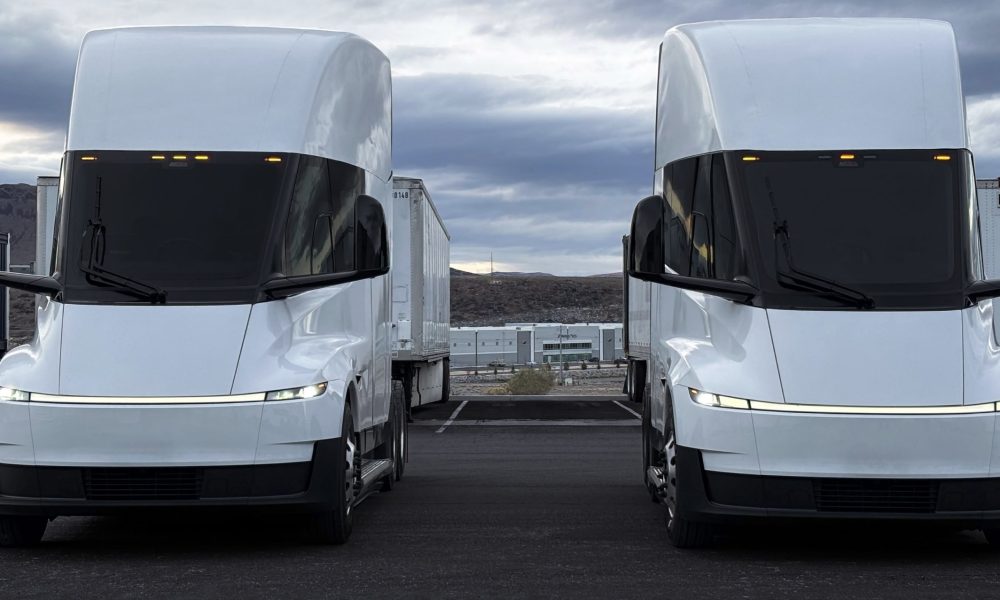
Tesla’s all-electric Semi is rapidly emerging as a transformative force in the heavy-duty trucking sector, consistently winning over the very professionals who spend their lives behind the wheel. As initial pilot programs expand across North America, a clear consensus is forming among participating drivers: the electric Class 8 truck offers a superior experience, characterized by unparalleled comfort, performance, and operational efficiency.
The feedback from these crucial real-world tests highlights several key advantages. Drivers universally praise the Semi’s remarkably quiet operation, instant torque, and the elimination of gear-shifting fatigue, all contributing to a significantly less strenuous and more enjoyable driving experience compared to traditional diesel rigs. This evolving narrative positions the Tesla Semi not merely as an alternative but as a preferred future for commercial transportation.

Revolutionising the Driver Experience
For decades, long-haul trucking has been synonymous with demanding physical labor, extended hours, and the constant hum of powerful diesel engines. The Tesla Semi aims to redefine this reality, offering features engineered to mitigate driver fatigue and enhance overall well-being. Central to this redesign is the truck’s unique centered driver’s seat, which significantly improves visibility and reduces blind spots, a critical safety enhancement.
Accompanying this ergonomic innovation is a massive touchscreen display, providing drivers with comprehensive control and navigation information at a glance. The immediate and powerful acceleration, characteristic of electric powertrains, coupled with the absence of a manual transmission, translates into a smoother, less jarring ride. These elements collectively contribute to transforming arduous shifts into noticeably easier and less stressful journeys for truck drivers.
First-Hand Accounts from the Road
The credibility of the Tesla Semi’s impact is perhaps best conveyed through the direct experiences of drivers navigating the realities of commercial logistics. Early pilot programs have yielded enthusiastic testimonials that underscore the vehicle’s practical benefits.

Dakota Shearer of IMC Logistics, sharing his experience in a recent Wall Street Journal profile, recounted a moment of unexpected agility with the Tesla Semi. After mistakenly entering a tight spot, he found the vehicle’s maneuverability exceptional. “I backed right out of there, no problem. It’s like I’d never done it in the first place. That right there showed me me that the technology the Tesla has makes a big difference,” Shearer stated, highlighting the precision and ease of operation.
His colleague, Angel Rodriguez of Hight Logistics, a veteran who transitioned from a 13-speed diesel truck, emphasized the physical relief offered by the electric design. “It’s just easier on your body. It’s less stressful because you’re not really having to engage the clutch and the stick shift,” Rodriguez affirmed, pointing to the reduction in physical strain during prolonged driving.
Similar sentiments resonate from other extensive testing initiatives. Tom Sterba, a Senior Driver at Saia, spent several days evaluating the Tesla Semi, expressing particular admiration for its advanced navigational capabilities and overall handling. “The navigation systems in these trucks are just unbelievable. That’s what I love about it,” Sterba remarked. His profound positive impression was captured in a statement that has since circulated widely within the trucking community: “I hope I retire in this truck.”
Comprehensive Pilot Program Feedback
Beyond individual testimonials, broader pilot programs with major logistics and supply chain companies like ArcBest, thyssenkrupp Supply Chain Services, and Mone Transport have consistently delivered positive feedback. Drivers in these diverse settings have uniformly lauded the center-seat configuration for its improved field of vision, the smooth and responsive acceleration, and the superior levels of overall comfort and safety embedded in the Tesla Semi’s design.
This positive reception is not solely based on subjective experience; it is increasingly supported by concrete real-world data. ArcBest, for instance, has meticulously logged thousands of miles, demonstrating highly efficient energy consumption rates even across challenging terrains, including the formidable Donner Pass. Furthermore, several other fleets participating in these pilot initiatives have reported efficiency metrics that have not only met but even exceeded Tesla’s own ambitious targets, validating the vehicle’s performance capabilities under operational conditions.
The collective agreement among all participants underscores a significant paradigm shift: the Tesla Semi is perceived as quieter, markedly quicker, and substantially less physically demanding than its diesel counterparts. Critically, it achieves this while delivering an impressive three times the power output and promising dramatically lower operating costs, representing a compelling economic proposition for fleet operators.
Significant Upgrades for Volume Production
The narrative surrounding the Tesla Semi gained further momentum with its recent appearance on Jay Leno’s Garage. This segment provided the first public glimpse of the updated long-range production model, with Leno himself becoming the inaugural outsider to drive the improved vehicle. He was joined by key Tesla figures, including Chief Designer Franz von Holzhausen and Semi Program Director Dan Priestley, who offered insights into the truck’s advancements.
The episode highlighted several major upgrades slated for volume production later this year. The updated Tesla Semi has undergone a significant weight reduction, shedding approximately 1,000 pounds, a crucial factor for payload capacity and efficiency. A shift to a more advanced 48-volt electrical architecture promises enhanced power delivery and system efficiency. The steering system has also been upgraded to a fully electric design, incorporating actuators derived from the innovative Cybertruck, offering improved responsiveness and precision.
Furthermore, the battery technology has seen a critical evolution, with the adoption of 4680 battery cells specifically engineered for an impressive lifespan exceeding one million miles. Aerodynamic enhancements have further boosted the Semi’s performance, allowing the long-haul version to achieve an estimated 500-mile range, while the shorter-wheelbase standard-range model offers approximately 325 miles. Charging capabilities have also been dramatically improved, with Megachargers now capable of delivering up to 1.2 megawatts, translating to roughly 300 miles of range replenishment in approximately 30 minutes.
During his drive, Jay Leno, while hauling heavy loads, expressed astonishment at the truck’s maneuverability and seemingly effortless power delivery. “I don’t feel like I’m pulling anything,” he remarked, underscoring the Semi’s remarkable performance under stress.
The Road Ahead for Electric Trucking
With hundreds of Tesla Semis already deployed across various fleets, accumulating over 13.5 million miles of operational data and demonstrating consistently high uptime, the evidence strongly suggests a promising future for electric heavy-duty trucking. The positive and often enthusiastic reviews from truck drivers are a powerful indicator of a fundamental shift in industry perception.
This widespread driver approval, coupled with verifiable efficiency gains and ongoing technological refinements, positions the Tesla Semi as a frontrunner in the electrification of commercial transport. As fleet operators increasingly prioritize sustainability, operational cost reductions, and driver retention, the electric trucking industry, spearheaded by innovations like the Tesla Semi, appears poised for significant expansion, with drivers readily embracing the transition to an all-electric future.