
In a significant advancement for the electric vehicle (EV) battery sector, Coperion K-Tron has introduced its innovative RF400 Roller Feeder, a system poised to enhance the consistency and efficiency of dry-electrode processing. This new technology, specifically designed for laboratory and pilot-scale applications, addresses long-standing challenges in achieving uniform material deposition, a critical factor in next-generation battery production.
The launch of the RF400 comes at a pivotal moment, as the global battery industry increasingly focuses on dry-electrode manufacturing. This method promises substantial environmental and economic benefits over conventional wet coating techniques. However, its widespread adoption has been hampered by the inherent complexities of material handling and ensuring precise, even deposition of electrode materials.

Advancing Dry-Electrode Deposition for Sustainable Battery Production
Dry-electrode manufacturing represents a paradigm shift in how batteries, particularly for electric vehicles, are produced. Unlike traditional wet coating processes that rely heavily on energy-intensive solvents, the dry method significantly reduces both energy consumption and the need for solvent handling. This not only lowers operational costs but also aligns with global efforts to create more sustainable and environmentally friendly industrial practices.
The conventional wet coating process involves dissolving active electrode materials in toxic and flammable solvents, followed by a substantial drying phase. This stage alone consumes considerable energy and necessitates elaborate solvent recovery or disposal systems. Dry-electrode techniques, in contrast, bypass this entire solvent-dependent phase, offering a greener and potentially more cost-effective alternative.
Despite its promise, the transition to dry-electrode manufacturing has faced formidable technical hurdles. Chief among these is the challenge of uniformly depositing the dry electrode blend onto the current collector. Inconsistent deposition can lead to performance variability in the final battery cells, reducing efficiency, cycle life, and overall reliability. Ensuring precise material distribution at a micro-scale is paramount for producing high-quality, high-performance batteries.
The RF400 Roller Feeder: A Solution for Precision and Uniformity
Coperion K-Tron’s RF400 Roller Feeder is engineered to directly tackle these critical material handling challenges. The system is meticulously designed to provide uniform deposition of electrode dry blends, a capability that directly translates into reduced waste and significantly lower production variability in battery pilot lines. This precision is vital for research and development efforts aimed at scaling up dry-electrode technology.
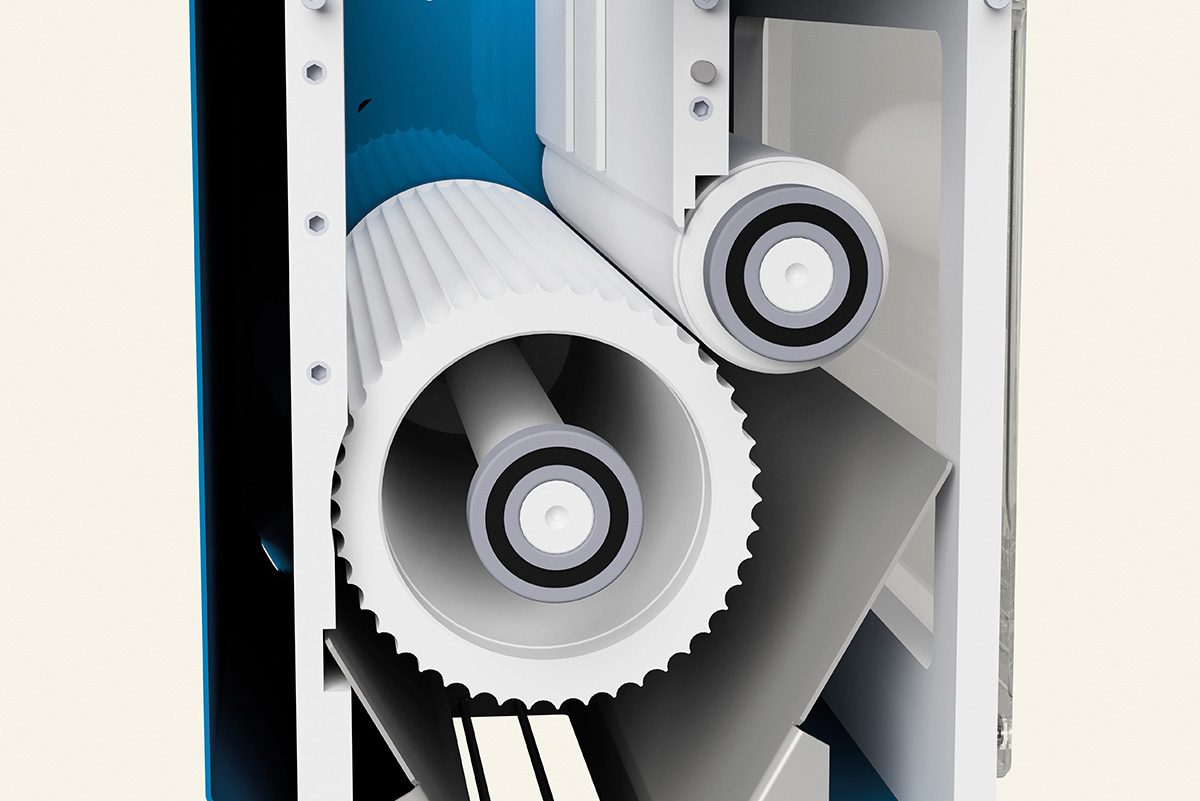
At the heart of the RF400’s design is an ingenious combination of a grooved feed roller working in tandem with a smooth scraper roller. This synergistic mechanism ensures a gentle yet consistent flow of material. The grooved roller facilitates an even presentation of the dry blend, while the smooth scraper roller meticulously controls the thickness and distribution of the material as it is fed onto the substrate below.
This innovative roller configuration plays a crucial role in overcoming common issues such as material bridging at the outlet, a prevalent problem in dry material feeding that can lead to inconsistent deposition. By preventing such blockages and promoting a steady flow, the RF400 substantially improves material distribution across the calender roller, thereby ensuring the homogeneity required for high-performance electrodes.
Integrated Controls for Enhanced Operational Efficiency
Beyond its mechanical innovation, the RF400 Roller Feeder boasts advanced integration capabilities. It seamlessly connects with Coperion K-Tron’s established KCM-III controls and Smart Force Transducer weighing technology. This integration is not merely a feature but a cornerstone of its operational efficacy, enabling real-time monitoring and precise feed-rate control.
The KCM-III control system offers operators a comprehensive interface for managing and optimizing the feeding process. Coupled with the highly sensitive Smart Force Transducer weighing technology, the system can detect even minute changes in material characteristics or flow. This allows for immediate, on-the-fly adjustments to the feed rate, ensuring consistent output despite any variations in the dry blend’s properties.
Such granular control is indispensable in laboratory and pilot environments where experimental precision is paramount. The ability to finely tune feed rates and monitor material behavior in real time accelerates research cycles, optimizes material usage, and provides invaluable data for process refinement and eventual commercialization.
Scalability and Industry Impact
The RF400’s design supports a coating width adjustable up to 400 mm, making it ideally suited for the demands of lab and pilot-scale battery production setups. This adjustability ensures versatility for various research parameters and prototype development. While designed for smaller-scale operations currently, the learnings and efficiencies gained from its use are expected to pave the way for larger industrial applications.
The potential impact of this technology on the future of EV battery manufacturing is significant. By providing a reliable and precise solution for dry-electrode deposition, Coperion K-Tron is helping to unlock the full potential of this environmentally friendly and economically advantageous production method. As battery demand continues to soar, particularly for electric vehicles, innovations that streamline production and reduce environmental footprint become increasingly critical.
Jay Daniel, Head of R&D Feeders and Feeding Systems at Coperion K-Tron, underscored the significance of this development, stating, “The RF400 will set a new standard in the industry.” This statement highlights the company’s confidence in its new feeder’s ability to not only solve immediate production challenges but also to influence the direction of future battery manufacturing processes.
Coperion K-Tron: A Legacy of Innovation in Material Handling
Coperion K-Tron, a globally recognized leader in feeding and conveying technologies, brings decades of expertise to the battery manufacturing sector. Their legacy of developing high-precision material handling systems positions them uniquely to address the complex requirements of modern battery production. The RF400 is a testament to their continuous commitment to innovation, specifically tailored to the evolving needs of the EV and energy storage industries.
As the electric vehicle market continues its rapid expansion, the demand for more efficient, sustainable, and cost-effective battery production methods intensifies. The introduction of the RF400 Roller Feeder by Coperion K-Tron marks a crucial step forward in fulfilling this demand, offering a precise and reliable solution that could accelerate the adoption of dry-electrode technology on a wider scale. This development is poised to bolster efforts towards a more sustainable and high-performance future for EV batteries worldwide.